
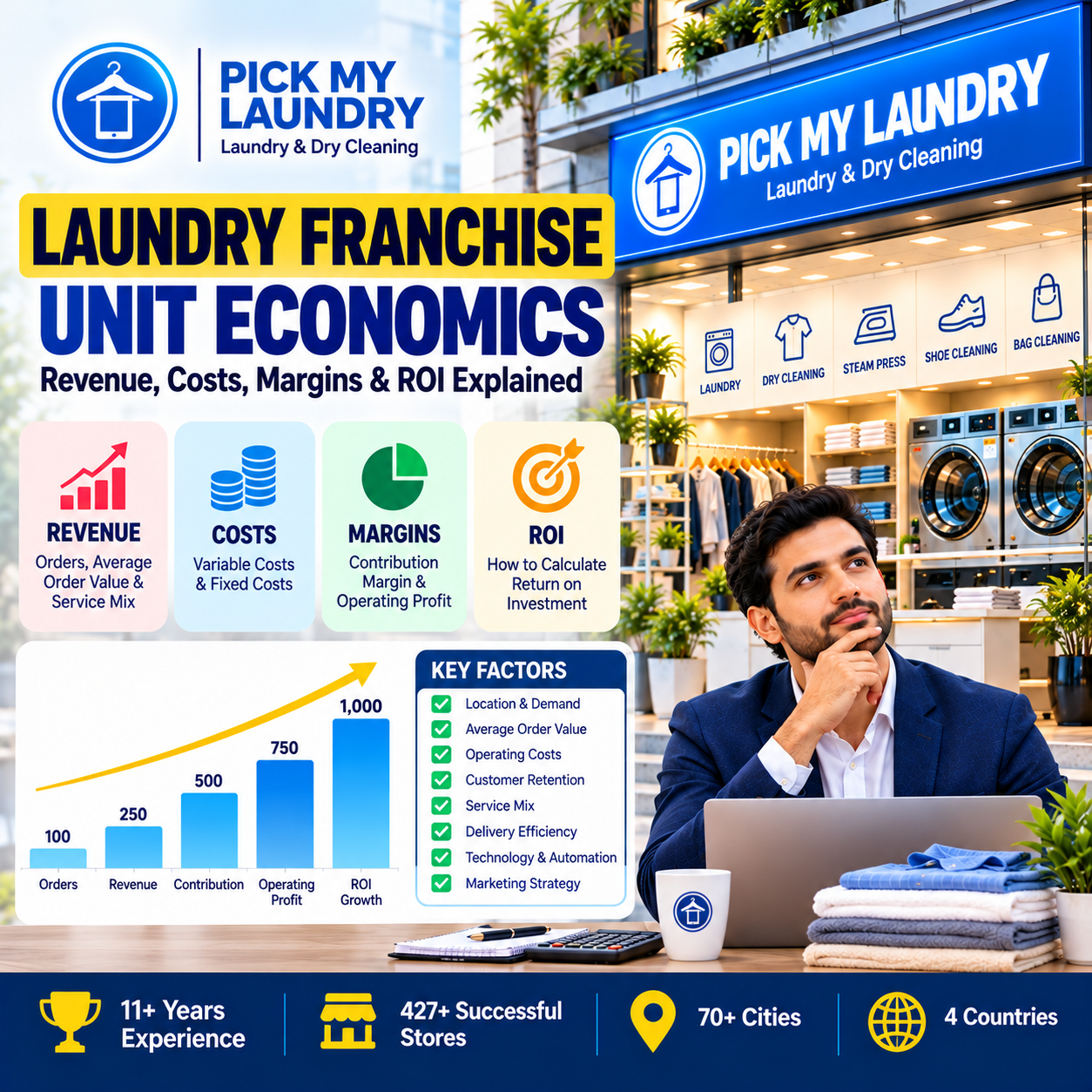
Laundry Franchise Unit Economics: Revenue, Costs, Margins & ROI Explained
Laundry Franchise Unit Economics: Revenue, Costs, Margins & ROI Explained
Introduction
Before investing in a laundry franchise, it is important to understand more than the initial franchise investment.
An investor should understand how one outlet generates revenue, what it costs to operate, how much contribution each order can generate, and how the overall business performance affects return on investment.
This is known as unit economics.
In simple terms:
Unit economics explains whether an individual laundry outlet can generate enough revenue and contribution to cover its operating costs and recover its initial investment.
For a laundry and dry cleaning business, unit economics can be influenced by customer volume, average order value, service mix, pricing, rent, salaries, utilities, delivery costs, marketing and customer retention.
Pick My Laundry's existing published material also identifies location, customer volume, operational efficiency, service quality, marketing and customer retention as factors affecting franchise returns.
What Are Unit Economics?
Unit economics refers to the financial performance of an individual business unit.
For a laundry franchise, the unit can generally be considered one outlet.
The basic relationship is:
Customers → Orders → Revenue → Operating Costs → Contribution → Profit
For example:
100 customers
↓
250 orders
↓
₹X average order value
↓
Monthly revenue
↓
Less:
- Rent
- Salaries
- Utilities
- Chemicals
- Packaging
- Delivery
- Marketing
- Maintenance
- Other expenses
↓
Operating profit
The exact numbers will vary from one location to another.
Why Unit Economics Matter in a Laundry Franchise
Two stores can have exactly the same franchise brand but produce very different financial results.
Why?
Because their:
- Locations may differ
- Customer acquisition costs may differ
- Rent may differ
- Order volume may differ
- Average order values may differ
- Service mix may differ
- Delivery costs may differ
- Staff costs may differ
Therefore, investors should evaluate the economics of the specific proposed outlet, rather than relying only on industry-wide numbers.
The Five Main Components of Laundry Franchise Unit Economics
A useful financial framework contains five major components:
1. Revenue
Money generated from customer orders.
2. Variable Costs
Costs that increase with business volume.
Examples:
- Chemicals
- Packaging
- Delivery
- Processing-related expenses
3. Fixed Costs
Expenses that remain relatively stable.
Examples:
- Rent
- Salaries
- Software
- Basic administration
4. Contribution Margin
Revenue remaining after variable costs.
5. Operating Profit
Contribution remaining after fixed operating expenses.
How Does a Laundry Franchise Generate Revenue?
A modern laundry outlet can generate revenue from multiple services.
Consumer Services
- Laundry
- Wash & Fold
- Wash & Iron
- Dry Cleaning
- Steam Press
- Shoe Cleaning
- Bag Cleaning
- Carpet Cleaning
- Curtain Cleaning
- Sofa Cleaning
- Blanket Cleaning
B2B Services
Potential commercial customers can include:
- Hotels
- Restaurants
- Salons
- Gyms
- Spas
- Hostels
- Offices
- Hospitals
- Other institutions
Pick My Laundry's published franchise material describes both residential and commercial customer segments as potential revenue sources.
Average Order Value
One of the most important metrics is Average Order Value (AOV).
Formula:
AOV = Total Revenue ÷ Number of Orders
For example, suppose a hypothetical outlet generates:
₹4,00,000 monthly revenue
from:
1,000 orders
Then:
₹4,00,000 ÷ 1,000 = ₹400 AOV
This is only an illustrative calculation, not a projection for a Pick My Laundry outlet.
Customer Volume
Revenue is also heavily influenced by order volume.
Basic Formula:
Monthly Revenue = Number of Orders × Average Order Value
For example:
1,000 orders × ₹400 = ₹4,00,000
If an outlet increases either:
- Number of orders, or
- Average order value
its revenue can increase, assuming other factors remain manageable.
Service Mix Matters
Not every order has the same economics.
A basic laundry order and a premium garment-care order can have different:
- Selling prices
- Processing requirements
- Labor requirements
- Chemical costs
- Processing times
- Packaging requirements
Therefore, an outlet should evaluate its service mix, not simply its total order count.
For example:
| Service Category | Possible Role |
|---|---|
| Laundry | Regular volume |
| Dry Cleaning | Premium service |
| Steam Press | Frequent add-on |
| Shoe Cleaning | Additional revenue |
| Bag Cleaning | Additional revenue |
| Carpet Cleaning | High-ticket service |
| Corporate Laundry | Recurring B2B volume |
The actual profitability of each service should be calculated using the outlet's real pricing and costs.
Fixed Costs of a Laundry Franchise
Fixed costs are expenses that generally do not increase directly with every additional order.
Common examples include:
Rent
Store rent can be one of the biggest fixed expenses.
Salaries
Employees may include:
- Store manager
- Laundry staff
- Ironing staff
- Delivery personnel
- Customer service staff
Technology
Depending on the model, businesses may have software and technology-related costs.
Administration
Other expenses can include:
- Accounting
- Communication
- Internet
- Basic office expenses
Variable Costs
Variable costs can increase as order volume increases.
Examples include:
- Chemicals
- Packaging
- Garment covers
- Tags
- Delivery fuel
- Payment processing
- Certain processing expenses
The exact classification can differ between business models.
Contribution Margin
Contribution margin is a useful metric for understanding how much revenue remains after variable costs.
Formula:
Contribution = Revenue − Variable Costs
Contribution Margin:
Contribution Margin % = Contribution ÷ Revenue × 100
For example, if hypothetical monthly revenue is:
₹4,00,000
and variable costs are:
₹1,60,000
then:
Contribution = ₹2,40,000
Contribution margin:
₹2,40,000 ÷ ₹4,00,000 × 100 = 60%
Again, this is only an example for understanding the calculation.
Operating Profit
After calculating contribution, fixed operating expenses must also be deducted.
Formula:
Operating Profit = Revenue − Variable Costs − Fixed Costs
For example:
Revenue: ₹4,00,000
Variable Costs: ₹1,60,000
Fixed Costs: ₹1,50,000
Operating profit:
₹4,00,000 − ₹1,60,000 − ₹1,50,000 = ₹90,000
This example is purely illustrative.
Break-Even Point
Break-even tells you when the business has generated enough contribution to cover its fixed costs.
Basic Formula:
Break-Even Orders = Fixed Costs ÷ Contribution per Order
Suppose:
Fixed costs = ₹1,50,000
and:
Contribution per order = ₹240
Then:
₹1,50,000 ÷ ₹240 = 625 orders
So the hypothetical outlet would need approximately 625 orders to cover those fixed costs.
This is much more useful for financial planning than simply asking:
"How much profit can a laundry franchise make?"
How ROI Is Calculated
ROI means Return on Investment.
A simple annual ROI calculation is:
Formula:
ROI = Annual Profit ÷ Initial Investment × 100
For example:
Initial investment:
₹20 Lakhs
Hypothetical annual operating profit:
₹4 Lakhs
ROI:
₹4 Lakhs ÷ ₹20 Lakhs × 100 = 20%
This is a mathematical example and should not be interpreted as a guaranteed Pick My Laundry return.
Actual ROI depends on the outlet's performance.
What Can Improve Laundry Franchise Economics?
Several operational factors can improve the financial performance of an outlet.
1. Increase Repeat Customers
Repeat customers can reduce dependence on continuous new-customer acquisition.
Strategies can include:
- Loyalty programs
- Subscription packages
- WhatsApp communication
- Customer reminders
- Service-quality consistency
2. Increase Average Order Value
An outlet can potentially increase AOV through relevant additional services.
For example:
A customer ordering garment cleaning may also require:
- Shoe cleaning
- Bag cleaning
- Steam press
- Curtain cleaning
Cross-selling should be based on genuine customer requirements rather than unnecessary services.
3. Control Delivery Costs
Pickup and delivery can improve convenience but also create costs.
Businesses should monitor:
- Delivery distance
- Orders per route
- Fuel
- Driver costs
- Failed pickups
- Delivery time
Route planning can help improve delivery efficiency.
4. Control Rent
A premium location can provide visibility and accessibility but may also have higher rent.
The objective is to evaluate:
Expected demand vs occupancy cost
rather than simply choosing the cheapest property.
5. Improve Capacity Utilization
Laundry equipment represents significant capital expenditure.
If equipment remains underutilized, the business may not fully utilize its installed capacity.
Better demand generation can help increase:
- Machine utilization
- Staff productivity
- Processing efficiency
Technology and Unit Economics
Technology can help franchise operators monitor business performance.
Depending on the available system, technology can provide information about:
- Orders
- Customers
- Revenue
- Payments
- Delivery
- Repeat purchases
- Service categories
- Customer history
Pick My Laundry's published material describes CRM, POS billing, online booking, order tracking and business reporting as part of its technology ecosystem.
This type of data can help an outlet identify which services and customer segments are contributing most to revenue.
What Metrics Should a Franchise Owner Track?
A monthly financial dashboard can include:
| Metric | Why It Matters |
|---|---|
| Total Orders | Measures demand |
| Monthly Revenue | Measures sales |
| Average Order Value | Measures customer spending |
| Repeat Customers | Measures retention |
| Customer Acquisition Cost | Measures marketing efficiency |
| Variable Cost | Measures order-level economics |
| Fixed Cost | Measures operating overhead |
| Contribution Margin | Measures unit economics |
| Operating Profit | Measures business performance |
| Capacity Utilization | Measures asset efficiency |
| B2B Revenue | Measures commercial business |
Tracking these numbers consistently makes financial decisions more data-driven.
Example Laundry Franchise Unit Economics
Consider this hypothetical example:
| Metric | Example |
|---|---|
| Orders/Month | 1,000 |
| Average Order Value | ₹400 |
| Monthly Revenue | ₹4,00,000 |
| Variable Costs | ₹1,60,000 |
| Contribution | ₹2,40,000 |
| Fixed Costs | ₹1,50,000 |
| Operating Profit | ₹90,000 |
These numbers are illustrative only.
An actual Pick My Laundry outlet may have substantially different results depending on location, pricing, order volume, business format, service mix and operating expenses.
What Can Cause Unit Economics to Become Weak?
Several factors can negatively affect outlet economics.
High Rent
Excessive rent can increase the break-even requirement.
Low Order Volume
A store with expensive infrastructure but insufficient orders can have poor capacity utilization.
High Customer Acquisition Cost
Heavy dependence on paid advertising can increase marketing expenditure.
Poor Customer Retention
If customers do not return, acquisition expenses may remain high.
Excessive Delivery Cost
Poorly planned pickup and delivery routes can reduce contribution.
Equipment Downtime
Machine breakdowns can reduce processing capacity and increase maintenance costs.
Poor Quality Control
Damaged or poorly processed garments can create refunds, rework and customer complaints.
Unit Economics Before Opening a Franchise
Before opening a store, prepare three scenarios:
Conservative Scenario
Lower customer volume and slower growth.
Base Scenario
Reasonable customer acquisition and expected operating conditions.
Higher-Volume Scenario
Higher order volume with increased operational capacity.
This approach is more useful than building a financial plan around a single optimistic projection.
Pick My Laundry Franchise: What Should Investors Evaluate?
Pick My Laundry's current published franchise material describes:
- Investment options beginning around ₹15 Lakhs
- Different investment levels depending on business model
- Technology support
- Training
- Marketing support
- Laundry and dry cleaning services
- Pickup and delivery capabilities
Published pages currently contain different network and investment figures, so prospective franchise partners should confirm the latest commercial proposal for their specific location before making a decision.
Questions to Ask Before Calculating ROI
Before creating your financial model, ask:
- What is the total initial investment?
- What is included in the investment?
- What are the recurring franchise-related costs?
- What equipment is included?
- What are the expected staffing requirements?
- What store size is recommended?
- What are the technology costs?
- What marketing support is provided?
- What are the estimated operating expenses?
- What working capital should be maintained?
- What services can the outlet offer?
- What pickup and delivery infrastructure is required?
- What assumptions should be used for revenue planning?
- Which expenses are fixed and which are variable?
- What local factors could affect the financial model?
Final Takeaway
Laundry franchise unit economics are more important than simply looking at the franchise investment amount.
A proper financial analysis should connect:
Investment → Customers → Orders → Average Order Value → Revenue → Variable Costs → Contribution → Fixed Costs → Operating Profit → ROI
There is no single ROI figure that applies to every laundry franchise outlet.
Location, customer demand, pricing, service mix, rent, staffing, marketing, delivery efficiency and operational management can all materially change the outcome.
For this reason, investors should build their financial model using location-specific assumptions and a current franchise quotation, rather than relying on generic industry projections.
Related Pick My Laundry Content
- Pick My Laundry Franchise Cost: Complete Investment Breakdown
- How Long Does It Take to Break Even in a Laundry Franchise?
- Laundry Franchise Monthly Expenses: Complete Cost Guide
- How to Choose the Right Location for a Laundry Franchise
- Financial Checklist Before Signing a Laundry Franchise Agreement
CTA:
Thinking about starting a laundry franchise? Explore the Pick My Laundry franchise model and request the latest investment details for your city.