
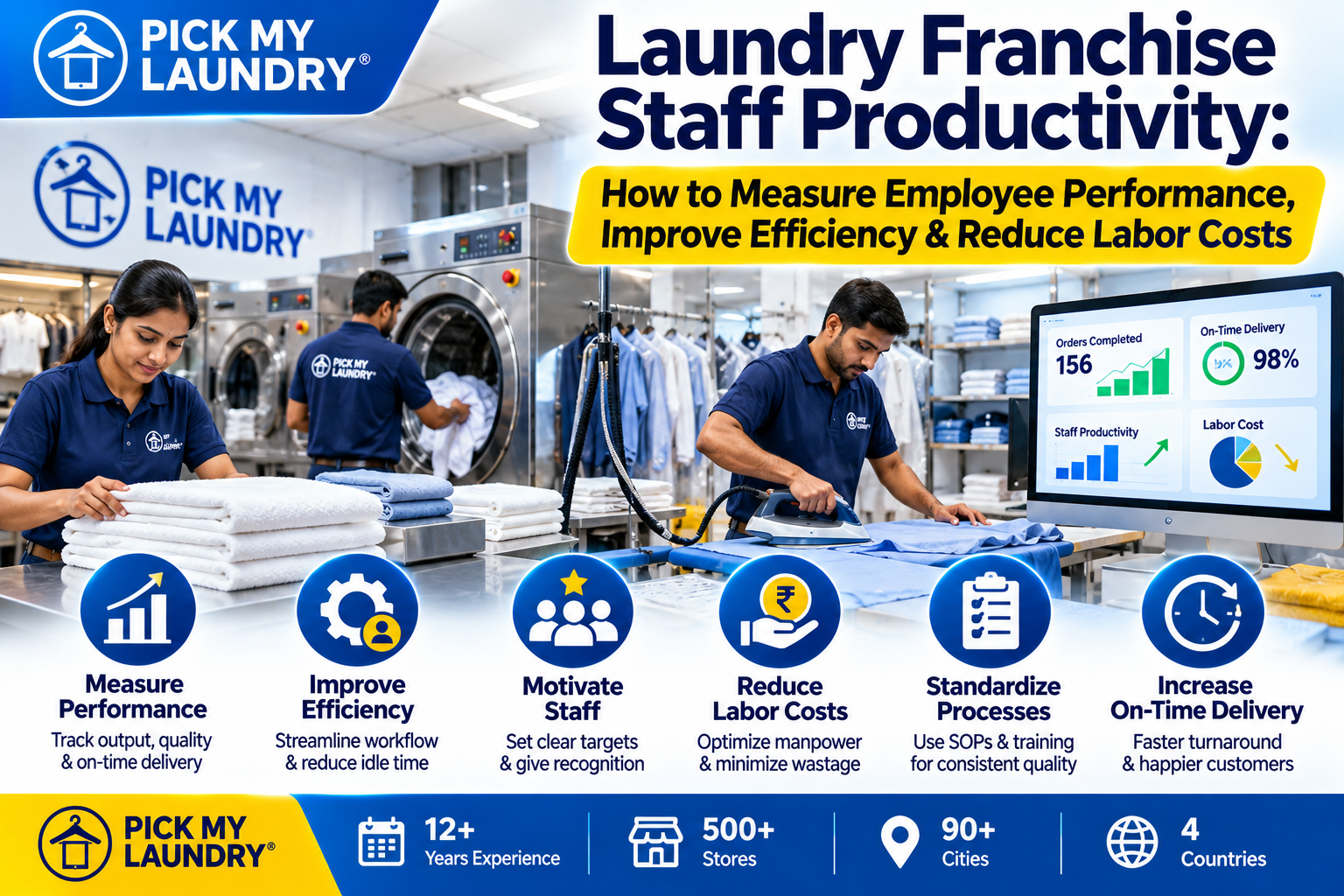
Laundry Franchise Staff Productivity: Complete Guide
Laundry Franchise Staff Productivity: How to Measure Employee Performance, Improve Efficiency & Reduce Labor Costs
Introduction
Running a successful laundry franchise requires efficient machines, reliable service processes, and a well-managed workforce.
Employees are responsible for several essential activities, including garment inspection, washing, drying, ironing, packaging, order management, and customer service.
Even with modern equipment and automation, poor workforce planning can lead to delayed orders, increased operating expenses, inconsistent service quality, and reduced customer satisfaction.
For laundry franchise owners, improving laundry franchise staff productivity is therefore an important part of operational management.
Staff productivity is not simply about making employees work faster. It involves organizing workflows, assigning responsibilities, reducing unnecessary movement, improving training, and maintaining consistent quality standards.
This guide explains how laundry franchise owners can measure employee productivity, calculate labor costs, optimize staffing, and build a more efficient laundry operation.
1. What Is Staff Productivity in a Laundry Franchise?
Laundry franchise staff productivity refers to the amount of useful work employees complete within a defined period while maintaining required service quality and safety standards.
Productivity may be measured through:
-
Kilograms of laundry processed per employee-hour
-
Garments ironed per hour
-
Orders completed per shift
-
Average processing time per order
-
Labor cost per kilogram
-
Labor cost per customer order
-
Rework and quality error rates
Different employees perform different tasks, so productivity measurements should reflect their actual responsibilities.
For example, a garment finishing employee may be evaluated using the number of garments finished accurately, while a customer service employee may be evaluated using order accuracy, customer response time, and issue resolution.
The objective is to measure meaningful performance rather than focusing only on speed.
2. Why Staff Productivity Matters in a Laundry Business
Labor expenses can represent a significant portion of laundry franchise operating costs.
Poor workforce efficiency may increase the cost of processing each customer order.
Better operational efficiency
A well-organized team can reduce delays between garment sorting, washing, drying, finishing, and packaging.
Improved labor cost control
Efficient staffing helps owners match workforce availability with actual business demand.
Faster order processing
Clear responsibilities and coordinated workflows can improve order turnaround times.
Consistent service quality
Proper training and quality monitoring reduce avoidable mistakes and rework.
Better customer experience
Employees who understand their responsibilities are better positioned to deliver accurate and timely service.
Improved business scalability
Standardized employee productivity systems can help owners manage higher order volumes or additional franchise locations.
However, productivity improvements should not compromise employee safety, legally required working conditions, or garment care quality.
3. Understand the Different Roles in a Laundry Franchise
A laundry franchise may have several operational roles depending on its business model and processing arrangements.
|
Employee Role |
Main Responsibility |
Productivity Indicator |
|---|---|---|
|
Laundry operator |
Washing and processing |
Kg processed per labor-hour |
|
Garment sorting staff |
Sorting and classification |
Garments accurately sorted per hour |
|
Ironing staff |
Pressing and finishing |
Garments finished per hour |
|
Packaging staff |
Packing completed garments |
Orders packed accurately |
|
Delivery executive |
Pickup and delivery |
Successful stops per shift |
|
Customer service staff |
Customer communication |
Response time and resolution quality |
|
Store manager |
Operational supervision |
Order completion, quality, and cost KPIs |
A small laundry store may combine multiple responsibilities into fewer positions.
Larger operations may require specialized teams.
Owners should avoid comparing employees across fundamentally different tasks without accounting for workload complexity.
4. How to Calculate Laundry Staff Productivity
A basic productivity formula is:
\[ \text{Staff Productivity} = \frac{\text{Total Output}}{\text{Total Labor Hours}} \]
For example, suppose a laundry processing team completes 240 kg of laundry in one day.
Four employees each work eight hours.
Total labor hours:
\[ 4 \times 8 = 32 \]
Productivity:
\[ \frac{240}{32}=7.5 \]
ILLUSTRATIVE PRODUCTIVITY CALCULATION
Laundry processed
240 kg
Productivity
7.5 kg/hr
Based on 32 employee-hours. This is a hypothetical example, not an industry productivity benchmark.
This calculation helps owners monitor processing efficiency over time.
However, it should be interpreted alongside fabric types, garment complexity, machine capacity, rework, and quality performance.
5. Calculate Labor Cost Per Kilogram
Labor cost per kilogram is a useful indicator for laundry businesses that process garments by weight.
The formula is:
\[ \text{Labor Cost Per Kg} = \frac{\text{Total Processing Labor Cost}}{\text{Total Kg Processed}} \]
Suppose a laundry franchise has monthly processing labor expenses of ₹90,000.
The store processes 6,000 kg of laundry during the same month.
\[ \frac{₹90,000}{6,000}=₹15 \]
Labor cost per kilogram = ₹15.
This metric helps owners understand how workforce expenses relate to processing volume.
It is important to define labor costs consistently, including applicable wages, employer contributions, overtime, and other relevant employment expenses.
The example excludes customer service, administration, and delivery labor unless those costs are explicitly included.
6. Labor Cost Per Order: Another Important KPI
Not every laundry franchise processes services using kilogram-based pricing.
Dry cleaning, shoe cleaning, premium garment care, and specialty services may be priced per item.
For these businesses, labor cost per order can provide additional insight.
\[ \text{Labor Cost Per Order} = \frac{\text{Total Relevant Labor Cost}}{\text{Completed Orders}} \]
For example:
|
Metric |
Illustrative Value |
|---|---|
|
Monthly labor expenses |
₹1,20,000 |
|
Completed customer orders |
1,500 |
|
Labor cost per order |
₹80 |
The calculation shows that the business spends approximately ₹80 in labor for each completed order.
This figure should be reviewed alongside average order value, order complexity, and contribution margin.
7. How to Improve Laundry Staff Productivity
Productivity improvement begins with understanding where time and resources are being used inefficiently.
Standardize daily workflows
Every employee should understand the correct sequence of tasks.
For example:
Order Receiving → Garment Inspection → Sorting → Washing or Dry Cleaning → Drying → Finishing → Quality Check → Packaging → Delivery
Clear processes help reduce confusion and unnecessary movement.
Assign responsibilities clearly
Employees should know which activities they are responsible for and when tasks must be completed.
Reduce unnecessary waiting
Poor coordination between washing, drying, and ironing can create processing bottlenecks.
Improve workspace organization
Frequently used tools and materials should be positioned where employees can access them safely and efficiently.
Use appropriate technology
Barcode systems, order tracking software, and digital job allocation may reduce manual administrative work.
Monitor quality
Faster processing is not productive if it increases garment damage, customer complaints, or rework.
8. Laundry Staff Scheduling and Shift Planning
Staff scheduling should reflect actual order demand.
Laundry businesses may experience higher workloads during weekends, seasonal periods, holidays, or promotional campaigns.
Assigning the same number of employees to every shift can result in overstaffing during slow periods and understaffing during peak demand.
Practical scheduling approach
-
Review historical order volumes.
-
Identify busy and slow processing periods.
-
Estimate labor hours required for each task.
-
Assign employees according to skills and availability.
-
Maintain adequate coverage for customer service and quality checks.
-
Review overtime and workload distribution.
Schedules must comply with applicable labor laws, working-hour limits, rest requirements, and employment agreements.
A flexible but predictable staffing plan can help improve operational efficiency and employee satisfaction.
9. How to Identify Productivity Bottlenecks
A bottleneck occurs when one stage of the laundry workflow limits the output of the entire operation.
For example, a laundry store may have enough washing capacity but insufficient ironing capacity.
As a result, washed garments accumulate while waiting for finishing.
Common bottlenecks include:
-
Slow garment sorting
-
Insufficient washing capacity
-
Delayed drying
-
Limited ironing stations
-
Packaging backlogs
-
Inaccurate order tracking
-
Poor pickup and delivery coordination
Example
Suppose the washing department can process 300 garments daily, but the finishing department can complete only 220 garments.
The finishing stage becomes the bottleneck.
Simply increasing washing speed will not solve the problem.
The owner should evaluate finishing equipment, staffing, garment complexity, and workflow design.
Improving the bottleneck can increase overall throughput without necessarily increasing every department's labor hours.
10. Employee Training and Productivity Improvement
Training is essential for maintaining efficient laundry operations.
Employees should understand:
-
Garment identification and classification
-
Appropriate washing procedures
-
Machine operating instructions
-
Chemical handling and safety
-
Stain treatment protocols
-
Quality inspection requirements
-
Order tracking procedures
-
Customer communication standards
Cross-training can also help employees support different departments when workloads change.
However, employees should operate specialized equipment only when appropriately trained and authorized.
Productivity training should focus on reducing errors and improving work methods rather than encouraging unsafe shortcuts.
11. How Technology Can Improve Workforce Efficiency
Laundry management technology can support employee productivity by reducing manual work and improving coordination.
Potential capabilities include:
Digital order tracking: Employees can view order status without repeatedly checking paper records.
Barcode scanning: Garments can be identified and tracked through processing stages.
Task allocation: Managers can assign responsibilities and monitor pending work.
Workload reporting: Software can show order volumes and processing activity.
Performance dashboards: Managers can review operational KPIs over time.
Delivery coordination: Route planning and order notifications can reduce administrative delays.
Technology should support employees rather than create unnecessary monitoring or administrative burdens.
Employee data should be collected and handled in accordance with applicable privacy and employment requirements.
12. Staff Productivity KPIs Every Franchise Owner Should Track
A useful productivity dashboard should combine output, cost, quality, and service measures.
|
KPI |
What It Measures |
|---|---|
|
Kg processed per labor-hour |
Processing productivity |
|
Garments finished per hour |
Finishing efficiency |
|
Labor cost per kg |
Processing labor cost |
|
Labor cost per order |
Order-level labor efficiency |
|
Order turnaround time |
Processing speed |
|
Rework rate |
Work requiring correction |
|
Order accuracy rate |
Correctly processed orders |
|
Overtime hours |
Additional labor demand |
|
On-time completion rate |
Service reliability |
|
Employee training completion |
Workforce readiness |
No single KPI should be used to judge overall employee performance.
A balanced dashboard helps managers identify improvements without overlooking service quality.
13. Example: Measuring Productivity Improvement
Consider a hypothetical laundry store processing 6,000 kg monthly.
The store initially requires 800 employee-hours for processing.
After reorganizing workflows and reducing avoidable waiting time, the same workload is completed in 720 employee-hours.
Illustrative Before vs After Comparison
Before
7.5 kg/hr
6,000 kg ÷ 800 labor-hours
After
8.33 kg/hr
6,000 kg ÷ 720 labor-hours
Productivity improvement
11.1%
Hypothetical calculation assuming unchanged output and service quality. Productivity gains do not automatically translate into equivalent payroll savings.
The improvement may allow employees to manage additional orders, reduce overtime, or spend more time on quality assurance.
Actual financial benefits depend on staffing arrangements and business demand.
14. Common Staff Productivity Mistakes
Measuring only processing speed
Fast output does not necessarily mean efficient operations if quality problems increase.
Ignoring workload complexity
A premium garment requiring specialized care should not be compared directly with a standard wash-and-fold item.
Setting unrealistic targets
Unreasonable expectations can contribute to errors, employee fatigue, and unsafe working practices.
Poor shift planning
Inadequate staffing during peak demand can create delays and increase overtime.
Not tracking rework
Repeated ironing, washing, or packaging corrections consume additional labor hours.
Failing to recognize employee feedback
Frontline employees may identify workflow problems that are not visible in management reports.
Productivity systems work best when managers combine performance data with practical operational feedback.
15. Staff Productivity Management for Multi-Unit Laundry Franchises
Managing employee performance across multiple stores requires standardized measurement.
Franchise operators should establish consistent definitions for productivity metrics.
For example, all stores should use the same method for calculating labor-hours and completed orders.
However, performance comparisons must account for differences in:
-
Service mix
-
Store size
-
Equipment capacity
-
Processing arrangements
-
Order volume
-
Customer requirements
-
Employee experience
A centralized reporting system can help management identify training needs, staffing imbalances, and operational bottlenecks.
The objective should be continuous improvement rather than creating unfair comparisons between locations.
16. How Pick My Laundry Franchise Owners Can Approach Staff Productivity
Pick My Laundry operates in the laundry and dry cleaning industry with a reported presence across multiple locations.
12+
Years Experience
500+
Stores
90+
Cities
4
Countries
For entrepreneurs considering a Pick My Laundry franchise, workforce planning is an important operational consideration.
Prospective franchise owners should evaluate:
-
Expected staffing requirements
-
Employee responsibilities
-
Training arrangements
-
Standard operating procedures
-
Store management systems
-
Labor cost assumptions
-
Performance monitoring methods
Actual franchise support, staffing structures, and operating requirements should be confirmed with the official franchise team.
A structured workforce management approach can help laundry businesses maintain consistent operations as customer demand increases.
17. Practical 30-Day Staff Productivity Improvement Plan
A phased improvement plan can help owners make measurable changes without disrupting daily operations.
|
Timeline |
Key Activities |
|---|---|
|
Days 1–7 |
Measure existing labor hours, output, rework, and delays |
|
Days 8–14 |
Identify workflow bottlenecks and clarify responsibilities |
|
Days 15–21 |
Improve task allocation, training, and shift planning |
|
Days 22–30 |
Compare productivity and quality KPIs against the baseline |
At the end of the month, management should review whether changes improved productivity without negatively affecting safety, employee wellbeing, or customer satisfaction.
Frequently Asked Questions (FAQs)
1. What is staff productivity in a laundry franchise?
Staff productivity measures how efficiently employees complete laundry-related work while maintaining quality, accuracy, and safety standards.
2. How do you calculate laundry employee productivity?
A common method divides total output, such as kilograms processed, by total employee labor-hours used for that activity.
3. How can a laundry franchise reduce labor costs?
Owners can control labor costs through better shift planning, standardized workflows, employee training, reduced rework, and improved workload coordination.
4. What are the most important laundry employee KPIs?
Important indicators include kilograms processed per labor-hour, labor cost per order, order accuracy, rework rate, turnaround time, and on-time completion.
5. Does automation improve laundry staff productivity?
Appropriate automation can reduce manual administrative tasks and improve workflow coordination. Actual results depend on implementation, training, and operational requirements.
6. How many employees does a laundry franchise need?
Staffing requirements depend on order volume, services offered, equipment capacity, operating hours, and whether processing is performed in-store or at a separate facility.
7. How can laundry stores improve ironing productivity?
Owners can improve finishing efficiency through suitable equipment, workstation organization, standardized processes, proper training, and effective workload distribution.
8. Should laundry franchise owners set employee productivity targets?
Yes, reasonable targets can support performance management. However, targets should account for garment complexity, equipment capacity, safety, and service quality.
Conclusion
Improving laundry franchise staff productivity is an important part of managing operational costs, maintaining service quality, and supporting business growth.
Franchise owners should focus on measuring meaningful performance indicators, improving workflow coordination, reducing avoidable delays, and providing employees with appropriate training.
Effective workforce management is not about maximizing speed at any cost. It is about helping employees complete their work accurately, safely, and efficiently.
By combining structured processes, practical technology, and balanced performance monitoring, laundry businesses can develop more reliable and scalable operations.
Explore Pick My Laundry Franchise Opportunities
Interested in starting your own laundry and dry cleaning business?
Discover Pick My Laundry's franchise opportunities, investment requirements, and business model.
Visit: Pick My Laundry Official Website
Recommended Internal Linking Strategy
|
Anchor Text |
Related Blog |
|---|---|
|
Laundry Franchise Staff Hiring & Training Guide |
Blog #7 |
|
Laundry Franchise Equipment Maintenance |
Blog #33 |
|
Laundry Franchise Technology & Automation |
Blog #31 |
|
Laundry Franchise Monthly KPI Dashboard |
Blog #23 |
|
Laundry Franchise Quality Audit Checklist |
Blog #24 |
|
Laundry Franchise Unit Economics |
Blog #3 |