
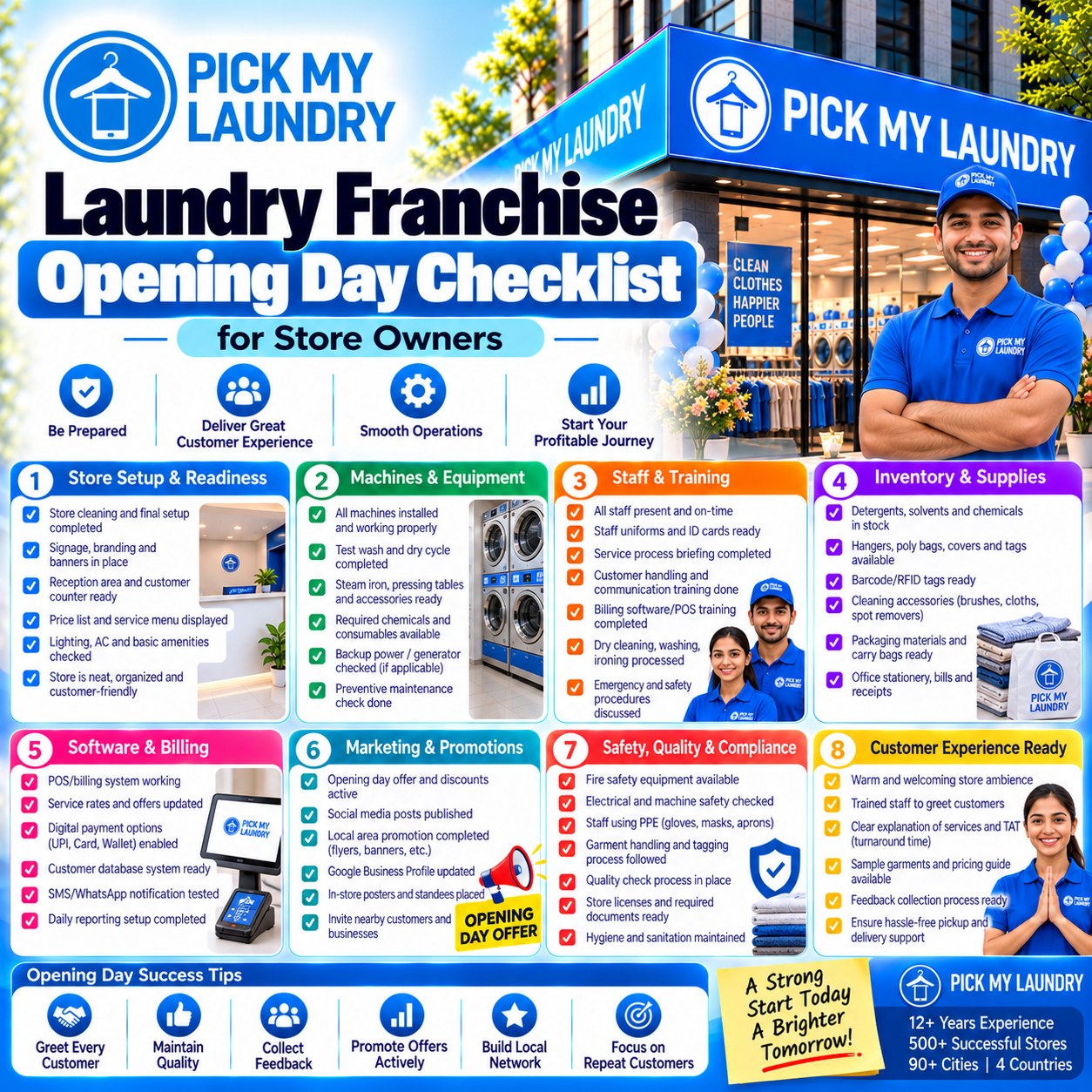
Laundry Franchise Opening Day Checklist for Store Owners
Introduction
Opening day is an important milestone for every laundry franchise owner. It is the first opportunity to demonstrate service quality, introduce the business to local customers, and establish a professional reputation in the market.
However, a successful opening involves more than putting up a signboard and announcing a launch offer. The store must be ready to receive garments, record orders accurately, explain service prices, manage payments, communicate turnaround times, and deliver a consistent customer experience.
Even a small mistake—such as a missing garment tag, an incorrect bill, or an unrealistic delivery promise—can create unnecessary problems during the first few days.
A well-planned laundry franchise opening day checklist helps owners coordinate staff, equipment, customer communication, marketing, and daily operations before accepting orders.
For prospective Pick My Laundry franchise partners, opening-day preparation should follow the applicable franchise procedures and the operating model selected for the store.
Pick My Laundry brings 12+ years of industry experience, 500+ stores, a presence in 90+ cities, and operations across 4 countries.
1. Complete the Final Store Inspection
Before the first customer arrives, inspect the entire store to confirm that it is clean, organised, safe, and ready to operate.
Store readiness checklist
-
Check the storefront, signboard, lighting, and entrance.
-
Clean the counter, floors, shelves, and customer area.
-
Organise garment storage and packaging materials.
-
Display the current service menu and prices.
-
Verify contact details and operating hours.
-
Check that staff have access to the tools they need.
-
Confirm that required safety measures are in place.
-
Remove unused boxes, tools, and setup materials from customer areas.
The store should look professional without making customers wait while employees finish basic setup tasks.
Check equipment and utilities
For stores that process garments on-site, confirm that equipment has been installed, tested, and approved for use. Verify water supply, drainage, electrical connections, ventilation, and other relevant utilities.
For collection-and-delivery outlets that use a central processing facility, confirm order handover procedures, transport arrangements, tracking systems, and coordination with the processing team.
Do not operate equipment that has unresolved safety or installation issues.
2. Conduct a Staff Briefing Before Opening
Your staff should understand the day's priorities before the store begins accepting orders.
Hold a short meeting to review:
-
Each employee's responsibilities
-
Opening and closing procedures
-
Customer greeting and order acceptance
-
Service prices and promotional terms
-
Garment inspection and tagging
-
Order tracking and billing
-
Turnaround-time communication
-
Complaint escalation
-
Emergency contacts and operational issues
Assign a person responsible for each important task. In a smaller outlet, one employee may handle multiple responsibilities, but accountability should remain clear.
Prepare a customer-service script
A simple, professional introduction can help staff communicate consistently.
For example:
“Welcome to our laundry store. Please let us know which services you need. We will check your garments, explain the applicable prices and turnaround time, and confirm your order before processing.”
Employees should explain services honestly and avoid promising specific cleaning results or delivery times without checking the actual requirements.
3. Verify the Service Menu and Pricing
Customers should be able to understand what the store offers and how much the services cost.
Before opening, confirm that the displayed prices match the billing system and current approved service menu.
Depending on the outlet's service range, the menu may include:
-
Washing
-
Washing and ironing
-
Ironing
-
Dry cleaning
-
Premium garment care
-
Shoe cleaning
-
Household textile cleaning
-
Pickup and delivery
Not every outlet will offer every service. Publish only services that the store is equipped and authorised to provide.
Check promotional offers
If you are offering an opening promotion, confirm the exact terms.
For example, if a promotion offers a free service after a qualifying order, staff must know the minimum spend or quantity, eligible services, validity period, exclusions, and redemption process.
The same terms should appear across applicable advertisements, social media posts, signage, and customer communications.
4. Test Billing and Order Management
Accurate order records are essential for preventing disputes and keeping track of garments.
Before opening, test the complete billing process.
Every order should record
-
Customer name and appropriate contact details
-
Unique order number
-
Garment count and description
-
Service requested for each item
-
Existing damage or special-care instructions, where relevant
-
Price and applicable discount
-
Promised turnaround time
-
Payment status
-
Collection or delivery details
Provide a receipt or order confirmation according to the store's process.
Test the payment process
Check the available payment methods, such as UPI, cards, cash, or other supported options.
Confirm that payments are recorded correctly, refunds or adjustments can be handled according to policy, and staff know what to do if a transaction fails.
Never rely solely on memory or handwritten notes when a reliable order-recording system is available.
5. Follow a Garment Safety and Identification Process
Garment handling is one of the most important operational responsibilities in a laundry and dry cleaning business.
Every item should remain identifiable throughout the customer journey.
Garment receiving procedure
-
Count and inspect the garments with the customer when practical.
-
Record the requested service for each item.
-
Check care labels and identify special handling requirements.
-
Document visible damage, missing buttons, stains, or other relevant observations.
-
Attach the appropriate order tag or identification label.
-
Confirm the total price and expected completion time.
-
Provide the customer with an order confirmation.
Do not assume that all garments can be processed using the same method. Items with special care requirements should be reviewed according to the store's procedures.
Maintain separation and traceability
Use clearly designated areas for incoming garments, items awaiting processing, completed orders, and orders ready for collection or delivery.
For outsourced or central processing, ensure that the receiving outlet and processing facility use compatible identification and handover procedures.
This reduces the risk of mixing orders and makes it easier to investigate discrepancies.
6. Check Quality Control Before Delivering Orders
Even on opening day, quality standards should not be compromised.
Before a completed order is handed over, follow the applicable quality-control procedure.
Check:
-
Whether the correct garments are included
-
Whether the requested service was completed
-
Whether visible stains or care concerns require further review
-
Whether garments are properly finished
-
Whether packaging is suitable
-
Whether the order count matches the original record
-
Whether any special customer instructions have been followed
If an item needs additional attention, communicate honestly with the customer and follow the store's rework or complaint procedure.
Avoid claiming that every stain can be removed or that every garment can be restored to its original condition.
7. Prepare the Store's Local Marketing
Opening day is an opportunity to introduce the business to people in the surrounding area.
Marketing should help relevant customers discover the store without creating more demand than the business can manage.
Before opening day
Prepare and verify:
-
Store opening announcement
-
Location and contact details
-
Social media posts
-
Google Business Profile information, where eligible
-
Local advertising campaigns
-
Signage and promotional materials
-
Introductory offer terms
-
Booking and enquiry process
Consider reaching nearby residential societies, offices, hostels, and other relevant customer groups where appropriate.
Keep local information accurate
Ensure that your website, social media profiles, and online business listings show the correct address, phone number, operating hours, and services.
Do not advertise services that are unavailable at the outlet. If processing is handled at another facility, communicate collection, delivery, and turnaround arrangements clearly.
8. Make the Customer Experience Convenient
The first interaction should make it easy for customers to understand the service and place an order.
Focus on five essentials
Clear communication: Explain the service, price, and turnaround time before confirming the order.
Convenient payments: Make supported payment methods easy to use.
Accurate records: Provide a receipt or order confirmation.
Reliable updates: Tell customers how they will be notified when an order is ready or delayed.
Professional handling: Treat garments carefully and respect customer concerns.
Avoid unnecessary upselling. Recommend additional services only when they are relevant to the customer's needs.
9. Manage Opening-Day Offers Carefully
Promotions can introduce a new laundry store to local customers, but poorly planned offers can create operational pressure.
Before launching a promotion, establish:
-
The target customer segment
-
The eligible services
-
The offer's validity period
-
The minimum qualifying order, if any
-
The discount or complimentary service
-
The expected cost of the promotion
-
The maximum order volume the store can handle
Train staff to explain the terms clearly. Keep a record of promotional orders so you can evaluate whether the campaign generated repeat bookings and acceptable contribution margins.
A promotion should support customer acquisition without making the service financially unsustainable.
10. Monitor Operations Throughout the Day
Opening-day readiness does not end when the doors open.
The owner or store manager should monitor order flow and resolve problems promptly.
|
Area |
What to Monitor |
|---|---|
|
Customer service |
Waiting time, enquiries and feedback |
|
Order intake |
Garment counts, tags and service instructions |
|
Billing |
Correct prices, discounts and payment records |
|
Garment handling |
Identification, sorting and storage |
|
Processing |
Capacity, quality and turnaround commitments |
|
Delivery |
Handover records and schedule coordination |
|
Marketing |
Enquiries and campaign response |
|
Staffing |
Workload, task ownership and support needs |
If demand becomes higher than the team can manage, communicate realistic timelines rather than accepting more orders with promises the store may not be able to meet.
11. Record Issues and Customer Feedback
The first day can reveal gaps in the setup process that were not apparent during testing.
Keep a simple log of operational issues, including:
-
Billing or software problems
-
Missing supplies
-
Unclear customer instructions
-
Staff training gaps
-
Equipment or utility problems
-
Delays in processing or delivery
-
Customer questions about pricing
-
Problems with promotional terms
For each issue, record who will resolve it and when it should be reviewed.
Customer feedback should be treated as an opportunity to improve operations. Respond professionally to concerns and avoid pressuring customers to provide positive reviews.
12. Complete the End-of-Day Review
At closing time, review the store's performance and prepare for the next operating day.
End-of-day checklist
-
Reconcile recorded payments and billing.
-
Confirm that all received garments are accounted for.
-
Check the status of pending orders.
-
Verify storage and handover records.
-
Record customer complaints and unresolved issues.
-
Review staff attendance and workload.
-
Check remaining supplies.
-
Clean and secure the premises.
-
Review opening-day marketing enquiries.
-
Prepare the next day's priorities.
Do not close an order in the system until its status accurately reflects the applicable process.
Laundry Franchise Opening Day Checklist
Use this interactive checklist to track readiness before opening.
Opening-day readiness
0/15 complete
Store cleaned and final inspection completed
Equipment and utilities checked
Required permissions and safety requirements verified
Staff briefing completed
Service menu and prices confirmed
Opening offer terms communicated to staff
Billing and payment systems tested
Order tracking process tested
Garment tagging and inspection supplies ready
Quality-control and complaint procedures available
Customer contact details and operating hours verified
Local marketing information checked
Pickup and delivery process confirmed, if applicable
Order storage and handover areas organised
End-of-day reconciliation process assigned
ResetCopy checklist
Common Opening-Day Mistakes to Avoid
1. Accepting Orders Before Systems Are Ready
Untested billing and tracking processes can lead to incorrect prices, missing garment details, or misplaced orders. Complete trial orders first.
2. Promising Unrealistic Turnaround Times
Customers value reliable service. Confirm processing capacity before giving a completion date, particularly when the store depends on a central processing facility.
3. Ignoring Garment Inspection
Failing to document existing damage, stains, or special-care instructions can lead to misunderstandings. Make inspection part of the standard receiving process.
4. Launching Promotions Without Clear Terms
Ambiguous discounts can cause disputes at the counter. Train staff and publish the same terms across all relevant channels.
5. Failing to Track Opening-Day Costs
Record advertising expenses, promotional discounts, supplies, and other launch costs. These figures can help you evaluate the launch campaign and plan future marketing.
6. Neglecting Follow-Up
Where customers have provided appropriate consent, follow up professionally to confirm satisfaction, resolve concerns, and share relevant service information. Avoid excessive messaging.
How Pick My Laundry Franchise Owners Can Prepare for Launch
Pick My Laundry's network and industry experience can be useful context for prospective franchise partners evaluating a laundry business opportunity.
Before opening, discuss the specific support available for your chosen franchise model, including:
-
Store setup requirements
-
Equipment and technology standards
-
Staff training
-
Standard operating procedures
-
Brand identity and signage
-
Local marketing responsibilities
-
Opening approval and launch coordination
-
Ongoing operational support
Confirm which activities are handled by the franchisor and which remain the franchise owner's responsibility. The actual support arrangement depends on the applicable franchise agreement and model.
Brand experience and network size should be considered alongside location suitability, investment requirements, operating costs, and local customer demand.
Learn more at https://pickmylaundry.in.
Frequently Asked Questions (FAQs)
1. What should I do first on laundry franchise opening day?
Start with a final store inspection, equipment and system checks, and a staff briefing. Confirm that order intake, billing, garment identification, customer communication, and safety procedures are ready before accepting customers.
2. What documents and systems should be ready before opening?
Prepare applicable business and compliance documents, franchise procedures, service menus, pricing, customer receipts, order records, and relevant operating instructions. The exact requirements depend on the store model and local regulations.
3. How should a laundry franchise handle its first customer orders?
Inspect and count garments, record service instructions, document relevant garment conditions, tag items, confirm prices and turnaround times, and issue an order confirmation. Maintain identification throughout processing and handover.
4. Should I offer discounts on opening day?
An introductory offer may help attract attention, but it should have clear terms and fit the store's capacity and cost structure. Evaluate the promotion based on relevant measures, including customer acquisition cost, contribution margin, and repeat orders.
5. How can I promote my laundry store opening?
Use accurate local listings, neighbourhood outreach, social media, relevant local advertising, signage, and suitable introductory promotions. Ensure that customers can easily find the store, understand its services, and contact the business.
6. What should I do if there is a problem on opening day?
Record the issue, inform the responsible person, communicate honestly with affected customers, and follow the store's complaint or escalation procedure. Safety, garment traceability, and accurate customer communication should take priority.
7. What should a franchise owner review after the first day?
Review order records, payments, customer feedback, garment discrepancies, unresolved complaints, supply levels, staff workload, and marketing enquiries. Use the findings to prioritise improvements before the next operating day.
Conclusion
Opening day sets the tone for a laundry franchise's early customer experience. A clean store, trained staff, accurate billing, reliable garment tracking, clear communication, and consistent quality-control procedures can help establish a professional foundation.
Use this checklist before opening and repeat the relevant operational checks regularly. Treat customer feedback and early operational data as tools for improving service rather than assuming that every process will work perfectly from day one.
For prospective franchise partners, a well-prepared launch should be supported by a realistic budget, an appropriate location, suitable training, and a clear understanding of the responsibilities involved.
Explore the Pick My Laundry franchise opportunity to learn about the available models, investment requirements, and applicable support.
Website: https://pickmylaundry.in
Internal Linking Suggestions
Add contextual internal links to these related Pick My Laundry blogs:
-
Laundry Franchise Launch Checklist: 60 Days Before Opening Your Store — link from the pre-opening preparation section.
-
Laundry Franchise Staff Hiring & Training Guide: Roles, Skills, SOPs & Team Structure — link from staff briefing and training.
-
Garment Safety & Quality Control in Professional Dry Cleaning: A Complete Guide — link from garment inspection and quality control.
-
How to Attract Local Customers to a New Laundry Franchise — link from opening-day marketing.
-
Laundry Franchise Complaint Management: SOPs for Handling Customer Issues — link from complaint handling and customer feedback.
Use the correct published URLs when adding these internal links.