
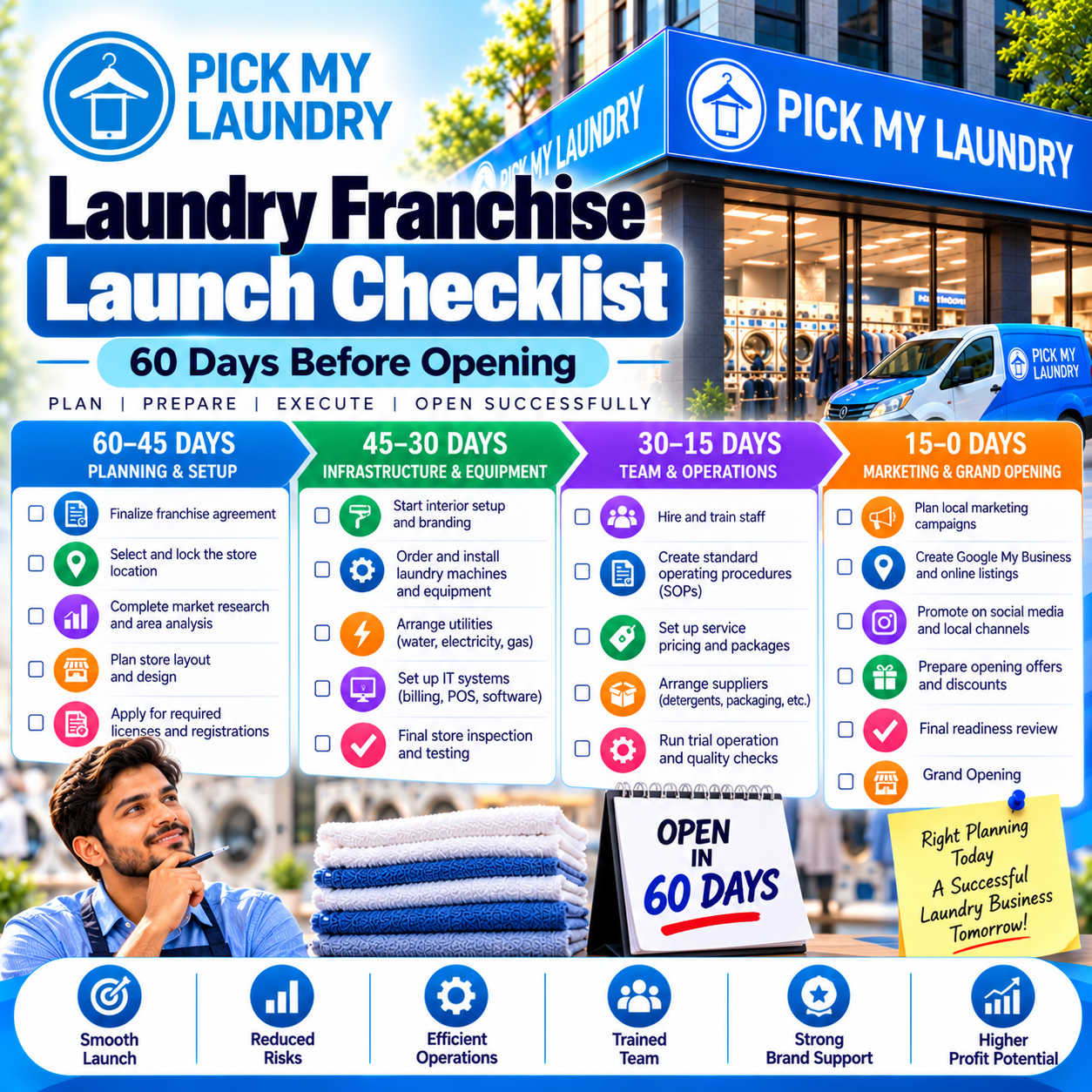
Laundry Franchise Launch Checklist: 60 Days Before Opening
Introduction
Opening a laundry franchise requires more than selecting a location and installing equipment. Before the first customer walks into the store, the owner must coordinate the premises, equipment, utilities, staff, training, service procedures, pricing, marketing, and customer communication.
Without a structured launch plan, important tasks can be delayed. Equipment may not be ready, staff may lack training, local customers may not know about the opening, or the store may accept orders before its processes are fully tested.
A laundry franchise launch checklist helps organise these activities into manageable stages.
This guide explains how to prepare for your laundry franchise launch over the 60 days before opening. The timeline is a planning framework, not a guarantee that every store can open within 60 days. Actual timing depends on lease arrangements, fit-out work, equipment delivery, local approvals, and the franchise model.
Pick My Laundry has 12+ years of industry experience, 500+ stores, a presence in 90+ cities, and operations across 4 countries. Prospective franchise partners should discuss the applicable setup process, responsibilities, and opening timeline with the brand before finalising their launch plan.
Why a 60-Day Laundry Franchise Launch Plan Matters
A timeline helps franchise owners coordinate different activities without overlooking essential details.
A structured launch plan can help you:
-
Organise setup tasks in the correct order.
-
Identify delays before they affect the opening date.
-
Prepare staff before customer orders begin.
-
Test equipment and operational procedures.
-
Build awareness in the local market.
-
Plan initial working capital.
-
Create a more professional first customer experience.
The key is to treat opening day as the result of preparation, not as the starting point of business operations.
Days 60–46: Finalise the Business Foundation
Phase 1 — Planning, premises and approvals
1. Confirm Your Franchise Agreement
Before committing to major setup expenses, review the franchise agreement and understand your responsibilities.
Confirm:
-
Total investment and payment milestones
-
Franchise fees and recurring charges, where applicable
-
Equipment and technology requirements
-
Branding and store design standards
-
Training and operational support
-
Territory and location terms
-
Marketing responsibilities
-
Opening approval procedures
-
Agreement duration, renewal, and termination terms
Seek professional legal or financial advice if any clause is unclear. Do not rely on verbal promises when a material commitment should be documented.
2. Finalise the Store Location
The location can influence customer convenience, operating costs, visibility, and delivery logistics.
Evaluate:
-
Residential density and nearby housing societies
-
Working professionals and family households
-
Offices, hostels, hotels, and other potential customer segments
-
Visibility and accessibility
-
Parking and pickup or delivery access
-
Competitor locations and services
-
Rent, deposit, and lease conditions
-
Water supply, drainage, electricity, and ventilation
Make sure the premises are suitable for the intended laundry or dry cleaning model before signing the lease.
3. Check Local Permissions and Compliance
Requirements vary by location, business structure, premises, and services offered.
Identify the registrations, permissions, and compliance requirements applicable to your store. Depending on the business and jurisdiction, these may involve business registration, GST applicability, local trade permissions, Shops and Establishments requirements, fire safety, signage rules, labour compliance, and wastewater or environmental requirements.
Confirm the applicable rules with the relevant authorities or a qualified local professional. Do not assume that every laundry store requires exactly the same approvals.
4. Prepare a Setup Budget
Build a budget covering more than the initial franchise or equipment cost.
Include:
|
Expense Category |
What to Plan For |
|---|---|
|
Premises |
Security deposit, rent and fit-out |
|
Equipment |
Machines and other model-specific equipment |
|
Utilities |
Electrical work, water connections and drainage |
|
Interiors |
Counter, storage, signage and customer area |
|
Technology |
Billing, order management and payment systems |
|
Staffing |
Recruitment, training and initial salaries |
|
Marketing |
Launch campaign, local promotion and creative work |
|
Working capital |
Operating expenses during the initial period |
|
Contingency |
Unexpected costs and delays |
Use supplier quotations and actual local costs to build your budget. Keep working capital separate from one-time setup expenses.
Days 45–31: Set Up the Store and Arrange Equipment
Phase 2 — Infrastructure and procurement
5. Complete the Store Layout
Plan the customer counter, garment receiving area, storage, processing areas, packaging space, and dispatch area according to the services offered.
A good layout should support an orderly workflow:
-
Customer order acceptance
-
Garment inspection and tagging
-
Sorting and processing
-
Quality inspection
-
Finishing and packaging
-
Order storage
-
Customer collection or delivery
Keep customer garments identifiable throughout the process. Avoid layouts that allow incoming, processed, and ready-for-delivery garments to become mixed.
6. Confirm Equipment and Installation Requirements
Equipment requirements depend on whether the franchise uses an in-store processing model, a collection-and-delivery model, a central processing facility, or another approved operating structure.
Confirm:
-
Equipment specifications and capacity
-
Delivery and installation dates
-
Electrical load and connections
-
Water supply and drainage
-
Ventilation requirements
-
Maintenance arrangements
-
Operator training
-
Warranty and service contacts
Do not assume that every outlet needs the same machinery. Confirm the equipment list with the franchisor and the selected operating model.
7. Arrange Supplies and Packaging
Create an initial inventory list based on expected order volume and the services offered.
Common supplies may include:
-
Garment tags and order labels
-
Packaging bags and covers
-
Hangers
-
Cleaning and finishing supplies
-
Stain inspection materials
-
Receipt or invoice materials
-
Safety equipment
-
Cleaning and maintenance supplies
Set minimum stock levels for frequently used items. Avoid buying excessive inventory before demand patterns are understood.
8. Set Up Billing and Order Tracking
Every order should have a reliable record.
Test the systems used for:
-
Customer details
-
Garment count and service selection
-
Pricing and discounts
-
Order status
-
Payment collection
-
Delivery or collection scheduling
-
Receipts and invoices
-
Complaint records
If digital order management is part of the franchise model, ensure staff understand how to use it before the store opens.
Days 30–16: Recruit Staff and Build Operational Readiness
Phase 3 — People, procedures and service standards
9. Recruit the Required Team
Staffing depends on the size of the outlet, expected volume, service range, operating hours, and whether processing happens on-site or at a central facility.
Potential roles include:
-
Store manager or supervisor
-
Customer service executive
-
Garment inspection and sorting staff
-
Processing or finishing staff
-
Pickup and delivery personnel, where applicable
Define responsibilities clearly. In a smaller store, one employee may perform multiple functions, provided training, safety, and workload requirements are met.
10. Train Staff on Customer Service
Staff should know how to explain services, prices, turnaround times, exclusions, and special-care requirements.
Training should cover:
-
Customer greeting and order acceptance
-
Garment inspection
-
Identification of existing damage
-
Stain and fabric-care escalation
-
Order tagging and tracking
-
Payment and billing procedures
-
Customer complaints
-
Pickup and delivery handover
-
Data privacy and responsible customer communication
Employees should not promise stain removal, delivery dates, or garment outcomes that the business cannot reasonably guarantee.
11. Create Standard Operating Procedures
Standard Operating Procedures (SOPs) help the team deliver a consistent experience.
Prepare written procedures for:
-
Order receiving
-
Garment counting and tagging
-
Fabric and care-label checks
-
Sorting and processing
-
Quality control
-
Packaging
-
Order storage
-
Customer handover
-
Refunds, rework, and complaints
-
Daily opening and closing
-
Equipment cleaning and maintenance
Make the SOPs easy to access. Train staff on the actual procedures and verify that they can follow them independently.
12. Finalise the Service Menu and Pricing
Prepare a clear list of available services and prices.
Depending on the store's approved offerings, the menu may include washing, ironing, dry cleaning, premium garment care, shoe cleaning, or household textile cleaning.
Before publishing prices, confirm:
-
Service inclusions and exclusions
-
Garment categories and applicable rates
-
Turnaround times
-
Express-service availability, if offered
-
Minimum order values, if applicable
-
Pickup and delivery charges
-
Promotional terms
-
Complaint and rework policies
Ensure the prices are consistent across the store, website, digital listings, and marketing materials.
Days 15–8: Start Marketing and Test Operations
Phase 4 — Local awareness and readiness testing
13. Build Local Awareness Before Opening
Do not wait until opening day to tell people about the new store.
Create a pre-launch marketing plan focused on the store's service area.
Potential activities include:
-
Local social media announcements
-
Google Business Profile setup or updates
-
Local search optimisation
-
Nearby residential society outreach
-
Office and business introductions
-
Storefront signage
-
Local promotional materials
-
WhatsApp communication to opted-in contacts
-
Paid advertising targeted to the service area
Make sure opening dates, addresses, contact details, and promotional conditions are accurate.
14. Prepare the Store's Online Presence
Customers should be able to find the store and understand its services.
Check that your website or location page includes the correct store details, service list, contact information, operating hours, and booking instructions.
Where eligible, set up or update the store's Google Business Profile and ensure the information complies with platform requirements. Use genuine business information and avoid creating duplicate or misleading listings.
15. Conduct Trial Orders
Before accepting regular customer volume, run internal test orders.
Test the full journey from order acceptance to garment handover. Verify that:
-
Garments receive the correct tags.
-
Counts and service instructions are recorded.
-
Prices and discounts calculate correctly.
-
Processing instructions reach the appropriate team.
-
Quality checks are completed.
-
Packaging is appropriate.
-
Order status is updated correctly.
-
Collection and delivery procedures work.
Record any errors, assign responsibility for correcting them, and repeat the test where necessary.
16. Test Customer Communication
Confirm that customers can reach the store and receive accurate information.
Check phone numbers, messaging channels, booking forms, payment options, and order notifications.
Prepare simple templates for order confirmation, ready-for-collection messages, delivery updates, feedback requests, and complaint acknowledgements. Use these only through appropriate channels and in line with customer consent requirements.
Days 7–1: Complete the Final Opening Checklist
Phase 5 — Final checks and launch approval
17. Inspect the Store
Conduct a final physical inspection.
Check:
-
Signage and branding
-
Counter and customer waiting area
-
Equipment installation and safe operation
-
Water, drainage, ventilation, and electrical systems
-
Storage and garment identification
-
Cleanliness and housekeeping
-
Safety equipment
-
Price lists and customer notices
-
Billing and payment systems
-
Staff uniforms, where applicable
Confirm that all required permissions and safety requirements are satisfied before opening.
18. Verify Staff Readiness
Ask the team to demonstrate the important daily tasks rather than relying only on verbal confirmation.
Each employee should understand their role, escalation contacts, customer service expectations, garment handling procedures, and opening and closing responsibilities.
Ensure there is a clear process for handling unexpected situations, such as delayed orders, equipment breakdowns, or garment-related complaints.
19. Confirm Launch Offers
If you plan to offer an opening promotion, define the terms before advertising it.
Specify the eligible services, validity dates, minimum order conditions, discount limits, exclusions, and redemption process.
Check that the offer is financially viable and that staff can explain it consistently. Avoid promotions that create demand beyond the store's processing or delivery capacity.
20. Conduct a Final Go/No-Go Review
The owner or authorised manager should confirm that the store is genuinely ready to serve customers.
Do not proceed solely because the planned opening date has arrived. Resolve critical safety, compliance, equipment, staffing, and order-tracking issues first.
60-Day Laundry Franchise Launch Timeline
Days 60–46
Planning and premises
Review the agreement, finalise the location, identify compliance requirements, and prepare the budget.
Days 45–31
Infrastructure and equipment
Complete layout planning, arrange equipment, procure supplies, and configure billing systems.
Days 30–16
Staff and procedures
Recruit and train staff, document SOPs, and finalise services, prices, and turnaround policies.
Days 15–8
Marketing and testing
Promote the opening locally, verify online listings, run trial orders, and test customer communication.
Days 7–1
Final readiness
Inspect the premises, verify staff readiness, confirm offer terms, and complete the final go/no-go review.
Laundry Franchise Opening Checklist: Printable Task Tracker
Use this checklist to track the major launch activities.
Pre-opening task tracker
0 of 20 complete
Review and sign the franchise agreement
Finalise the location and lease
Confirm local permissions and compliance requirements
Prepare the setup budget and working capital
Complete store layout and fit-out
Confirm equipment installation and utilities
Procure initial supplies and packaging
Set up billing and order tracking
Recruit the required staff
Complete staff training
Document operational SOPs
Finalise service menu and pricing
Prepare local marketing campaigns
Set up accurate online store information
Run trial orders and correct errors
Test customer communication channels
Complete the final store inspection
Confirm launch offer terms
Verify staff and operational readiness
Complete the final go/no-go review
Reset checklistCopy checklist
Common Mistakes to Avoid Before Opening
Underestimating Working Capital
Opening costs are only one part of the financial plan. Rent, salaries, utilities, supplies, marketing, maintenance, and other operating expenses continue after opening.
Estimate cash requirements for the initial operating period using realistic costs and conservative revenue assumptions.
Starting Marketing Too Late
If customers learn about the store only after it opens, initial awareness may be limited. Begin local promotion early enough to build awareness, while keeping the advertised opening date realistic.
Accepting Orders Before Processes Are Ready
A rushed opening can create avoidable problems with garment tagging, delivery commitments, billing, and customer communication.
Run trial orders and fix operational gaps before taking on regular customer volume.
Ignoring Competitors
Review nearby laundry and dry cleaning providers, their service menus, convenience, public reviews, and positioning. Use the findings to understand the local market rather than copying competitors' prices without analysing your own costs.
Treating Opening Day as the End of Preparation
A store needs ongoing monitoring after launch. Track order volumes, customer feedback, rework, delivery performance, costs, and repeat bookings so that problems can be addressed early.
Frequently Asked Questions
1. How long does it take to open a laundry franchise?
The timeline depends on the franchise model, location, premises, equipment, permissions, and fit-out requirements. A 60-day checklist is a planning framework; some stores may require more time.
2. What should I do first when opening a laundry franchise?
Start by understanding the franchise agreement, confirming the investment requirements, evaluating the proposed location, and identifying the applicable compliance requirements. These decisions affect the remaining setup activities.
3. What equipment is required for a laundry franchise?
Equipment depends on whether the store processes garments on-site or operates through a collection-and-delivery or central processing model. Confirm the approved equipment specifications and utility requirements with the franchisor.
4. How much working capital does a laundry franchise need?
There is no universal amount. Working capital depends on rent, salaries, utilities, supplies, marketing, delivery costs, expected order volume, payment cycles, and available cash reserves. Prepare a store-specific estimate before opening.
5. How can I promote a new laundry franchise?
Consider local SEO, an accurate Google Business Profile, neighbourhood outreach, social media announcements, signage, relevant introductory offers, and partnerships with nearby businesses. Select channels based on your target customers and available budget.
6. Should a laundry franchise accept orders on opening day?
Yes, if the store is operationally ready and all applicable requirements have been met. Before launch, test garment identification, processing, quality checks, billing, customer communication, and order handover.
7. What should a laundry franchise owner monitor after launch?
Track order volume, average order value, customer complaints, rework, delivery performance, variable costs, repeat customer rate, and cash flow. Reviewing these indicators regularly can help identify issues early.
Conclusion
Launching a laundry franchise successfully requires coordination across business planning, premises, equipment, staff, procedures, marketing, and customer readiness.
A 60-day plan gives franchise owners a practical structure for organising these tasks, identifying delays, and preparing the store before opening. The exact schedule should be adjusted to the franchise model, local requirements, and actual setup progress.
For the best start, focus on three priorities: complete the essential setup correctly, train the team thoroughly, and make sure the store can deliver a consistent customer experience from its first order.
Explore the franchise opportunity and learn more about Pick My Laundry at https://pickmylaundry.in.
Internal Linking Suggestions
Add contextual links to these related Pick My Laundry blogs:
-
Laundry Franchise Site Selection Checklist: 15 Things to Check Before Finalizing a Location — link from the location-planning section.
-
Licenses & Registrations Required for a Laundry Business in India — link from the compliance section.
-
Laundry Franchise Staff Hiring & Training Guide: Roles, Skills, SOPs & Team Structure — link from the recruitment and training section.
-
Digital Marketing Strategy for a Laundry & Dry Cleaning Business in India — link from the pre-launch marketing section.
-
Laundry Franchise Investment Checklist: What to Check Before Investing in 2027 — link from the setup budget section.
Use the correct published URLs when adding these internal links.