
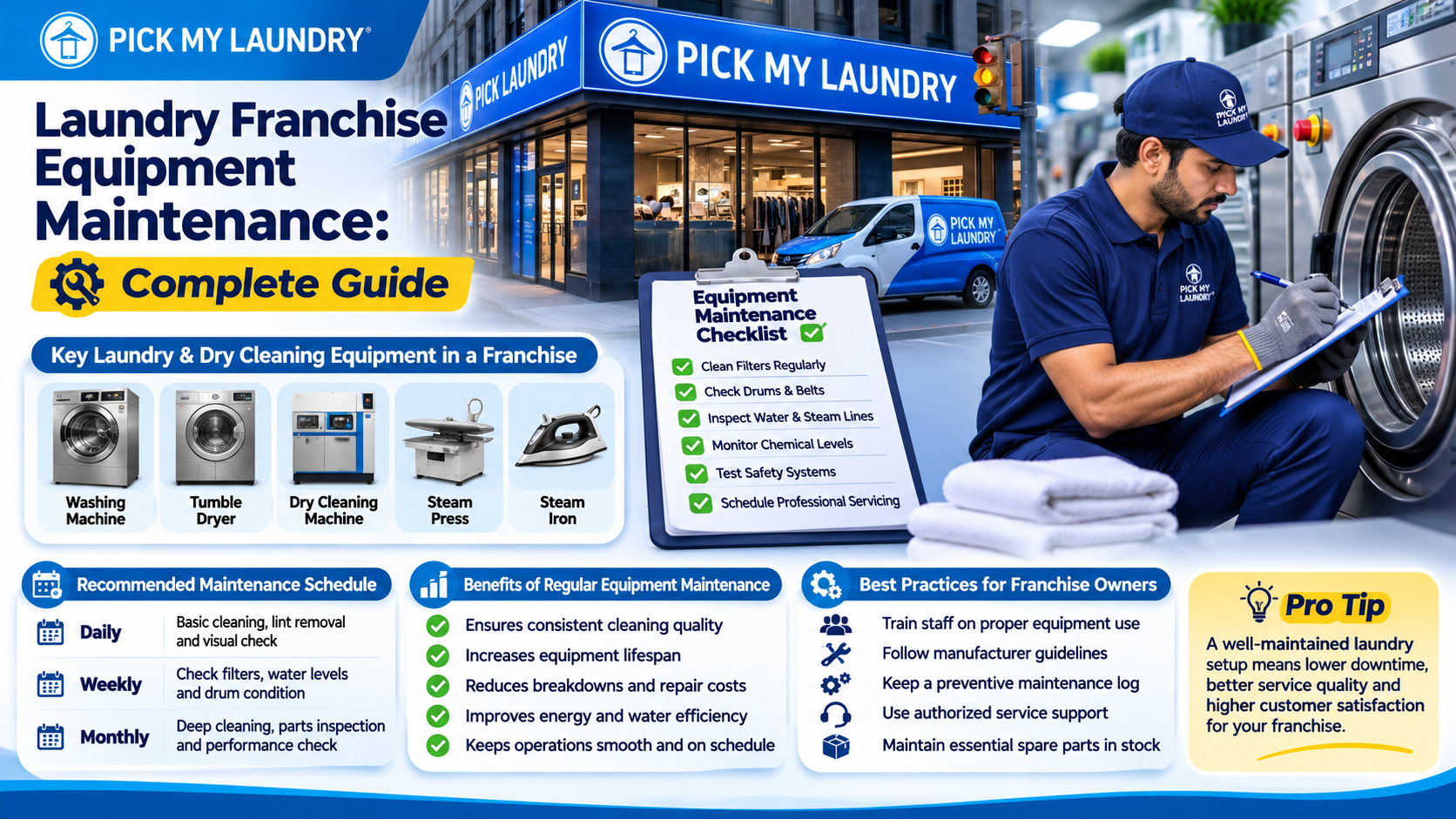
Laundry Franchise Equipment Maintenance: Complete Guide
Laundry Franchise Equipment Maintenance: How to Reduce Downtime, Control Repair Costs & Extend Machine Life
Introduction
Starting a laundry franchise requires investment in commercial washing machines, dryers, steam ironing equipment, and other professional garment care systems. However, purchasing the right equipment is only the beginning.
Long-term operational success also depends on how effectively these machines are maintained.
Unexpected equipment breakdowns can interrupt laundry processing, delay customer deliveries, increase repair expenses, and affect customer satisfaction.
For franchise owners, laundry franchise equipment maintenance is therefore an essential part of daily business management.
A structured preventive maintenance system can help reduce unexpected breakdowns, improve equipment reliability, maintain cleaning quality, and support better cost control.
This guide explains how to maintain commercial laundry equipment, prepare servicing schedules, monitor repair expenses, and reduce operational downtime.
1. What Is Laundry Franchise Equipment Maintenance?
Laundry franchise equipment maintenance refers to the inspection, servicing, cleaning, testing, and repair of machines used in professional laundry and dry cleaning operations.
Its primary objective is to keep equipment operating safely and efficiently while reducing unexpected failures.
A typical laundry franchise may use several types of equipment:
-
Commercial washing machines
-
Industrial tumble dryers
-
Steam ironing tables
-
Steam generators or boilers
-
Hydro extractors
-
Dry cleaning machines, where applicable
-
Water treatment and filtration systems
-
Garment finishing equipment
-
Air compressors and supporting utilities
Each machine has different servicing requirements depending on its design, usage, manufacturer instructions, and operating environment.
Effective maintenance involves both routine operator checks and specialized servicing by qualified technicians.
2. Why Equipment Maintenance Matters in a Laundry Franchise
Equipment reliability directly affects the daily operations of a laundry business.
Prevents unexpected downtime
A machine breakdown can reduce processing capacity and delay customer orders.
Regular inspections help identify developing problems before they cause major interruptions.
Helps control repair expenses
Minor faults can sometimes develop into more expensive failures if they are ignored.
Preventive maintenance allows owners to address problems at an earlier stage.
Supports consistent garment care
Poorly maintained equipment may produce inconsistent wash results, inadequate drying, or garment finishing problems.
Improves operational efficiency
Machines operating according to manufacturer specifications are more likely to deliver reliable performance.
Supports workplace safety
Commercial laundry equipment can involve electricity, heat, pressure, moving components, and cleaning chemicals.
Proper servicing helps reduce avoidable operational hazards.
Supports equipment longevity
Maintenance can help limit premature wear, although actual equipment lifespan depends on many factors, including workload, water quality, installation, and manufacturing quality.
3. Types of Laundry Equipment Maintenance
There are three major approaches to equipment maintenance.
|
Maintenance Type |
Description |
Example |
|---|---|---|
|
Preventive maintenance |
Scheduled servicing before failure |
Periodic inspection of belts and bearings |
|
Corrective maintenance |
Repairing identified faults |
Replacing a defective valve |
|
Predictive maintenance |
Using operating data to anticipate failure |
Monitoring unusual vibration or temperature trends |
Preventive maintenance
Preventive maintenance is usually the foundation of a practical laundry equipment maintenance program.
It includes scheduled inspections, cleaning, adjustments, and component replacement according to manufacturer recommendations.
Corrective maintenance
Corrective maintenance is performed after a problem has been identified.
Some faults can be addressed during planned servicing, while serious issues may require immediate shutdown and professional repair.
Predictive maintenance
Predictive maintenance uses machine performance data, sensor readings, or historical records to identify possible equipment failures.
This approach may be useful for larger commercial laundry operations with advanced monitoring systems.
4. Commercial Washing Machine Maintenance Checklist
Commercial washing machines often operate for extended periods and handle substantial laundry volumes.
Their condition directly influences cleaning performance and processing capacity.
Important maintenance activities
Inspect water inlet systems: Check for visible leaks, damaged hoses, or unusual water flow.
Monitor drainage performance: Slow drainage may indicate a blockage or another mechanical problem.
Check machine vibration: Excessive vibration can indicate uneven loading, installation problems, or worn components.
Inspect door seals: Damaged seals may cause leakage and operational problems.
Monitor washing cycles: Unusual cycle times, noises, or error codes should be recorded and investigated.
Review detergent dosing systems: Confirm that dosing equipment operates according to the approved process.
Schedule professional servicing: Qualified technicians should inspect internal mechanical and electrical components according to manufacturer requirements.
Operators should never bypass safety interlocks or attempt internal repairs without appropriate training and authorization.
5. Commercial Dryer Maintenance and Safety
Dryers are important for processing washed garments efficiently.
However, inadequate maintenance can increase energy consumption, reduce drying performance, and create safety risks.
Lint accumulation is a particularly important concern.
Dryer maintenance priorities
-
Clean accessible lint filters at the frequency specified by the manufacturer.
-
Inspect accessible airflow paths for restrictions.
-
Monitor unusual drying times.
-
Report abnormal sounds or vibration.
-
Check for visible damage to door seals.
-
Arrange qualified inspection of exhaust systems and heating components.
-
Follow manufacturer requirements for ventilation and clearance.
Dryers should not be operated when critical safety systems are defective.
Gas-fired dryers, where used, require additional attention to combustion, ventilation, and gas safety by appropriately qualified personnel.
A properly maintained dryer can support consistent processing and reduce avoidable operational interruptions.
6. Steam Ironing and Finishing Equipment Maintenance
Professional garment finishing is an important part of many laundry and dry cleaning services.
Steam ironing equipment may include steam tables, presses, steam generators, and related accessories.
Common maintenance concerns include:
-
Inconsistent steam output
-
Water leakage
-
Pressure irregularities
-
Damaged hoses
-
Worn pressing surfaces
-
Temperature-control problems
Routine operator checks should focus on visible condition, operating performance, and unusual behavior.
Pressure equipment and boilers must be inspected, serviced, and operated according to applicable safety requirements and manufacturer instructions.
Only qualified personnel should perform work involving pressure controls, electrical systems, or internal components.
Consistent finishing equipment maintenance helps support garment presentation and reliable service quality.
7. Dry Cleaning Machine Maintenance
Dry cleaning machines require specialized maintenance because their operating systems and cleaning agents may differ significantly from ordinary laundry equipment.
Depending on the technology used, maintenance may involve:
-
Monitoring machine operating parameters
-
Inspecting seals and accessible components
-
Checking filtration performance
-
Maintaining solvent-handling systems
-
Reviewing ventilation and safety systems
-
Scheduling qualified technical inspections
Dry cleaning equipment should be serviced according to the machine manufacturer's instructions and applicable environmental, occupational, and fire-safety requirements.
Operators must not open, drain, modify, or service solvent-handling systems unless they are specifically trained and authorized to do so.
For franchise owners, selecting qualified service providers is particularly important when managing specialized dry cleaning equipment.
8. Daily, Weekly and Monthly Preventive Maintenance Checklist
A maintenance schedule helps store managers assign responsibilities and monitor equipment condition.
The following is a general operational checklist. It does not replace machine-specific maintenance instructions.
Equipment Maintenance Checklist
0 of 15 completed
Daily Checks
Check machines for visible leaks or damage
Monitor unusual noise and vibration
Clean accessible lint filters as instructed
Record machine errors and abnormal cycle performance
Confirm guards and safety controls appear functional
Weekly Checks
Review equipment maintenance logs
Inspect accessible hoses and connections visually
Check machine cleanliness and surrounding work areas
Review recurring faults and processing delays
Follow up on pending technician service requests
Monthly Checks
Review servicing due dates for every machine
Analyze breakdown frequency and downtime
Check maintenance and repair expenses
Review technician recommendations and unresolved faults
Update the preventive maintenance schedule
Reset
9. How to Calculate Laundry Equipment Downtime Costs
Equipment downtime can create financial losses beyond the direct cost of repairs.
Potential costs include:
-
Lost processing capacity
-
Overtime expenses
-
Outsourced laundry processing
-
Delayed order fulfillment
-
Additional pickup and delivery coordination
-
Customer compensation
-
Repair and replacement expenses
Example: Estimating downtime impact
Suppose a commercial washing machine processes 40 kg of laundry per hour.
If it remains unavailable for five operating hours:
\[ 40 \times 5 = 200 \text{ kg} \]
Potential processing capacity unavailable = 200 kg.
If the store estimates a contribution margin of ₹25 per kg for the affected workload:
\[ 200 \times ₹25 = ₹5,000 \]
ILLUSTRATIVE DOWNTIME SCENARIO
Unavailable capacity
200 kg
Potential contribution at risk
₹5,000
This is an illustrative capacity-based calculation, not a confirmed financial loss. Actual losses depend on demand, spare capacity, rescheduling, outsourcing, and whether orders are permanently lost.
A downtime register helps franchise owners understand the frequency and operational impact of equipment failures.
10. How to Control Laundry Equipment Repair Costs
Repair expenses are an important component of laundry franchise operating costs.
Owners should establish a systematic approach to maintenance spending.
Maintain a maintenance budget
Allocate a reasonable amount for routine servicing, inspections, replacement components, and unexpected repairs.
The budget should reflect the actual equipment inventory, machine age, operating hours, service agreements, and repair history.
Maintain equipment service records
Every machine should have a service history containing:
-
Equipment identification number
-
Purchase and installation dates
-
Warranty details
-
Maintenance schedule
-
Previous faults and repairs
-
Replacement components
-
Technician information
-
Servicing expenses
Compare repair and replacement decisions
Repeated repairs may indicate that equipment replacement should be evaluated.
However, replacement decisions should consider more than repair cost alone.
Owners should compare remaining useful life, reliability, energy consumption, downtime, replacement price, and installation expenses.
Use qualified technicians
Unqualified repairs can create additional safety and reliability risks.
Owners should prioritize manufacturer-authorized or appropriately qualified service providers.
11. Preventive Maintenance vs Emergency Repair: Cost Comparison
Consider a hypothetical annual equipment maintenance scenario.
|
Expense Category |
Planned Maintenance Approach |
Reactive Repair Approach |
|---|---|---|
|
Routine servicing |
₹24,000 |
₹5,000 |
|
Unexpected repairs |
₹10,000 |
₹35,000 |
|
Downtime-related costs |
₹5,000 |
₹20,000 |
|
Total estimated annual cost |
₹39,000 |
₹60,000 |
These figures are hypothetical and are not Pick My Laundry operating results or industry benchmarks. Actual maintenance costs and savings vary by equipment and location.
Illustrative Annual Maintenance Cost Comparison
Hypothetical amounts in Indian rupees
₹0₹20,000₹40,000₹60,000₹80,000Planned maintenanceReactive repair
The example illustrates why preventive maintenance deserves consideration as part of financial planning.
However, planned maintenance cannot eliminate every breakdown, and actual results depend on equipment condition and service quality.
12. Key Equipment Maintenance KPIs
Laundry franchise owners should track maintenance performance using measurable indicators.
|
KPI |
Purpose |
|---|---|
|
Equipment uptime |
Measures machine availability |
|
Breakdown frequency |
Tracks unexpected failures |
|
Mean time between failures (MTBF) |
Measures average operating time between failures |
|
Mean time to repair (MTTR) |
Measures average repair duration |
|
Maintenance cost per machine |
Tracks equipment-specific spending |
|
Preventive maintenance completion rate |
Tracks scheduled servicing completion |
|
Equipment utilization |
Measures actual usage relative to available capacity |
Equipment uptime formula
\[ \text{Uptime \%} = \frac{\text{Available Time - Downtime}}{\text{Available Time}} \times 100 \]
For example, if a machine is scheduled to be available for 300 hours and experiences 12 hours of downtime:
\[ \frac{300-12}{300}\times100=96\% \]
Equipment uptime = 96%.
This metric helps identify machines requiring closer attention.
13. Equipment Maintenance for Multi-Unit Laundry Franchises
Managing equipment across multiple franchise stores requires additional coordination.
A multi-unit operator may need to monitor different machine models, equipment ages, service providers, and maintenance schedules.
A centralized maintenance system can help with:
-
Equipment identification across locations
-
Preventive maintenance reminders
-
Technician scheduling
-
Warranty tracking
-
Repair expense reporting
-
Downtime comparisons
-
Equipment replacement planning
Comparing maintenance data across stores can also reveal recurring technical problems.
For example, if one location consistently reports higher machine downtime, management can investigate factors such as installation, workload, water quality, operator practices, or equipment age.
14. How Technology Can Improve Laundry Equipment Maintenance
Digital maintenance tools can help franchise owners move beyond paper-based servicing records.
Depending on the platform, a maintenance management system may provide:
Automated reminders: Notifications when scheduled servicing is due.
Equipment service history: Digital records of inspections and repairs.
Fault reporting: A structured process for employees to report machine problems.
Maintenance dashboards: Reports showing downtime and repair expenses.
Multi-location visibility: Centralized information about equipment across stores.
Some commercial machines may also provide diagnostic information through built-in monitoring systems.
Before adopting maintenance software, owners should assess cost, compatibility, training requirements, and practical benefits.
15. How Pick My Laundry Franchise Owners Can Approach Equipment Maintenance
Pick My Laundry operates in the laundry and dry cleaning sector with a reported network spanning multiple cities and countries.
12+
Years Experience
500+
Stores
90+
Cities
4
Countries
For entrepreneurs evaluating a Pick My Laundry franchise, equipment selection and maintenance planning are important considerations.
Prospective franchise owners should ask about:
-
Equipment specifications and installation requirements
-
Manufacturer warranties
-
Preventive maintenance schedules
-
Technical support arrangements
-
Approved service providers
-
Replacement part availability
-
Equipment-related operating expenses
Actual maintenance responsibilities and support arrangements should be confirmed through official franchise documentation.
A well-managed maintenance process can help store operators deliver more reliable laundry and dry cleaning services.
Frequently Asked Questions (FAQs)
1. What is preventive maintenance in a laundry franchise?
Preventive maintenance involves scheduled inspections, servicing, cleaning, and replacement of components to reduce the likelihood of unexpected equipment failures.
2. How often should commercial laundry machines be serviced?
Servicing frequency depends on machine type, manufacturer instructions, operating hours, workload, and equipment condition. Daily operator checks and scheduled professional servicing should be combined.
3. What causes commercial laundry machine breakdowns?
Possible causes include worn components, improper loading, drainage problems, electrical faults, poor installation, inadequate maintenance, and operating conditions outside manufacturer specifications.
4. How can a laundry franchise reduce machine downtime?
Owners can reduce avoidable downtime by implementing preventive maintenance, training employees, maintaining service records, monitoring warning signs, and arranging timely professional repairs.
5. How much does laundry equipment maintenance cost?
Costs vary according to machine type, age, operating hours, warranty coverage, location, and service provider. Owners should obtain actual servicing estimates and maintain a maintenance budget.
6. Should laundry franchise owners repair or replace old machines?
The decision should consider repair frequency, remaining useful life, downtime, efficiency, safety, replacement cost, and installation requirements.
7. Can maintenance software help laundry franchises?
Yes. Suitable software can help track service schedules, repair histories, machine downtime, and maintenance spending, particularly across multiple locations.
8. What is the most important laundry equipment maintenance KPI?
Equipment uptime is an important indicator because it shows machine availability. However, it should be evaluated alongside breakdown frequency, repair costs, safety performance, and preventive maintenance completion.
Conclusion
Effective laundry franchise equipment maintenance is essential for maintaining reliable operations, controlling repair expenses, and supporting consistent customer service.
A structured maintenance program helps franchise owners monitor equipment condition, identify potential problems, and plan servicing activities before major interruptions occur.
By combining preventive maintenance schedules, qualified technical support, employee training, and performance monitoring, laundry businesses can improve equipment management and reduce avoidable downtime.
For entrepreneurs planning to start or expand a laundry franchise, equipment maintenance should be treated as an ongoing operational responsibility rather than an occasional repair expense.
Start Your Laundry Franchise Journey with Pick My Laundry
Interested in exploring opportunities in the laundry and dry cleaning industry?
Learn more about Pick My Laundry's franchise business model, investment requirements, and available opportunities.
Website: https://pickmylaundry.in