
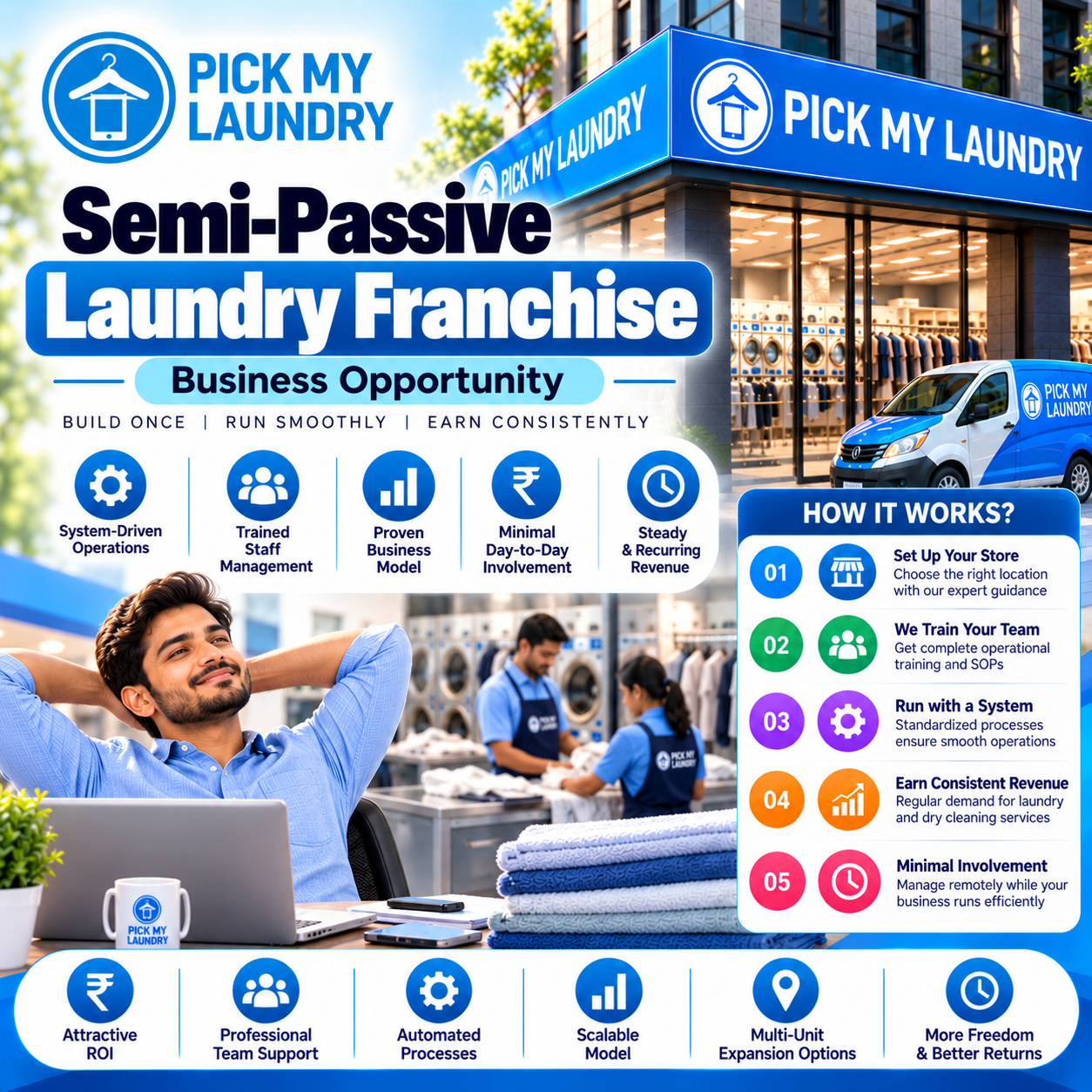
semi-passive laundry franchise business
Introduction
Many entrepreneurs want to start a business without having to manage every operational task themselves. They may already have a full-time job, run another company or prefer to focus on strategy rather than daily store activities.
This raises an important question: Can you run a laundry franchise as a semi-passive business?
The answer is that it may be possible to reduce your day-to-day involvement by hiring capable staff, establishing standard operating procedures, using suitable technology and reviewing performance regularly. However, a laundry franchise should not automatically be considered a passive investment.
Laundry and dry-cleaning operations involve customer service, garment handling, order tracking, quality control, staff management and financial monitoring. These responsibilities still need to be performed, even when the owner delegates them.
In this guide, we explain how a manager-led laundry franchise can work, what systems it requires, the costs to consider and how to evaluate whether this model suits your business goals.
1. What Is a Semi-Passive Laundry Franchise?
A semi-passive laundry franchise is a business in which the owner delegates most routine operations to trained staff or a store manager while retaining responsibility for important business decisions and oversight.
The owner may focus on:
-
Reviewing financial performance
-
Monitoring revenue and expenses
-
Evaluating marketing campaigns
-
Approving major purchases
-
Reviewing customer feedback
-
Planning business growth
-
Managing the relationship with the franchisor
Meanwhile, a store manager and trained employees may handle daily activities such as receiving orders, coordinating garment processing, managing customers and overseeing delivery.
The key distinction is that the owner delegates operational tasks but does not eliminate business responsibility.

2. How Does a Manager-Run Laundry Franchise Work?
A manager-led setup usually depends on clearly defined roles and repeatable processes.
A typical structure may look like this:
Business Owner
Strategy, investment, financial oversight and expansion
Store Manager
Daily operations, staff supervision and service standards
Customer Service
Orders, billing and complaints
Processing & Delivery
Garment handling and dispatch
The exact team structure depends on the franchise model. An outlet that sends garments to a centralized processing facility may need a different staffing arrangement from a store that processes garments on-site.
Before choosing this structure, confirm which tasks the franchisor handles and which remain your responsibility.
3. Can You Run a Laundry Franchise Alongside a Full-Time Job?
It may be possible, provided that the business has a dependable manager, clear procedures and effective reporting systems.
However, the workload will depend on the size of the outlet, customer volume, staff experience and complexity of operations.
A working professional considering a laundry franchise should plan for:
-
A designated person responsible for daily decisions
-
Defined escalation procedures for complaints
-
Reliable financial and order reports
-
Scheduled performance reviews
-
Backup arrangements for staff absences
-
Access to business information when needed
During the launch phase, the owner may need to be more involved in hiring, training, marketing and resolving initial operational problems.
As the team becomes more capable, the owner may be able to reduce routine involvement. This transition should be based on demonstrated performance rather than assumptions.
4. The Role of a Store Manager
A competent store manager is one of the most important requirements for a semi-passive operating model.
The manager may be responsible for:
-
Opening and closing procedures
-
Staff attendance and scheduling
-
Order acceptance and tracking
-
Customer communication
-
Garment quality checks
-
Delivery coordination
-
Daily sales reconciliation
-
Inventory and supply monitoring
-
Complaint escalation
-
Reporting operational issues
Before hiring, define the manager's authority and accountability.
For example, the manager should know which discounts can be approved independently, which expenses require owner approval and how damaged or missing garments should be handled.
A manager's salary is an additional operating expense. Include it in the financial forecast before deciding whether a semi-passive setup is economically viable.
5. Build Standard Operating Procedures
Delegation becomes much easier when employees follow documented processes rather than relying on the owner's personal instructions.
Important SOPs may cover:
-
Customer order registration
-
Garment tagging and identification
-
Sorting and processing
-
Stain and special-care identification
-
Quality inspection
-
Packaging and dispatch
-
Payment collection
-
Pickup and delivery
-
Complaint handling
-
Refunds and adjustments
-
Daily cash reconciliation
-
Store opening and closing
The franchise's prescribed operating procedures should remain the foundation. Any changes that require franchisor approval should be authorized before implementation.

6. Use Technology to Monitor Operations
Technology can help reduce the need to be physically present at the outlet for every routine task.
Depending on the available system, useful features may include:
-
Store-wise sales reports
-
Order status tracking
-
Digital billing
-
Customer records
-
Payment reconciliation
-
Outstanding invoice reports
-
Staff access controls
-
Complaint records
-
Daily and monthly summaries
For a manager-led business, reports should be consistent and easy to review.
However, technology does not replace operational discipline. The owner must ensure that employees record transactions accurately and that reports are checked regularly.
7. Understand the Additional Cost of Semi-Passive Operations
A manager-led model can reduce the owner's daily workload, but it may increase the outlet's operating expenses.
Potential additional or relevant costs include:
|
Expense |
Why it matters |
|---|---|
|
Store manager salary |
Covers daily supervision |
|
Staff training |
Supports consistent service |
|
Software |
Helps track orders and transactions |
|
Quality control |
Reduces avoidable service errors |
|
Accounting support |
Improves financial visibility |
|
Backup staffing |
Helps manage absences |
|
Owner travel and oversight |
May be required across locations |
The actual expenses depend on the business model and local operating conditions.
Do not assume that a franchise can run without daily owner involvement simply because it has established systems. Verify the level of operational support provided and budget for the tasks that remain your responsibility.
8. Compare an Owner-Managed and Manager-Managed Model
Owner-managed model
-
Owner is closely involved in daily operations.
-
Fewer management layers may be needed.
-
Owner must allocate significant time to the outlet.
-
Business knowledge may be concentrated in the owner.
Manager-managed model
-
Manager handles routine operations.
-
Additional management costs may apply.
-
Owner focuses more on reporting and decisions.
-
Strong SOPs and accountability are essential.
Neither model is automatically more profitable. Compare both using realistic revenue, salary, operating expense and owner-time assumptions.
9. Calculate Whether the Business Can Support a Manager
Before choosing a semi-passive structure, estimate whether the outlet can afford the management layer.
For example, suppose a hypothetical outlet has monthly operating profit of ₹90,000 before accounting for a separately hired manager. If the manager costs ₹30,000 per month, the remaining operating surplus would be ₹60,000 before any other excluded costs or adjustments.
That figure is only an illustration, not an expected industry return or a Pick My Laundry earnings claim.
The calculation should also consider taxes, financing, equipment replacement, working capital and the owner's required return.
If the business only works financially when the owner provides substantial unpaid labor, a manager-led model may have a very different economic outcome.
10. Set Up a Weekly Monitoring System
You do not necessarily need to inspect every order personally. Instead, establish a regular review routine.
A weekly review may include:
-
Total sales
-
Number of orders
-
Average order value
-
Customer complaints
-
Delayed orders
-
Repeat customers
-
Marketing performance
-
Staff attendance
-
Cash balance
-
Outstanding payments
Monthly reviews should include a more detailed examination of expenses, operating margin, cash flow and performance against the business plan.
Set clear thresholds for issues that require immediate attention, such as unexplained payment differences, repeated quality complaints or significant delays.

11. Common Risks of a Semi-Passive Laundry Franchise
Delegating routine work creates opportunities, but it also introduces risks.
Poor staff accountability
Without clear responsibilities, problems may go unnoticed or remain unresolved.
Inaccurate financial reporting
Sales, expenses and payments should be reconciled regularly rather than accepted without verification.
Inconsistent service quality
Employees must follow the required procedures for garment handling, processing and customer communication.
Dependence on one manager
Have documented procedures and backup arrangements so the business does not become entirely dependent on a single employee.
Underestimating owner involvement
Even a well-managed outlet may require the owner to handle important hiring, financial, contractual and customer decisions.
Expanding before the system is ready
Do not replicate a management model across several stores until it works reliably at the first outlet.
12. Is a Semi-Passive Laundry Franchise Right for You?
This model may suit entrepreneurs who have other professional commitments, prefer strategic oversight or want to build a business with defined management responsibilities.
It may be less suitable for someone who expects a completely hands-off investment or is unable to monitor staff, cash flow and service quality.
Before investing, consider:
-
Whether you can afford a manager
-
Whether the business model supports delegation
-
Whether you can review financial performance consistently
-
Whether you have enough working capital
-
Whether the franchisor provides documented operating procedures
-
Whether you can respond when problems need your attention
The most useful question is not simply whether the business can run without you every day. It is whether it can operate reliably, meet its obligations and maintain service quality under a realistic management structure.
Why Consider Pick My Laundry?
Pick My Laundry operates in the laundry and dry-cleaning franchise sector.
12+ Years of Industry Experience | 500+ Stores | 90+ Cities | Operations Across 4 Countries
Entrepreneurs considering a manager-led franchise should review the proposed franchise model, staff requirements, technology, operating procedures and applicable fees before investing.
Ask the franchise team what operational support is included, which activities remain the franchise owner's responsibility and what staffing structure is recommended for the proposed outlet.
Prepare a location-specific financial plan that includes management costs rather than assuming the business will generate a particular profit or require a particular level of owner involvement.
Frequently Asked Questions
1. Can a laundry franchise run without the owner being present every day?
Potentially, if a trained manager, reliable staff, clear SOPs and effective monitoring systems are in place. The owner will still need to oversee financial performance and important business decisions.
2. Is a laundry franchise a passive investment?
Not necessarily. It is an operating business involving customers, garments, staff, service quality and expenses. Delegating routine work can reduce owner involvement, but it does not eliminate business responsibilities.
3. Do I need to hire a manager for a semi-passive model?
A designated manager or another dependable person responsible for daily operations is generally important when the owner cannot be present regularly. The exact staffing arrangement depends on the franchise model.
4. Does hiring a manager reduce business profit?
It adds a management expense, although effective supervision may also help improve consistency and reduce operational problems. Evaluate the net impact using realistic financial assumptions.
5. Can I operate a laundry franchise while working full-time?
It may be possible if you establish reliable management, reporting and escalation processes. The launch phase may require more attention than the business needs after operations become established.
6. What technology is useful for managing a laundry franchise remotely?
Depending on availability, order management, billing, sales reports, payment reconciliation and customer records can help owners monitor operations. Verify the actual features included in the proposed franchise system.
7. Can I expand to multiple stores using a semi-passive model?
Potentially, but each additional outlet adds management, financial and operational complexity. Establish reliable processes at the first store before expanding.
Conclusion
A laundry franchise can potentially operate as a semi-passive business when daily responsibilities are delegated to capable staff and supported by documented procedures, appropriate technology and consistent financial monitoring.
However, reducing owner involvement requires planning, management costs and ongoing oversight. It should never be treated as a guarantee of passive income.
For entrepreneurs exploring a Pick My Laundry franchise, evaluate the operating model, confirm the support available, budget for staffing and prepare a realistic financial forecast before making an investment decision.