
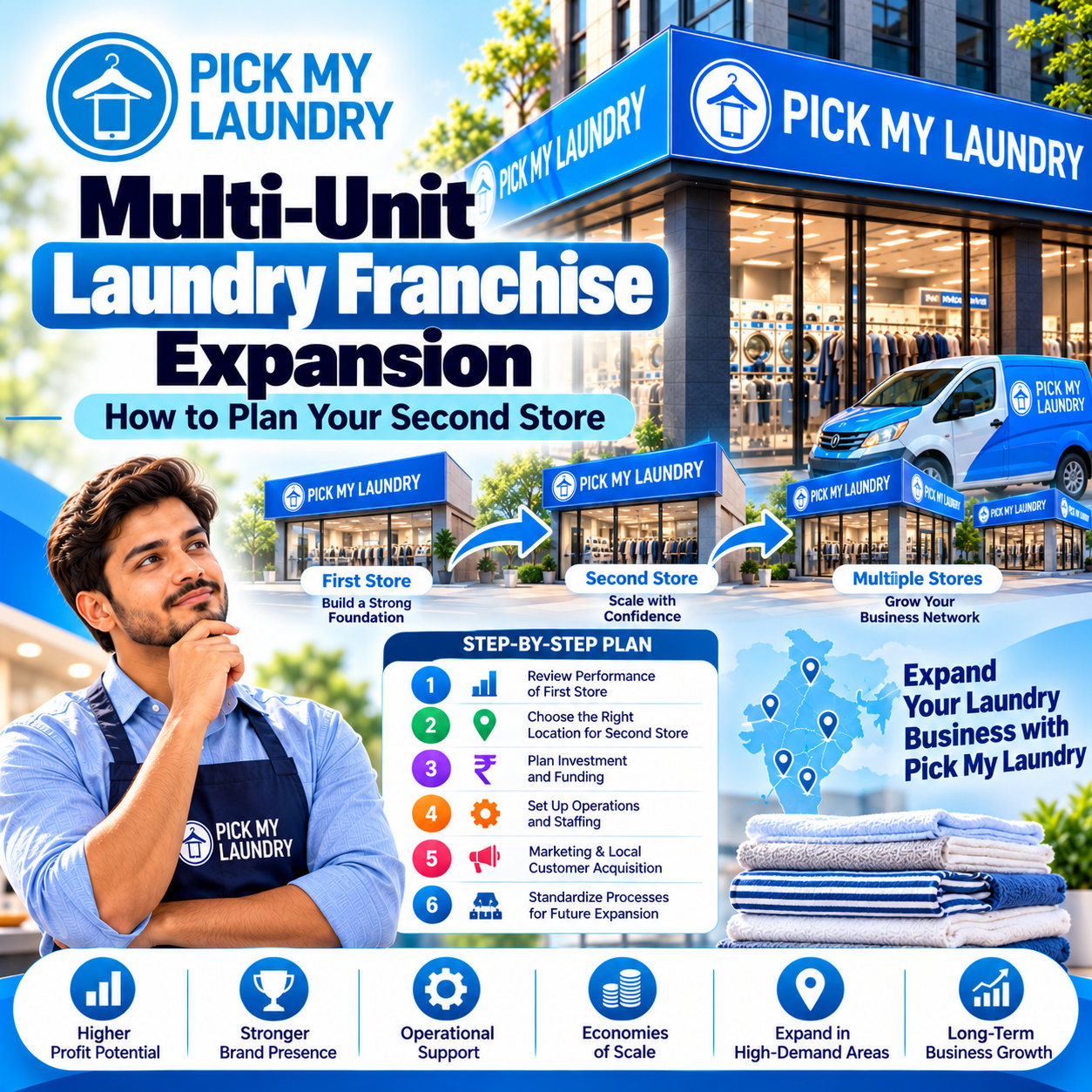
Multi-Unit Laundry Franchise Expansion: How to Plan Your Second Store
Introduction
Opening your first laundry franchise is an important business milestone. Once the outlet has established its customer base and developed reliable operating processes, you may start considering the next stage of growth: opening a second store.
However, expanding from one laundry outlet to multiple locations requires more than additional investment. It involves evaluating financial performance, choosing the right location, building a dependable team, maintaining service quality and creating systems that work across stores.
A successful first outlet does not automatically guarantee that a second outlet will perform equally well. Each location has its own demand, competition, rental costs, customer preferences and operational challenges.
This guide explains how to plan a second laundry franchise store, assess expansion readiness and build a practical multi-unit growth strategy in India.
1. Evaluate Your First Store Before Expanding
Before investing in another location, review the performance of your existing outlet.
Do not make the decision based only on increasing sales or customer enquiries. Examine the complete financial and operational picture.
Review the following indicators:
-
Monthly revenue trends
-
Operating expenses
-
Cash flow
-
Outstanding customer payments
-
Repeat-customer rate
-
Average order value
-
Customer complaints
-
On-time delivery performance
-
Staff productivity
-
Owner involvement in daily operations
Ask yourself whether the existing outlet can operate reliably without your constant supervision.
If the business depends on you personally handling every customer complaint, approving every transaction and supervising every employee, opening another outlet may increase complexity before your management systems are ready.
Expansion readiness begins with operational stability, not simply with strong sales.
2. Understand the Financial Requirements of a Second Store
Opening another outlet generally requires a separate investment plan.
Your second-store budget may include:
|
Cost category |
What to evaluate |
|---|---|
|
Franchise charges |
Applicable fees for the additional outlet |
|
Property |
Deposit, rent and related expenses |
|
Interiors |
Store setup and branding |
|
Equipment |
Machinery and installation, where required |
|
Technology |
Software, billing and order-management setup |
|
Recruitment |
Hiring and training staff |
|
Marketing |
Launch campaigns and local promotion |
|
Working capital |
Cash required to support early operations |
|
Contingency |
Reserve for unexpected expenses |
Do not assume that the second outlet will cost the same as the first. Costs may change because of location, property conditions, equipment requirements or the terms of the franchise agreement.
Ask the franchisor whether multi-unit owners receive different commercial terms or operational support. Confirm any applicable arrangements in writing.
3. Check Whether Your Existing Store Generates Sufficient Cash
A second outlet should not put the financial stability of the first outlet at risk.
Before expanding, evaluate:
-
Whether the first store consistently covers its operating expenses
-
Whether it has adequate working capital
-
Whether outstanding payments are under control
-
Whether loan repayments are manageable
-
Whether sufficient funds remain after planned expansion expenses
-
Whether you can handle a slower-than-expected launch at the new location
Prepare a separate cash flow forecast for the second outlet and a combined forecast for both stores.
The combined forecast should account for shared costs, separate store expenses, additional management requirements and any financing obligations.
Remember that a store can be profitable on paper while still facing a cash shortage. Protecting liquidity is essential during expansion.
4. Choose the Right Location for Your Second Outlet
Location selection becomes more strategic when you already operate a store.
You may want to expand near your existing outlet to simplify supervision, or enter a different market to reach new customers. Both approaches have advantages and limitations.
Option A: Expand within the existing service area
Potential advantages include:
-
Familiarity with local demand
-
Easier management oversight
-
Opportunities to share some resources
-
Better understanding of local marketing channels
However, a nearby store may compete with your existing outlet for the same customers.
Option B: Enter a new locality
Potential advantages include:
-
Access to a different customer base
-
Greater geographic coverage
-
Opportunities to test a new market
The trade-offs may include longer travel times, less direct supervision and the need to understand a new competitive environment.
Before selecting a location, investigate:
-
Residential communities
-
Apartment complexes
-
Offices and commercial areas
-
Local laundry and dry-cleaning competitors
-
Property rental costs
-
Accessibility and visibility
-
Delivery distances
-
Local pricing expectations
-
Potential corporate customers
Also review the franchise agreement for territorial restrictions and approval requirements.
5. Create Standard Operating Procedures for Both Stores
When operating one store, you may manage many activities informally. That approach becomes harder to maintain as the business grows.
Develop standard operating procedures (SOPs) for recurring activities such as:
-
Customer order acceptance
-
Garment tagging
-
Sorting and processing
-
Quality inspection
-
Packaging
-
Billing and payments
-
Pickup and delivery
-
Customer complaints
-
Missing or damaged garments
-
Opening and closing procedures
-
Daily cash reconciliation
The aim is to make service quality less dependent on individual employees.
For a franchise business, follow the brand's prescribed operating procedures and obtain approval for any changes that require franchisor authorization.
6. Build a Reliable Team
A multi-unit business needs clear responsibilities.
Depending on the operating model, the team may include:
-
Store managers
-
Customer service staff
-
Processing personnel
-
Pickup and delivery staff
-
Quality-control personnel
-
Administrative or accounts support
You may not need every role at every location. Staffing should reflect store size, service mix, operating hours and whether garment processing is performed on-site or centrally.
Before opening the second store, determine:
-
Who will manage the new outlet?
-
Who will supervise the existing store?
-
Who will handle customer escalations?
-
Who will monitor daily sales and expenses?
-
Who will ensure SOP compliance?
-
Who will cover staff absences?
Hiring a manager without defining responsibilities and reporting processes may simply move operational problems from one location to another.
7. Decide How the Two Stores Will Share Resources
Multi-unit owners should identify which activities can be coordinated centrally and which must remain store-specific.
Potential shared functions include:
-
Accounting and reporting
-
Marketing planning
-
Recruitment
-
Training
-
Customer relationship management
-
Supplier coordination
-
Performance reviews
Other functions, such as store-level customer service and daily order handling, may need local responsibility.
For example, a common marketing calendar can help both outlets maintain consistent brand messaging, while each store can promote services relevant to its own locality.
Before centralizing an activity, assess whether doing so reduces costs without slowing down service.
8. Use Technology to Monitor Both Outlets
Managing multiple locations becomes easier when business information is organized consistently.
Depending on the software available, useful capabilities may include:
-
Store-wise sales reports
-
Order tracking
-
Customer records
-
Payment reconciliation
-
Outstanding invoice reports
-
Staff access controls
-
Expense reporting
-
Complaint tracking
-
Service-level monitoring
Create a dashboard that allows you to compare the performance of each store.
Avoid judging locations only by total revenue. A larger store may generate more sales but also incur higher rent, payroll and delivery costs.
Compare each outlet using relevant measures such as operating margin, revenue per order, repeat purchases, customer complaints and cash flow.
9. Develop a Separate Marketing Plan for the Second Store
Your first store's customer base may not automatically transfer to the new location.
Plan a local marketing campaign before opening the second outlet.
Digital marketing
-
Set up or update the appropriate Google Business Profile.
-
Create location-specific website content.
-
Use local search advertising where commercially suitable.
-
Publish social media posts announcing the new location.
-
Encourage genuine customer reviews in accordance with platform policies.
Local marketing
-
Introduce the store to nearby residential communities.
-
Build relationships with relevant local businesses.
-
Promote available services and collection options.
-
Use approved opening offers.
-
Develop a customer referral strategy.
Retention marketing
-
Communicate service updates.
-
Encourage repeat orders.
-
Track returning customers.
-
Resolve complaints promptly.
-
Offer promotions based on customer needs and business economics.
Keep the branding consistent across both locations while adapting the marketing message to each local market.
10. Consider a Central Processing Model Carefully
Some laundry businesses process garments at each retail outlet, while others use a central processing facility with retail collection points.
A centralized model may create opportunities to coordinate equipment, processing staff and quality-control systems. However, it can also introduce transportation costs, turnaround-time dependencies and capacity constraints.
Before expanding, evaluate:
-
Processing capacity
-
Transportation distance
-
Order transfer procedures
-
Garment tracking
-
Quality-control responsibilities
-
Peak-period capacity
-
Backup arrangements during equipment downtime
The appropriate model depends on the franchise's operating structure and the distance between locations.
Do not assume that centralization is automatically cheaper. Compare the complete costs and service requirements of each option.
11. Track Performance with a Multi-Store KPI Dashboard
Use a consistent reporting structure across both outlets.
|
KPI |
Why it matters |
|---|---|
|
Revenue by store |
Compares sales performance |
|
Operating expenses |
Reveals cost differences |
|
Operating margin |
Helps assess operating efficiency |
|
Average order value |
Tracks revenue per order |
|
Repeat-customer rate |
Indicates customer retention |
|
Customer acquisition cost |
Evaluates marketing efficiency |
|
Complaint rate |
Highlights service problems |
|
On-time completion |
Measures operational reliability |
|
Cash balance |
Monitors liquidity |
|
Staff productivity |
Helps evaluate resource utilization |
Set realistic targets based on each outlet's location, size, operating model and stage of development.
Review results weekly or monthly, and investigate meaningful differences instead of assuming that both stores should perform identically.
12. Avoid Common Multi-Unit Expansion Mistakes
Expanding before the first store is stable
If the first outlet still has unresolved operational or financial problems, a second location may increase the burden.
Underestimating working capital
The new store may need time to establish its customer base. Plan for a slower launch rather than assuming immediate full-capacity operations.
Hiring without clear accountability
Every outlet needs defined responsibilities, escalation processes and performance expectations.
Ignoring location-specific demand
The same pricing, customer mix and marketing strategy may not work equally well in every locality.
Overlooking franchise restrictions
Check the agreement for territory, additional-outlet approvals, fees and other relevant conditions.
Expanding without management reporting
Without consistent reports, owners may discover problems only after they begin affecting cash flow or customer satisfaction.
13. A Practical Checklist Before Opening Your Second Store
Use this checklist to assess your readiness.
Expansion readiness
0/10 completed
First store has stable financial and operating reports
Second-store investment and working capital are budgeted
Combined cash flow forecast has been prepared
New location has been independently evaluated
Franchisor approvals and territorial terms are checked
Store manager and staff responsibilities are defined
Operating procedures and training plans are ready
Technology and reporting are configured
Local marketing plan is prepared
Contingency and slower-sales scenarios are considered
Copy checklist
This checklist is a planning aid, not a substitute for financial, legal or operational due diligence.
Why Consider Pick My Laundry?
Pick My Laundry operates in the laundry and dry-cleaning franchise sector.
12+ Years of Industry Experience | 500+ Stores | 90+ Cities | Operations Across 4 Countries
Entrepreneurs exploring multi-unit expansion should evaluate the applicable franchise terms, location requirements, investment structure and operational support available for additional outlets.
Before opening another location, prepare a separate financial plan, verify all required approvals and ensure that your existing business can continue operating reliably while you manage expansion.
Frequently Asked Questions
1. When should I open a second laundry franchise store?
Consider expansion when the first outlet demonstrates stable operations, manageable expenses, adequate cash flow and repeatable processes. There is no single timeline that suits every business.
2. Is the second laundry franchise store cheaper to open?
Not necessarily. Some resources may be shared, but property, staffing, setup, fees and working capital can still create substantial costs. Obtain an outlet-specific estimate.
3. Should I open the second store near the first one?
That depends on local demand, delivery economics, territory rules and your ability to manage both outlets. A nearby store may simplify supervision but could also compete for the same customers.
4. Can one manager handle two laundry outlets?
Possibly, depending on store size, staff experience, operating processes, travel distance and order volume. Evaluate the actual workload before combining management responsibilities.
5. How can I manage two laundry franchise stores efficiently?
Use documented SOPs, defined staff responsibilities, consistent financial reporting, store-wise performance dashboards and regular management reviews.
6. Should I expand using my own funds or a business loan?
Compare the cost of financing, repayment obligations, available cash reserves and downside scenarios. The right choice depends on your financial position and risk tolerance.
7. Does opening more stores guarantee higher profits?
No. Additional stores increase revenue opportunities but also introduce costs, management requirements and operational risks. Evaluate each outlet's contribution to the combined business.
Conclusion
Multi-unit laundry franchise expansion can create opportunities for business growth, but the decision should be based on financial readiness, reliable operations and realistic market research.
Before opening your second store, review the performance of your first outlet, prepare a separate investment plan, evaluate the new location, establish management systems and maintain adequate working capital.
The goal is not simply to operate more stores. It is to build a business that can manage multiple locations without sacrificing service quality or financial stability.
For entrepreneurs considering expansion with Pick My Laundry, start by reviewing the applicable franchise terms and preparing a location-specific plan for the additional outlet.