
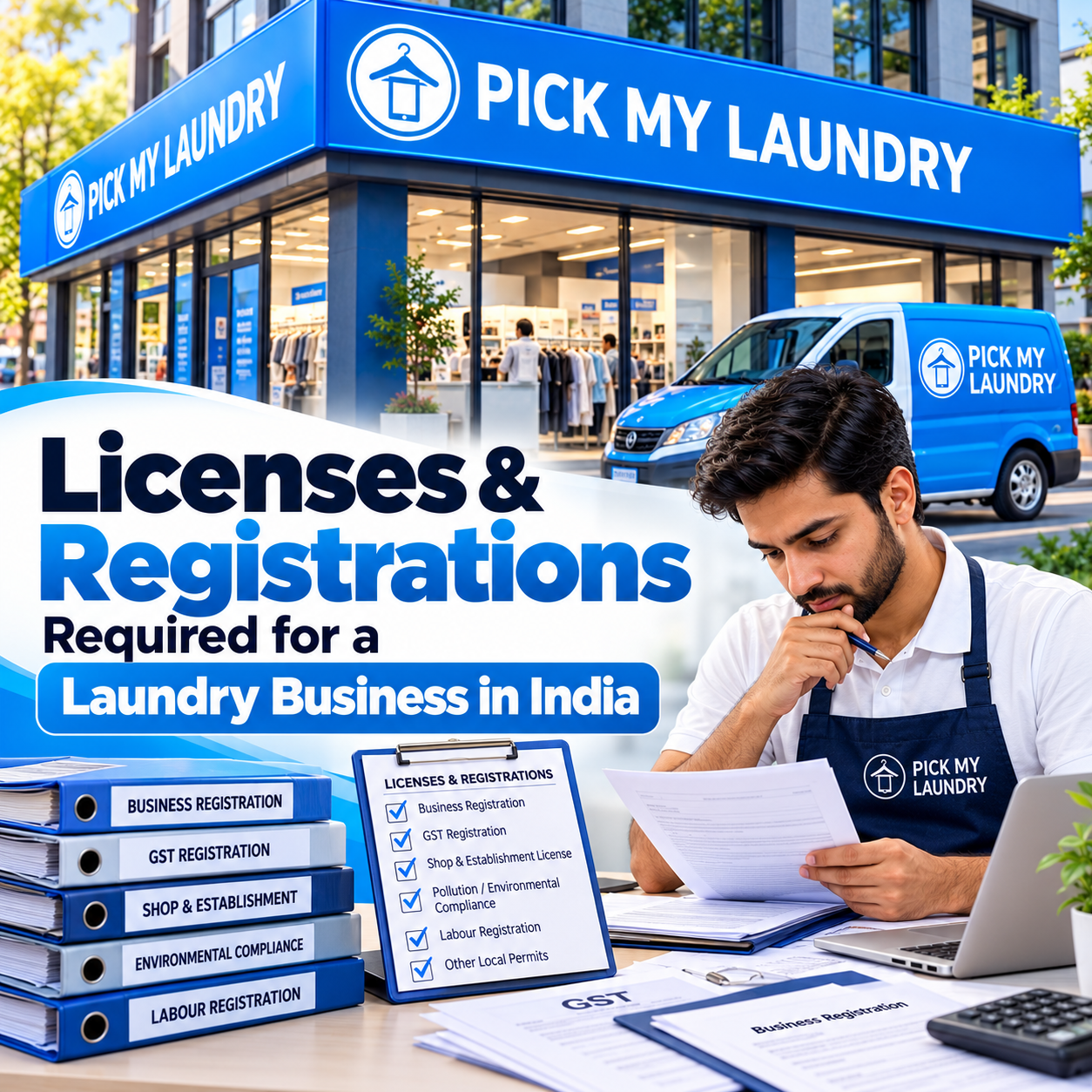
Licenses & Registrations Required for a Laundry Business in India
Introduction
Starting a laundry or dry-cleaning business involves more than arranging equipment, staff and a shop. Entrepreneurs also need to understand the business registrations, tax registrations, local permissions and employment-related compliances that may apply to their particular business and location.
The exact requirements can vary depending on factors such as:
- Business structure
- State and city
- Nature of services
- Number of employees
- Turnover
- Property and premises
- Wastewater or environmental requirements
- Whether the business operates independently or as a franchise
Therefore, there is no single universal checklist that applies identically to every laundry business in India.
This guide explains the major registrations and permissions that a laundry entrepreneur should investigate before starting operations.
1. Choose Your Business Structure
Before applying for registrations, decide how the business will be structured.
Common options include:
Sole Proprietorship
Suitable for an individually owned business.
The business and owner are closely connected from a legal and tax perspective.
Partnership Firm
Useful when two or more individuals operate the business together under a partnership arrangement.
Limited Liability Partnership (LLP)
An LLP combines partnership-style management with a separate legal structure and limited liability for partners, subject to applicable law.
Private Limited Company
A common structure for businesses planning a corporate setup, multiple investors or larger expansion.
Franchise-Owned Business
A franchise outlet may operate through any suitable legal structure chosen by the franchisee, depending on the agreement and professional advice.
Important: The appropriate structure should be selected after considering taxation, liability, funding, compliance and future expansion.
2. PAN and Business Banking
A business generally needs appropriate tax and banking documentation.
Depending on the structure, this can involve:
- PAN
- Business bank account
- Address proof
- Identity documents
- Incorporation/registration documents
- Partnership deed, where applicable
- Company/LLP documents, where applicable
A dedicated business bank account also makes it easier to separate business transactions from personal finances.
3. GST Registration
GST is one of the major tax-related considerations for a laundry or dry-cleaning business.
Whether GST registration is required depends on the applicable GST provisions, including factors such as turnover, nature of supplies and other statutory conditions.
Therefore, entrepreneurs should not assume that every laundry outlet automatically requires or does not require GST registration.
Before applying, prepare:
- PAN
- Business constitution documents
- Business address proof
- Bank details
- Identity/address documents of relevant persons
- Other information requested on the GST portal
Because GST rules and thresholds can change, verify the current applicability before registration.
4. Udyam Registration
Laundry businesses may also consider Udyam Registration if they qualify as an MSME.
The Government of India's official Udyam portal states that registration is free, paperless and based on self-declaration. It also provides an online Udyam Registration Certificate. Udyam Registration
The current MSME classification uses investment and turnover criteria. The official portal currently lists:
| Category | Investment Limit | Turnover Limit |
|---|---|---|
| Micro | Up to ₹2.5 crore | Up to ₹10 crore |
| Small | Up to ₹25 crore | Up to ₹100 crore |
| Medium | Up to ₹125 crore | Up to ₹500 crore |
These criteria are based on the current Udyam portal information. Udyam Registration
Why consider Udyam?
Depending on eligibility and applicable schemes, MSME registration can be useful when accessing certain government schemes and formal business facilities.
Use the official Government Udyam portal, rather than paying an unofficial intermediary for registration. Udyam Registration
5. Shops & Establishments Registration
A physical laundry outlet may fall under the applicable Shops and Establishments legislation of the state or Union Territory where it operates.
This can regulate areas such as:
- Working hours
- Weekly holidays
- Employment conditions
- Employee records
- Leave
- Wages and other workplace requirements
The exact registration process and applicability vary by state.
Therefore, a laundry entrepreneur should check the relevant state labour department or official single-window portal before opening the outlet.
6. Local Trade Licence
Many municipalities and local authorities have their own licensing or permission requirements for commercial establishments.
A laundry outlet may need to investigate whether a municipal trade licence or local business permission applies to its premises and activity.
Requirements can differ significantly between cities.
Before signing a long-term lease, it is useful to verify:
- Whether the property can legally be used for the intended activity
- Whether the local authority permits the business category
- Whether additional permissions apply
- Whether signage permissions are required
- Whether building or commercial-use restrictions apply
7. Fire Safety Requirements
Depending on the premises, building, equipment, occupancy and local regulations, fire-safety requirements may apply.
A laundry business uses electrical equipment and may have multiple machines operating simultaneously, so appropriate safety planning is important.
Depending on the location and building, this may involve:
- Fire extinguishers
- Emergency exits
- Electrical safety
- Fire-safety equipment
- Fire NOC/certificate where applicable
- Periodic inspection requirements
The exact requirements should be confirmed with the relevant local fire authority.
8. Pollution & Environmental Compliance
Laundry and dry-cleaning businesses can involve water consumption, wastewater, detergents, chemicals and other operational considerations.
Depending on the size and nature of the facility, State Pollution Control Board (SPCB) requirements may need to be evaluated.
This is particularly important for larger processing facilities rather than assuming that every small collection outlet has identical requirements.
Entrepreneurs should check:
- Wastewater discharge requirements
- Water usage
- Chemical storage/handling
- Waste disposal
- Applicable consent requirements
- Local environmental regulations
The applicable State Pollution Control Board should be consulted before setting up a processing facility.
9. Labour & Employee Compliance
Once a laundry business employs staff, several employment-related obligations may apply.
Depending on employee count, wages, state and business structure, the entrepreneur may need to examine:
- Minimum wage requirements
- Employee records
- Working hours
- Leave requirements
- Salary records
- Workplace safety
- Provident Fund applicability
- ESI applicability
- Professional tax, where applicable
Not every requirement applies to every business.
The correct compliance position should be determined based on the outlet's workforce and location.
10. Professional Tax
Some Indian states levy Professional Tax on specified individuals and/or employers.
Its applicability differs from state to state.
If you are opening a laundry outlet, check whether professional-tax registration, deduction or payment applies in your state.
11. Signage & Advertising Permissions
A laundry store usually requires external branding and signage.
However, local municipal authorities may regulate:
- Signboard size
- Placement
- Illumination
- Advertising boards
- Road-facing signage
- Hoardings
Before installing large outdoor signage, check the local authority's rules.
12. Electricity & Commercial Connection
Laundry businesses use equipment such as:
- Washing machines
- Dryers
- Steam equipment
- Pressing equipment
- Water pumps
- Other processing machinery
The electrical load requirement can therefore be considerably different from a normal retail shop.
Before taking possession of the premises, evaluate:
Electrical Load
Can the available sanctioned load support the equipment?
Wiring
Is the electrical installation suitable for commercial equipment?
Safety
Are proper protection systems and earthing available?
Expansion
Will the connection support future equipment?
A qualified electrical professional should assess the installation rather than relying only on the existing connection.
13. Water & Drainage
Water is an important operational input for many laundry processes.
Before finalizing a location, check:
- Water availability
- Water pressure
- Storage capacity
- Drainage
- Wastewater disposal
- Local water-use restrictions
- Plumbing infrastructure
A location that appears attractive commercially may still be unsuitable if its utility infrastructure cannot support the intended operation.
14. Documents You May Need
The exact document list depends on the registration.
However, entrepreneurs commonly need some combination of:
- PAN
- Aadhaar/identity documents
- Passport-size photographs, where required
- Business constitution documents
- Partnership deed
- Certificate of incorporation
- Address proof
- Rent/lease agreement
- Owner NOC, where required
- Electricity bill
- Bank details
- Property documents, where applicable
- Employee information
- Equipment details, where applicable
Do not submit unnecessary documents to unofficial agents.
15. Franchise Outlet vs Independent Laundry
The compliance process can also differ depending on the business model.
Independent Laundry
The entrepreneur establishes the brand, systems, processes and business structure independently.
Franchise Outlet
The franchisee operates under a franchise agreement and receives brand and operational support according to that agreement.
However, a franchise agreement does not automatically mean that every local legal requirement is handled by the franchisor.
The franchisee should clearly understand:
- Which registrations are the franchisee's responsibility
- Which permissions are supported by the franchisor
- Who handles local licences
- Who handles tax registrations
- Who handles employee compliance
- Who is responsible for premises-related approvals
This should be confirmed in writing before signing the agreement.
16. Pre-Launch Compliance Checklist
Before opening a laundry outlet, create a checklist like this:
| Requirement | Check |
|---|---|
| Business structure | ☐ |
| PAN | ☐ |
| Business bank account | ☐ |
| GST applicability | ☐ |
| Udyam eligibility | ☐ |
| Shops & Establishments applicability | ☐ |
| Local trade licence | ☐ |
| Fire-safety requirements | ☐ |
| Pollution/environment requirements | ☐ |
| Employee compliance | ☐ |
| Professional tax applicability | ☐ |
| Electricity load | ☐ |
| Water & drainage | ☐ |
| Signage permission | ☐ |
| Lease/property documents | ☐ |
| Insurance review | ☐ |
17. Don't Wait Until After Opening
One common business-planning mistake is to finalize a location first and investigate permissions later.
A better approach is:
Business Plan → Location → Legal Due Diligence → Registrations → Equipment → Staff → Launch
This can help identify potential issues before significant money is committed to the premises.
18. Pick My Laundry Franchise & Business Setup
For entrepreneurs considering a laundry franchise, legal and operational planning should be treated as two connected areas.
Pick My Laundry's franchise information describes support around areas such as training, operational guidance, technology and business processes. Udyam Registration
The franchisee should still independently understand the registrations and permissions applicable to their particular outlet and location.
Current Pick My Laundry Brand Profile
12+ Years of Industry Experience | 500+ Stores | 90+ Cities | Operations Across 4 Countries 🌍
Frequently Asked Questions
What licence is required to start a laundry business in India?
There is no single nationwide licence that covers every laundry business. Requirements can include GST, Shops & Establishments registration, local trade permissions, Udyam registration and other approvals depending on the business and location.
Is GST mandatory for every laundry business?
Not automatically. GST registration depends on applicable GST rules, including turnover and other statutory conditions.
Is Udyam Registration mandatory?
Udyam registration is not universally mandatory simply because a business is a laundry. Eligible businesses can register through the official government portal, which currently describes the process as free and paperless. Udyam Registration
Does a laundry franchise need local registration?
The franchisee should check the applicable local and state requirements for the particular outlet. The franchise agreement should also clearly state which compliance responsibilities belong to the franchisor and franchisee.
Do I need a fire NOC for a laundry shop?
It depends on the premises, building, occupancy, equipment and local fire regulations. Check with the relevant fire authority.
Does a laundry business require pollution approval?
Potential environmental requirements depend on the nature and scale of operations, wastewater, chemicals and local regulations. A processing facility should check with the relevant State Pollution Control Board.
Can I open a laundry business without registering a company?
A laundry business does not necessarily need to be incorporated as a private limited company. The appropriate business structure depends on the entrepreneur's circumstances and plans.
Conclusion
Setting up a laundry or dry-cleaning business requires both commercial planning and compliance planning.
The important point is that requirements are not identical across India. State, municipal, premises and business-specific rules can change the registrations that apply.
Before launching, entrepreneurs should verify the applicable requirements with the relevant government departments and, where necessary, a qualified CA, CS or legal professional.
For official Udyam registration information, use the Government of India's Udyam portal. Udyam Registration
Thinking about starting a laundry franchise? Explore Pick My Laundry and understand the business model, investment structure, training and operational support available to franchise entrepreneurs.