
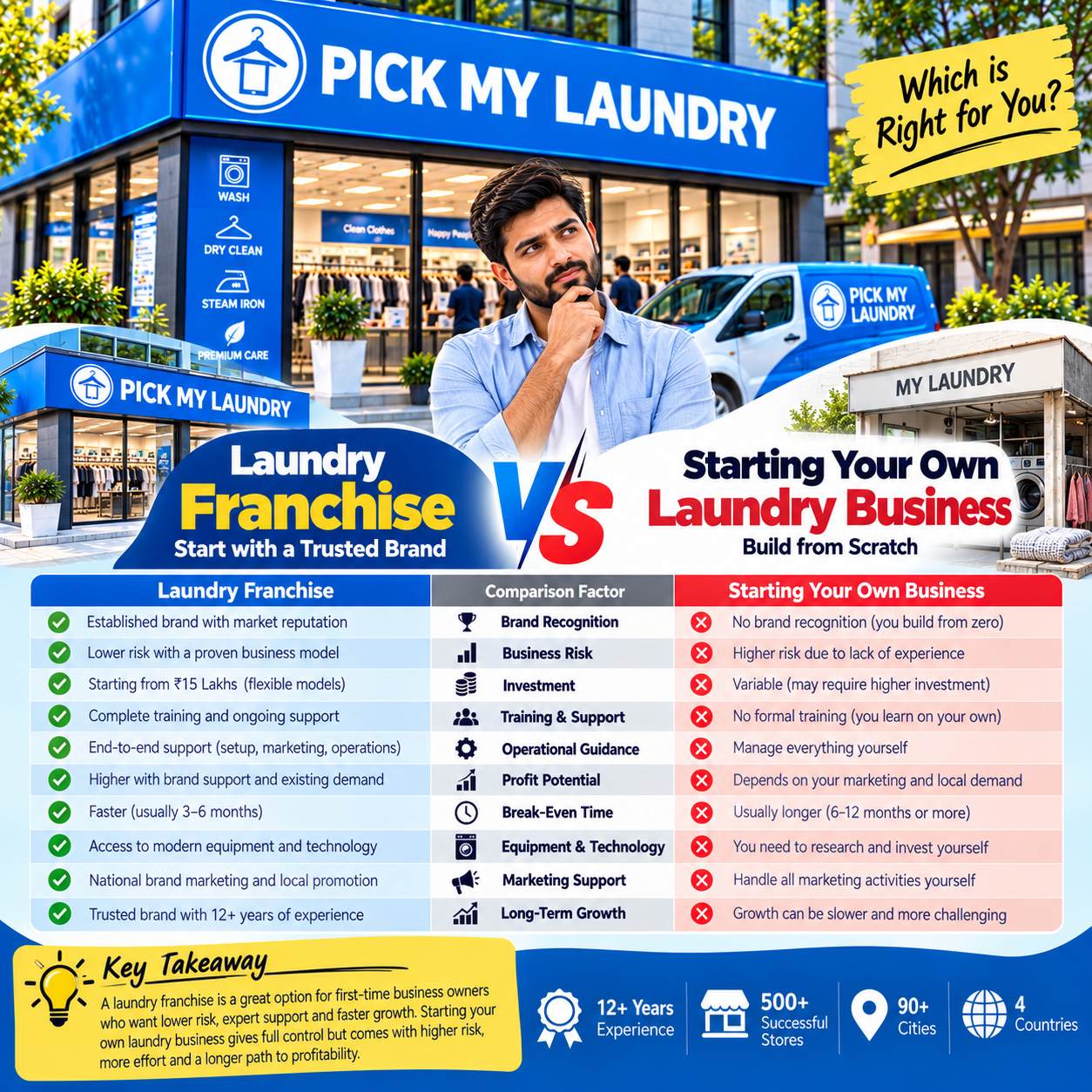
Laundry Franchise vs Starting Your Own Laundry Business
Laundry Franchise vs Starting Your Own Laundry Business: Cost, Control, Support & Key Differences
Entrepreneurs planning to enter India's laundry and dry-cleaning industry generally have two broad routes:
Start an independent laundry business
or
Join an established laundry franchise.
Both models can involve investment, operational responsibilities, customer acquisition and local market competition. However, the way these responsibilities are handled can be very different.
If you are comparing a laundry franchise vs own business, it is important to understand the differences before choosing a model.
This guide compares the two approaches across investment, branding, operations, marketing, technology, training, control and scalability.
Note: Actual costs and responsibilities vary between businesses and franchise agreements. The comparison below is a general framework and should not be treated as a financial guarantee.
1. Independent Laundry Business vs Franchise: Basic Difference
An independent laundry business is built and operated under your own brand.
You generally decide:
- Brand name
- Pricing
- Services
- Suppliers
- Equipment
- Marketing
- Technology
- Staff structure
- Operating procedures
With a franchise, you operate under an established brand and follow the systems and contractual requirements defined by the franchisor.
Depending on the franchise agreement, the franchisor may provide some combination of:
- Brand identity
- Training
- SOPs
- Technology
- Marketing support
- Store setup guidance
- Operational assistance
The exact scope varies by franchise.
2. Investment Comparison
Investment is one of the first things prospective business owners compare.
Independent Business
Your investment may include:
- Property
- Equipment
- Interiors
- Branding
- Technology
- Licences
- Staff
- Marketing
- Working capital
Because you are creating the business from scratch, you decide where and how the budget is allocated.
Franchise Business
Investment may include:
- Franchise-related charges
- Property
- Store setup
- Equipment
- Branding
- Technology
- Training
- Initial marketing
- Working capital
The exact structure depends on the franchise model and agreement.
Important
Don't compare only the initial investment.
Also compare what you receive in exchange for that investment.
3. Brand Building
This is one of the biggest differences.
Independent Laundry
You have to build the brand yourself.
That includes:
- Logo
- Website
- Google Business Profile
- Social media
- Advertising
- Customer reviews
- Local awareness
- Brand reputation
Building recognition can take time and consistent marketing.
Franchise
A franchise operates under an existing brand.
This can provide a starting point for brand recognition, subject to the strength and presence of the particular franchise.
For Pick My Laundry, the current brand proof points used in this content strategy are:
12+ Years of Industry Experience | 500+ Stores | 90+ Cities | Operations Across 4 Countries
These figures describe the broader brand network and should not be interpreted as a guarantee of performance for an individual outlet.
4. Control Over the Business
Independent businesses generally provide greater freedom.
You can decide:
- Pricing
- Promotions
- Suppliers
- Equipment
- Services
- Branding
- Customer policies
- Marketing strategy
A franchise generally involves following the franchisor's established systems and contractual requirements.
This can include rules related to:
- Branding
- Store appearance
- Service standards
- Technology
- Marketing
- Procurement
- Customer experience
Therefore, the decision involves a trade-off between independence and operating within an established system.
5. Operations & SOPs
An independent business needs to develop its own operating processes.
You may need to create SOPs for:
- Garment receiving
- Tagging
- Sorting
- Washing
- Dry cleaning
- Ironing
- Quality control
- Packaging
- Pickup
- Delivery
- Customer complaints
A franchise may already have standardized operating procedures.
This can reduce the amount of time required to develop processes from scratch, although franchise owners still need to manage their outlet and employees according to the applicable system.
6. Training
Independent Business
You are responsible for developing your own training system.
You may need to train staff in:
- Garment handling
- Stain identification
- Machine operation
- Ironing
- Packaging
- Customer service
- Quality control
Franchise
Depending on the agreement, the franchisor may provide initial or ongoing training.
Before signing, ask:
- Who receives training?
- How long is training?
- Is staff training included?
- Is refresher training available?
- Is operational support available after launch?
Don't assume that every franchise provides the same level of training.
7. Technology
Technology can be developed independently or provided through a franchise system.
An independent laundry may need to select and integrate:
- POS
- Order management
- Customer database
- Payment systems
- Pickup and delivery software
- Reporting
- Customer notifications
A franchise may already have a technology platform or recommended systems.
For example, modern laundry operations can use technology for:
Order → Processing → Quality Check → Packaging → Delivery → Customer Notification
The important question is whether the technology actually supports your operational requirements.
8. Marketing
Marketing is another major difference.
Independent Business
You are responsible for developing your marketing strategy.
Potential channels include:
- Google Search
- Google Maps
- Local SEO
- Meta Ads
- Local partnerships
- Referral programs
- Society marketing
- Corporate outreach
Franchise
A franchise may provide some combination of:
- Brand-level marketing
- Creative assets
- Digital marketing guidance
- Launch campaigns
- Local marketing support
- Brand campaigns
However, the franchise owner should confirm exactly what is included.
9. Customer Acquisition
An independent laundry starts without an established brand network.
Therefore, the owner must build customer awareness.
Possible strategies include:
- Introductory offers
- Google Business Profile
- Local SEO
- Reviews
- Residential society partnerships
- Referral programs
- Local advertising
- Corporate partnerships
A franchise may provide a recognized brand and marketing framework, but local customer acquisition still depends on factors such as location, service quality, pricing and local execution.
10. Supplier & Equipment Decisions
Independent owners generally have greater freedom to select:
- Equipment suppliers
- Chemicals
- Packaging
- Technology providers
- Maintenance vendors
A franchise may have preferred suppliers or defined procurement requirements.
This can help create standardization, but it can also limit supplier flexibility.
The franchise agreement should clearly explain these requirements.
11. Pricing Flexibility
An independent business usually has more freedom to determine:
- Laundry prices
- Dry-cleaning prices
- Discounts
- Packages
- Memberships
- Corporate pricing
A franchise may have pricing guidelines or brand-level pricing structures.
Before investing, ask:
Who decides the final customer price?
Also understand how local competition is considered.
12. Customer Experience
Both models need to deliver consistent customer experiences.
Important factors include:
- Order accuracy
- Processing quality
- Delivery timelines
- Garment safety
- Communication
- Packaging
- Complaint handling
A franchise can provide standardized procedures, while an independent business has to develop those systems itself.
However, actual customer experience ultimately depends on how the individual outlet operates.
13. Risk & Responsibility
Neither model eliminates business risk.
An independent business owner may face the challenge of building:
- Brand
- SOPs
- Technology
- Marketing
- Customer base
- Supplier network
A franchise owner may have additional contractual obligations and less flexibility in certain areas.
Both models can be affected by:
- Location
- Competition
- Demand
- Operating expenses
- Staffing
- Customer retention
- Service quality
- Local economic conditions
14. Scalability
If you plan to operate multiple stores, the business model becomes particularly important.
Independent Model
You need to replicate your own:
- Brand
- SOPs
- Training
- Technology
- Marketing
- Quality-control systems
Franchise Model
An established franchise system may already have standardized processes designed to support multiple outlets.
However, multi-unit expansion still requires capital, management capability and suitable locations.
15. Independent Laundry vs Franchise: Comparison Table
| Factor | Independent Laundry | Franchise |
|---|---|---|
| Brand | Build your own | Established franchise brand |
| Control | Generally higher | Governed by agreement |
| SOPs | Develop yourself | May be provided |
| Training | Develop yourself | May be provided |
| Technology | Select/build yourself | May be provided/recommended |
| Marketing | Self-managed | May receive brand support |
| Supplier freedom | Generally higher | May have defined suppliers |
| Pricing freedom | Generally higher | May have guidelines |
| Business systems | Build yourself | Existing framework may be available |
| Expansion | Develop own model | Can potentially replicate franchise format |
| Contractual obligations | Generally fewer | Franchise agreement applies |
| Brand recognition | Must be built | Depends on existing brand |
16. Questions to Ask Before Choosing a Franchise
If you are considering a franchise, ask the franchisor:
Financial
- What is the complete investment?
- What costs are included?
- What recurring charges apply?
- How much working capital is recommended?
Operational
- What training is provided?
- What SOPs are provided?
- What manpower is required?
- What equipment is required?
Marketing
- What marketing support is included?
- Who handles local advertising?
- Are digital marketing resources provided?
Technology
- What software is included?
- How is order tracking handled?
- Is customer data accessible to the outlet?
Agreement
- What is the agreement duration?
- What are renewal terms?
- What are termination conditions?
- Are there territory restrictions?
- What supplier requirements apply?
17. Questions to Ask Before Starting Independently
If you're choosing the independent route, consider:
- Do I understand laundry operations?
- Can I develop garment-care SOPs?
- Do I know which equipment is required?
- Can I train staff?
- Can I build a local brand?
- Can I manage digital marketing?
- Can I build customer-management technology?
- Can I handle quality control?
- Do I have enough working capital?
- Can I develop the business model independently?
If several of these areas are unfamiliar, they should be included in your planning and budget.
18. Which Model Requires More Independence?
The answer depends on what you value.
Independent Business
Generally offers more control over:
Brand + Pricing + Suppliers + Marketing + Operations
Franchise
Generally offers a more structured framework around:
Brand + Systems + SOPs + Training + Technology + Support
The specific balance depends on the franchise agreement.
19. A Simple Decision Framework
Instead of asking only:
“Which model is cheaper?”
Ask these five questions:
1. How much control do I want?
If complete independence is important, compare how much flexibility each model provides.
2. How much infrastructure do I need to build?
If you prefer an established system, examine what the franchise provides.
3. How much business experience do I have?
Your previous experience can affect how much operational support you may need.
4. What is my available budget?
Compare total investment—not just the initial franchise fee.
5. What is my long-term plan?
If you eventually want multiple outlets, evaluate how easily the operating model can be replicated.
20. Why Entrepreneurs Consider a Laundry Franchise
A franchise structure can be considered by entrepreneurs who want to operate within an established brand and system rather than developing every component independently.
For Pick My Laundry, the current brand positioning includes:
12+ Years of Industry Experience
500+ Stores
90+ Cities
Operations Across 4 Countries
The actual support, investment requirements, responsibilities and contractual terms should be evaluated based on the latest franchise documentation applicable to the prospective outlet.
Frequently Asked Questions
Is a laundry franchise better than an independent laundry?
There is no universal answer. The two models differ in control, systems, brand development, investment structure, support and contractual obligations. The appropriate choice depends on the entrepreneur's objectives and circumstances.
Is an independent laundry cheaper than a franchise?
Not necessarily. An independent business may avoid franchise-related charges, but the owner may need to independently invest in branding, technology, training, marketing, SOP development and customer acquisition.
Does a franchise guarantee customers?
No business model can guarantee customer volume. Local demand, location, marketing, pricing, service quality and customer experience all influence customer acquisition.
Can I set my own prices in a laundry franchise?
This depends on the specific franchise agreement and pricing policies.
Which model gives more control?
An independent business generally provides greater control because the owner develops the brand and operating system. A franchise operates within the contractual and brand framework established by the franchisor.
Can I start a laundry business without experience?
It is possible to enter the industry without prior laundry-business experience, but you should understand the operational requirements, training needs, investment and responsibilities before starting.
Final Takeaway
The comparison between a laundry franchise vs own business is ultimately a comparison between two different approaches to building a business.
An independent laundry gives the entrepreneur greater freedom to create the brand, pricing and operating system.
A franchise provides an opportunity to operate within an established brand and business framework, subject to the specific franchise agreement.
Before making a decision, compare:
Investment → Control → Brand → Training → Technology → Marketing → Operations → Agreement → Long-Term Goals
A detailed comparison of these factors can help you understand which business structure aligns with your own plans.