
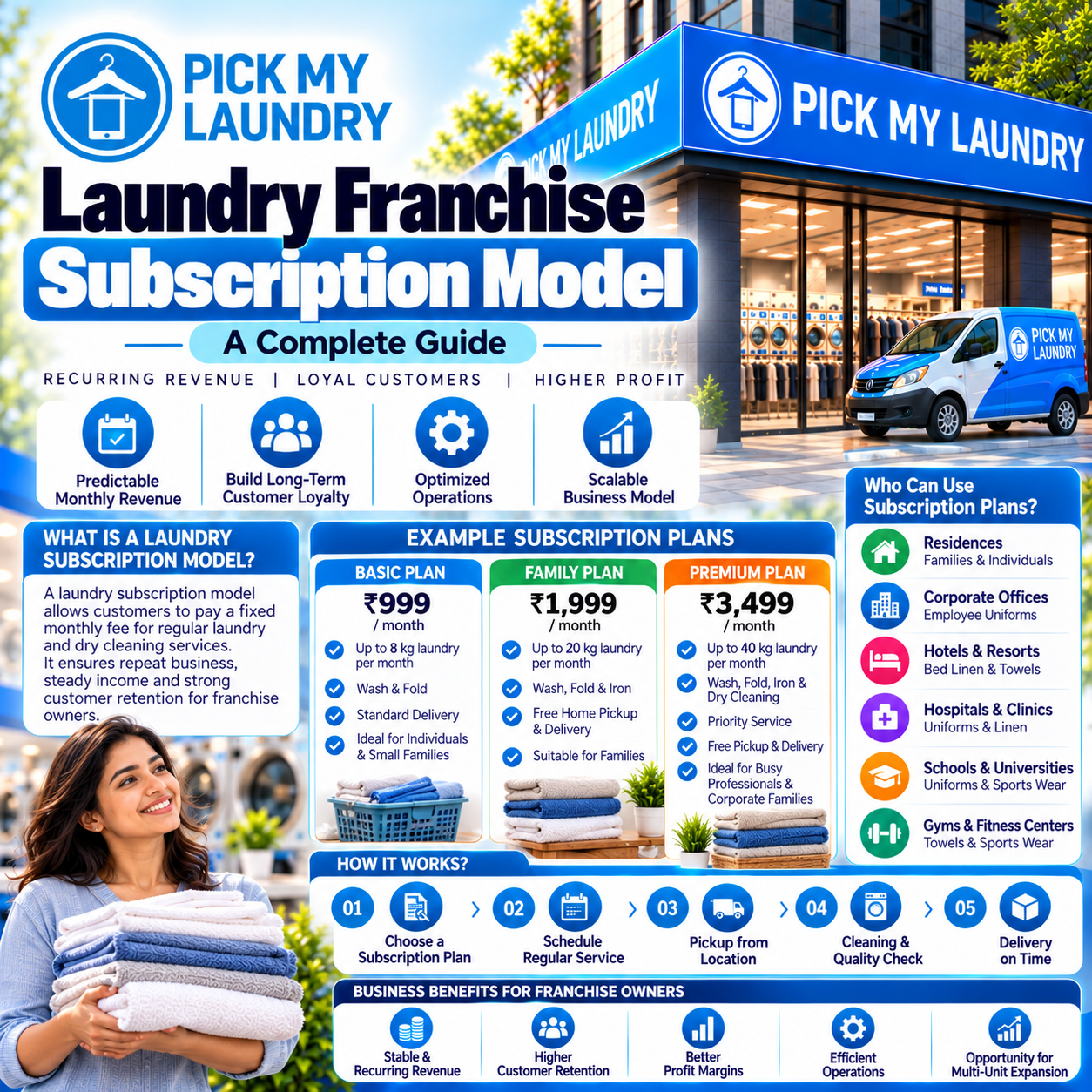
Laundry Franchise Subscription Model: Complete Guide
Introduction
The laundry and dry-cleaning industry depends on customers who need regular garment care. Working professionals, families, students, and businesses often require laundry services every week or month. For laundry franchise owners, this recurring demand creates an opportunity to build stronger customer relationships through subscription plans.
A laundry franchise subscription business model allows customers to pay for a defined package of services over a set period, such as a month or quarter. Depending on the business, packages may include a specified laundry weight, a certain number of garments, discounted dry cleaning, or convenient pickup and delivery options.
Instead of relying entirely on individual orders, a laundry store can use subscriptions to encourage repeat purchases and make customer demand easier to plan. However, a subscription plan must be designed carefully. If pricing is too low or customers use more services than expected, the business may experience lower margins instead of stronger profitability.
For aspiring franchise owners, understanding subscriptions can help when evaluating the operating model, marketing strategy, and long-term growth potential of a laundry business.
1. What Is a Laundry Subscription Business Model?
A laundry subscription model is a service arrangement in which customers pay in advance or at regular intervals for access to a defined set of laundry services.
For example, a store might offer a monthly plan that includes a fixed laundry allowance. Customers use the allowance throughout the month according to the package's terms.
Common subscription formats include:
-
Monthly laundry packages: Customers pay monthly for a defined quantity of laundry.
-
Family laundry plans: Packages designed for households with regular laundry requirements.
-
Professional garment-care plans: Plans combining laundry, ironing, and selected dry-cleaning services.
-
Pickup and delivery subscriptions: Packages that include scheduled collections or delivery benefits.
-
Business subscriptions: Recurring service arrangements for salons, gyms, clinics, hotels, or other suitable businesses.
The exact structure depends on local demand, service capacity, operating costs, and the laundry brand's policies.
A subscription should clearly explain what is included, what costs extra, when the package expires, and whether unused allowances can be carried forward.
2. Why Subscription Plans Can Benefit Laundry Franchise Owners
Subscriptions can support a laundry store's growth when they match customers' real needs and are priced according to service costs.
More predictable customer demand
Individual orders can fluctuate from week to week. Subscriptions may help a store estimate upcoming workloads because customers have already committed to a package.
This information can help with planning staff schedules, detergent purchases, machine capacity, and pickup routes.
However, subscription revenue should not automatically be treated as guaranteed profit. The business must still deliver the services customers have purchased.
Better customer retention
Customers who choose a suitable monthly package have a reason to continue using the same store. A convenient and reliable service experience can further encourage repeat business.
Retention depends on more than discounts. Garment quality, accurate order tracking, transparent pricing, timely delivery, and responsive complaint handling remain essential.
Opportunities to increase customer value
A customer who initially purchases only washing services may later need ironing, premium garment care, shoe cleaning, or dry cleaning.
A subscription can introduce customers to relevant services, provided upgrades are optional and pricing remains clear.
Easier demand planning
Recurring plans can give managers a better view of expected order volumes. This can support staffing decisions and help identify periods when the store has spare capacity.
The benefit is strongest when the business tracks actual subscription usage rather than relying only on the number of memberships sold.
3. Types of Laundry Subscription Plans
A successful subscription strategy does not require every customer to buy the same package. Different customer segments have different laundry needs and budgets.
|
Plan type |
Target customer |
Possible structure |
|---|---|---|
|
Individual plan |
Working professionals and students |
Fixed monthly laundry allowance |
|
Family plan |
Households with regular laundry needs |
Larger monthly allowance |
|
Wash-and-iron plan |
Customers seeking everyday convenience |
Defined washing and ironing services |
|
Premium garment-care plan |
Customers with garments requiring special care |
Selected dry-cleaning or premium services |
|
Pickup and delivery plan |
Busy customers |
Scheduled collections or delivery benefits |
|
Business plan |
Gyms, salons, clinics, and similar businesses |
Agreed recurring volume and service terms |
These are illustrative formats, not confirmed Pick My Laundry packages. Franchise owners should check the brand's approved services, pricing, and subscription policies before advertising a plan.
4. How to Price a Laundry Subscription Plan
Pricing is one of the most important decisions in a subscription business. A package must feel worthwhile to the customer while covering the cost of the services delivered.
Step 1: Calculate the cost of providing the service
Estimate the variable cost of fulfilling the package. Depending on the service, this may include:
-
Water, electricity, and detergents
-
Packaging and consumables
-
Labour directly associated with processing orders
-
Pickup and delivery expenses
-
Outsourced dry-cleaning or specialist treatment costs
-
Expected reprocessing and service-recovery costs
Also account for the store's fixed operating expenses when evaluating overall profitability.
Step 2: Estimate realistic customer usage
Do not assume that every subscriber will use exactly the same quantity of service. Review the likely usage pattern of each customer segment.
For example, a family plan may generate much higher usage than an individual plan. A package with unlimited services can be particularly difficult to price because customer usage varies widely.
Fixed allowances and clearly defined service limits can make costs easier to forecast.
Step 3: Set the price using a cost-based model
Consider this illustrative example.
Example: Monthly laundry subscription
Monthly subscription price
₹2,000
Estimated service delivery cost
₹1,100
Contribution before fixed overheads
₹900
Illustrative figures only. The ₹900 contribution is before rent, salaries not included in the service cost, marketing, software, taxes where applicable, and other overheads.
In this example, the contribution is ₹900, or 45% of subscription revenue, before the remaining overheads.
This is not the same as net profit. The store must account for all operating expenses before assessing the actual profitability of the plan.
Step 4: Test the price before scaling
Start with a limited pilot or a small group of customers. Measure actual usage, service costs, customer satisfaction, and renewal rates.
If customers consistently use more services than forecast, revise the package structure or pricing before expanding it.
5. How to Design Subscription Packages Customers Understand
A good subscription plan should be simple to explain and easy to use.
Define exactly what is included
Specify whether the package covers washing, ironing, dry cleaning, or other services. Avoid presenting all garments as interchangeable because different items may require different processing methods and costs.
Set transparent usage limits
If a package includes a weight allowance or a certain number of garments, explain how usage is measured. Clarify the cost of additional services and the treatment of unused allowances.
Make renewal terms clear
Tell customers when their plan begins and ends, how renewal works, and whether cancellation or refunds are permitted under the agreed terms.
Keep discounts sustainable
A subscription should not depend entirely on deep discounts. Convenience, reliable quality, clear service standards, and easy ordering can all contribute to customer value.
Avoid overcomplicated packages
Too many plans can confuse customers and make billing difficult. Begin with a small number of packages based on genuine customer segments, then improve them using performance data.
6. How to Market Laundry Subscription Plans
Subscription marketing should focus on the customer's recurring problem rather than simply promoting a low price.
Promote convenience
Explain how a package may help customers manage regular laundry without placing a separate order each time, where the service arrangement supports that benefit.
Use local digital marketing
A laundry franchise can promote its approved subscription offerings through its website, Google Business Profile, social media, customer messages, and local campaigns.
The offer should include clear eligibility, price, inclusions, exclusions, and contact details.
Introduce subscriptions to existing customers
Customers who order regularly may be suitable candidates for a monthly package. Staff can explain the plan and help customers compare the cost with their usual spending.
Avoid pressuring customers to subscribe if their usage is irregular or a package would not suit them.
Build referral opportunities
Satisfied subscribers may recommend the store to family, friends, or colleagues. If referral benefits are offered, define the conditions and confirm that the promotion is permitted under the brand's policies.
Track marketing performance
Measure how many enquiries become paying subscribers, the cost of acquiring each subscriber, and how many subscribers renew.
A campaign that generates many sign-ups may still perform poorly if customers cancel quickly or the service costs exceed the revenue generated.
7. Key Metrics to Track in a Subscription Laundry Business
Monitor subscription performance alongside normal store operations.
|
Metric |
What it tells you |
|---|---|
|
Active subscribers |
Number of customers with valid subscriptions |
|
Monthly recurring revenue |
Subscription revenue expected for the month under the chosen accounting definition |
|
Renewal rate |
Percentage of eligible customers who renew |
|
Cancellation rate |
Percentage of subscribers who cancel during a period |
|
Average revenue per subscriber |
Average subscription revenue per customer |
|
Cost per subscriber |
Cost of acquiring a paying subscriber |
|
Service cost per subscriber |
Actual cost of fulfilling subscription orders |
|
Package utilisation |
How much of the included allowance customers use |
|
Customer complaints |
Common issues with quality, billing, or delivery |
|
Contribution per plan |
Subscription revenue minus the costs directly associated with fulfilling it |
Review these metrics monthly and compare them by package type. A popular package is not necessarily the most profitable one.
8. Common Subscription Model Mistakes to Avoid
Laundry franchise owners should watch for several common problems.
-
Underpricing packages: Discounts may attract sign-ups but leave too little revenue to cover fulfilment costs.
-
Offering unlimited services without analysis: Heavy users can create substantial processing and delivery expenses.
-
Ignoring delivery economics: Frequent collections can erode margins if route density and delivery costs are not considered.
-
Failing to define exclusions: Customers may expect specialist treatments or delicate-garment services that were not included.
-
Not monitoring usage: Without usage data, the store may not notice that a package is consistently underpriced.
-
Making cancellation difficult: Unclear or restrictive terms can damage customer trust.
-
Promising guaranteed savings or results: Claims should be based on transparent comparisons and actual package conditions.
The best subscription structure is one that creates value for customers while allowing the store to deliver reliable service sustainably.
9. Is a Subscription Model Suitable for Every Laundry Franchise?
Not necessarily. Subscriptions are most suitable when customers have recurring needs, the store can deliver services consistently, and package costs can be estimated with reasonable accuracy.
A subscription model may be harder to manage when demand is highly irregular, processing capacity is limited, delivery costs are high, or the service mix varies significantly between customers.
Before introducing subscriptions, a franchise owner should assess:
-
How frequently local customers use laundry services.
-
Which customer groups have predictable monthly needs.
-
Whether the store has enough processing and delivery capacity.
-
The cost of fulfilling each proposed package.
-
The technology and staff processes required to track usage.
-
The brand's approved pricing, service terms, and marketing guidelines.
For a franchise business, the plan should also fit the franchisor's operating model. Owners should confirm whether subscriptions can be created locally or must follow centrally approved packages.
10. How Pick My Laundry Fits into a Long-Term Growth Strategy
Pick My Laundry has 12+ years of industry experience, 500+ stores, presence in 90+ cities, and operations across 4 countries. These brand milestones can help prospective franchise partners understand the company's footprint, but they do not guarantee the performance of any individual store.
When evaluating a laundry franchise opportunity, prospective owners should examine the complete business model: investment requirements, operating costs, training, service standards, technology, marketing support, and local market demand.
A subscription strategy may be one way to encourage repeat customers, but its suitability depends on the approved franchise offering and the economics of the specific location.
Explore the franchise opportunity and available information on the official website: Pick My Laundry.
Frequently Asked Questions
1. What is a laundry franchise subscription business model?
It is a model in which customers pay for a defined package of laundry services over a set period, such as a month. The package may include a service allowance, selected garment-care services, or pickup and delivery benefits.
2. Do laundry subscriptions guarantee recurring revenue?
No. Subscriptions can make revenue more predictable while customers remain enrolled, but renewals, cancellations, refunds, service usage, and operating costs affect actual performance.
3. How should a laundry business price a monthly package?
Calculate the expected cost of fulfilling the package, estimate customer usage, account for overheads, and test the proposed price. The price must be competitive while supporting sustainable operations.
4. Are unlimited laundry subscriptions a good idea?
They can be difficult to manage because customers have different usage patterns. Before offering an unlimited plan, the business should model heavy usage, delivery costs, machine capacity, and service exclusions.
5. Which customers are most suitable for laundry subscriptions?
Potential segments include working professionals, families, students, and businesses with recurring laundry needs. The best target market depends on local demand and the services the store can provide.
6. What metrics should a laundry franchise track for subscriptions?
Important metrics include active subscribers, recurring revenue, renewal and cancellation rates, acquisition cost, package utilisation, fulfilment cost, contribution per plan, and customer complaints.
7. Can a Pick My Laundry franchise introduce its own subscription packages?
Prospective and existing franchise partners should confirm the current brand policies and approved service offerings with Pick My Laundry before launching or advertising a package.
Conclusion
A well-designed subscription model can help a laundry franchise build repeat business, understand customer demand, and plan operations more effectively. Its success depends on transparent package terms, accurate service costing, reliable garment care, and regular performance reviews.
Rather than launching a large number of plans immediately, start by understanding customer needs, testing a simple package, and measuring its actual contribution. Expand only when the service experience and economics support growth.
For more information about the franchise opportunity, visit pickmylaundry.in.
Internal Linking Suggestions
Link this blog to relevant existing articles on your website:
-
Laundry Franchise Unit Economics: Revenue, Costs, Margins & ROI Explained —
/laundry-franchise-unit-economics-revenue-cost-margin-roi -
Laundry Franchise Customer Lifetime Value: Why Repeat Customers Matter — use the published URL for Blog #20.
-
Laundry Franchise Customer Acquisition Cost: How to Measure Marketing ROI — use the published URL for Blog #19.
-
Laundry Franchise Pricing Strategy: How to Set Prices for Your Market — use the published URL for Blog #18.
-
How to Attract Local Customers to a New Laundry Franchise —
/how-to-attract-local-customers-laundry-franchise
Use descriptive anchor text naturally within the article and confirm that each destination URL is live before publishing.