
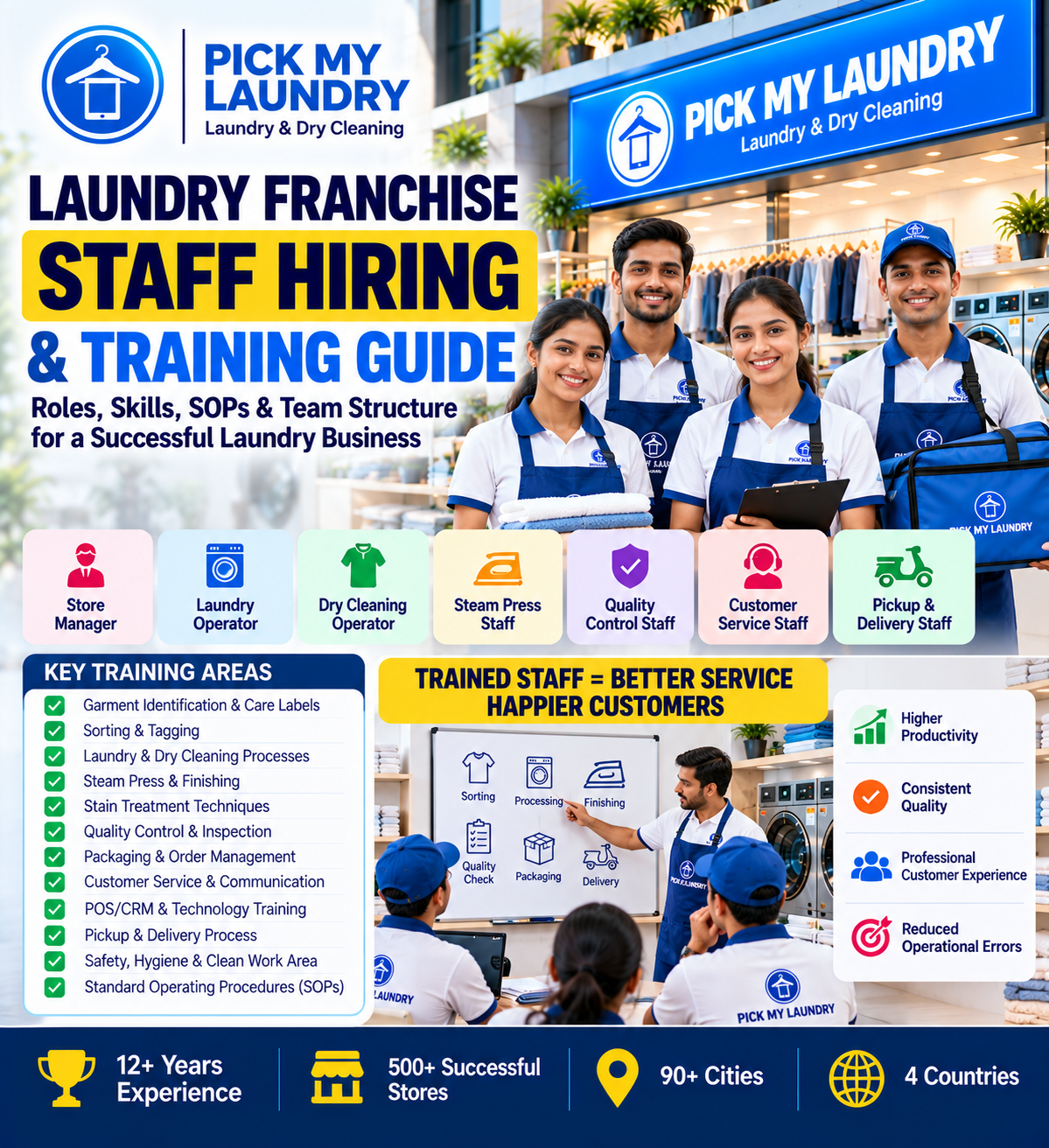
Laundry Franchise Staff Hiring & Training Guide: Roles, Skills & SOPs
Introduction
A laundry franchise depends on more than machines, technology and a good location. People are responsible for receiving garments, identifying customer requirements, processing clothes correctly, maintaining quality, packaging orders and delivering them on time.
For this reason, staffing should be planned before a new laundry outlet opens.
Pick My Laundry's current franchise material identifies several potential roles, including laundry operators, dry-cleaning operators, steam-press staff, quality-control personnel, customer-service staff, pickup and delivery personnel and store managers.
The exact number of employees depends on the outlet's size, service mix, order volume and operating model.
Why Staff Management Matters in a Laundry Business
Laundry is a process-driven service.
A single order can pass through several stages:
Customer Order → Garment Receiving → Tagging → Sorting → Processing → Quality Check → Finishing → Packaging → Delivery
A mistake at any stage can affect the customer experience.
Common operational problems can include:
- Incorrect garment tagging
- Wrong processing method
- Missed stains
- Poor ironing
- Delayed orders
- Incorrect packaging
- Wrong delivery
- Poor customer communication
A trained team can help create consistency across these stages.
What Staff Does a Laundry Franchise Need?
The exact structure depends on the business model, but a typical outlet may require several of the following roles.
1. Store Manager
The store manager can oversee:
- Daily operations
- Staff scheduling
- Customer service
- Order status
- Quality control
- Inventory
- Revenue reporting
- Customer complaints
The manager acts as the operational link between the customer, staff and business owner.
2. Laundry Operator
The laundry operator handles processing activities according to the applicable garment-care procedures.
Responsibilities may include:
- Sorting garments
- Checking labels
- Selecting appropriate processes
- Operating equipment
- Monitoring wash cycles
- Maintaining cleanliness
- Following safety procedures
Training should focus on correct garment handling rather than simply operating machinery.
3. Dry-Cleaning Operator
Dry cleaning requires specific knowledge and procedures.
Training may cover:
- Garment identification
- Care-label interpretation
- Pre-inspection
- Stain identification
- Appropriate processing
- Finishing
- Quality inspection
Staff should follow the company's prescribed operating procedures and equipment guidelines.
4. Steam-Press Staff
Steam pressing requires attention to:
- Fabric type
- Temperature
- Steam
- Garment structure
- Finishing quality
Staff should be trained to avoid excessive heat, pressure or unsuitable handling.
5. Quality-Control Staff
Quality control is one of the most important stages.
The QC process can check:
☑ Garment identity
☑ Cleaning quality
☑ Stain treatment
☑ Ironing/finishing
☑ Packaging
☑ Order completeness
☑ Visible damage
☑ Special customer instructions
A final inspection before delivery can help identify problems before the customer receives the order.
6. Customer-Service Staff
Customer-service employees may handle:
- New orders
- Customer questions
- Pricing information
- Delivery updates
- Complaints
- Special instructions
- Follow-ups
Good communication is particularly important when customers have specific garment-care requirements.
7. Pickup & Delivery Staff
For doorstep laundry businesses, delivery personnel can become an important part of the customer experience.
Responsibilities may include:
- Pickup scheduling
- Garment collection
- Order verification
- Safe transportation
- Delivery
- Payment collection where applicable
- Customer communication
Route planning can also help control delivery time and operating costs.
8. Store Manager + Multi-Skilled Team
Smaller outlets may use a multi-skilled staffing model.
For example, one trained employee may handle:
Customer Reception + Order Tagging + Packaging
while another handles:
Processing + Finishing + Quality Check
The exact staffing structure should match expected order volume.
How Many Employees Does a Laundry Franchise Need?
There is no universal number.
Staff requirements can depend on:
- Store size
- Daily order volume
- Service portfolio
- Processing capacity
- Pickup & delivery area
- Business hours
- B2B orders
- Automation
- Centralized vs in-store processing
A new outlet should avoid hiring solely based on an industry-wide employee number.
Instead calculate:
Expected Orders → Processing Workload → Working Hours → Required Staff
How to Hire Laundry Franchise Staff
Step 1: Define the Job Role
Don't advertise a generic "laundry worker" position.
Specify:
- Job title
- Responsibilities
- Working hours
- Required skills
- Experience
- Salary structure
- Training requirements
Step 2: Look for Relevant Skills
Useful qualities include:
- Attention to detail
- Reliability
- Time management
- Cleanliness
- Customer service
- Ability to follow SOPs
- Willingness to learn
- Teamwork
Technical laundry experience can be useful, but training can also be provided for suitable employees depending on the role.
Step 3: Conduct a Practical Interview
Instead of relying only on questions, test practical thinking.
Ask:
"What would you do if a customer gives you an expensive garment with a difficult stain?"
A good operational answer should involve:
Inspection → Garment Label → Identification → Appropriate Process → Escalation if Required
The employee should understand that not every garment should be processed in the same way.
Step 4: Verify Basic Information
Depending on company policy and applicable requirements, maintain appropriate employee records such as:
- Identity details
- Address
- Contact information
- Emergency contact
- Employment records
- Training records
Laundry Franchise Staff Training Program
Training should not end after the first day.
A structured program can be divided into different modules.
Module 1 — Laundry Fundamentals
Employees learn:
- Fabric basics
- Garment categories
- Care labels
- Sorting
- Basic stain identification
Module 2 — Garment Receiving
Employees learn:
- Receive garment
- Inspect garment
- Record order
- Tag garment
- Record special instructions
- Store safely
This stage helps reduce identification mistakes.
Module 3 — Processing
Employees should learn the approved procedures for:
- Laundry
- Dry cleaning
- Steam pressing
- Stain treatment
- Special garments
The exact procedure should follow the company's SOP and equipment requirements.
Module 4 — Quality Control
Before packaging, staff should inspect:
Garment
- Is it clean?
- Is it properly finished?
- Are stains addressed according to the agreed process?
Order
- Is every item present?
- Does the order match the customer record?
Packaging
- Is the garment appropriately packed?
- Is the customer/order identification correct?
Module 5 — Customer Service
Employees should know how to handle:
- New customers
- Repeat customers
- Delayed orders
- Special instructions
- Complaints
- Refund/claim escalation
Staff should avoid making unsupported promises about difficult stains, damage or delivery times.
Module 6 — Technology Training
Modern laundry operations can use technology for:
- Order management
- CRM
- Digital payments
- Customer records
- Pickup scheduling
- Delivery tracking
- Reporting
Pick My Laundry's published franchise material describes technology support including CRM, mobile applications, order management and digital systems.
Employees should be trained to use the actual technology deployed at their outlet.
Create an SOP for Every Major Process
An SOP means Standard Operating Procedure.
For a laundry franchise, SOPs can cover:
Garment Receiving SOP
Receive → Inspect → Tag → Record → Sort → Store
Processing SOP
Identify → Sort → Process → Finish → Inspect
Packaging SOP
QC → Fold/Hang → Pack → Label → Store
Delivery SOP
Verify → Route → Deliver → Confirm
Written SOPs make training easier and reduce dependence on individual employee memory.
Employee Training Checklist
A new employee can be evaluated against:
☐ Garment identification
☐ Care-label understanding
☐ Sorting
☐ Order tagging
☐ Processing procedure
☐ Equipment safety
☐ Stain handling
☐ Steam pressing
☐ Quality inspection
☐ Packaging
☐ Customer service
☐ Software/POS
☐ Pickup & delivery
☐ Complaint handling
How to Measure Staff Performance
Don't measure employees only by the number of garments processed.
Track multiple metrics.
| KPI | What It Measures |
|---|---|
| Orders Processed | Productivity |
| Processing Errors | Accuracy |
| Rework | Quality |
| Customer Complaints | Customer experience |
| Delayed Orders | Timeliness |
| Missing/Damaged Items | Process control |
| Delivery Success | Logistics |
| Attendance | Reliability |
A balanced KPI system can provide a better picture of staff performance.
How to Reduce Staff Errors
1. Use Garment Tagging
Every order should have clear identification.
2. Follow Checklists
Checklists reduce dependence on memory.
3. Use Multiple Quality Checks
Important garments can receive additional inspection.
4. Maintain Clear Work Areas
Separate:
New Orders → Processing → QC → Ready → Delivery
5. Record Customer Instructions
Special requirements should be documented rather than communicated only verbally.
Staff Training for New Franchise Owners
A franchise owner may not personally know professional laundry processing.
Pick My Laundry's current franchise material states that training and operational guidance are provided to franchise partners, including staff training.
Before launching, prospective franchise partners should confirm:
- Owner training
- Staff training
- Training duration
- Practical training
- SOP documentation
- Refresher training
- Post-launch support
Staff Cost Planning
Employee expenses should be included in the financial model from the beginning.
Calculate:
Number of Employees × Monthly Salary
Then add applicable costs such as:
- Recruitment
- Training
- Uniforms
- Employee benefits where applicable
- Overtime
- Transportation, if provided
Staff cost should be evaluated against expected order volume and revenue.
Common Staff Management Mistakes
Hiring Without Training
Laundry involves garment-specific processes, so employees should understand the operating procedures.
No Quality-Control Stage
Sending garments directly from processing to delivery increases the chance that mistakes reach customers.
Poor Order Identification
Incorrect tagging can create serious operational problems.
No Backup Staff
Unexpected absence can disrupt operations.
Ignoring Customer Service
Even technically correct processing can result in a poor experience if communication is weak.
30-Day Staff Preparation Plan
Week 1
Recruitment + Basic Orientation
Week 2
Garment Handling + Processing Training
Week 3
Technology + Customer Service + QC
Week 4
Live Practice + SOP Testing + Final Assessment
The exact training timeline can vary according to the outlet's business model and training program.
Frequently Asked Questions
Do I need experienced laundry workers?
Not necessarily. The required experience depends on the role, while suitable employees can be trained according to the outlet's processes.
How many employees are needed?
There is no fixed number. It depends on store size, order volume, services, operating hours and pickup/delivery requirements.
Does Pick My Laundry provide staff training?
Published franchise information lists staff training and operational training as part of its franchise support.
What should laundry staff learn first?
Start with garment identification, care labels, order tagging, sorting, safe handling and the outlet's SOPs.
Is quality control necessary?
Yes. A final inspection can help identify processing, packaging and order-matching issues before delivery.
Can one employee perform multiple roles?
In smaller operations, employees may be cross-trained for multiple responsibilities, depending on workload and operational requirements.
Conclusion
A laundry franchise is a people-driven operation as much as it is a technology- and equipment-driven business.
A properly structured team should understand:
Garment Handling → Processing → Quality Control → Packaging → Customer Service → Delivery
Pick My Laundry's published franchise material describes staff training, operational guidance and technology support as part of its franchise support system.
Before launching a store, prepare a clear staffing plan, training program, SOP system and performance dashboard. This can help create consistent processes as the outlet grows.
CTA
Planning to start a Pick My Laundry franchise?
Explore the franchise model, training support and operational requirements for your city.
Pick My Laundry — Laundry & Dry Cleaning Franchise
Official Pick My Laundry Website