
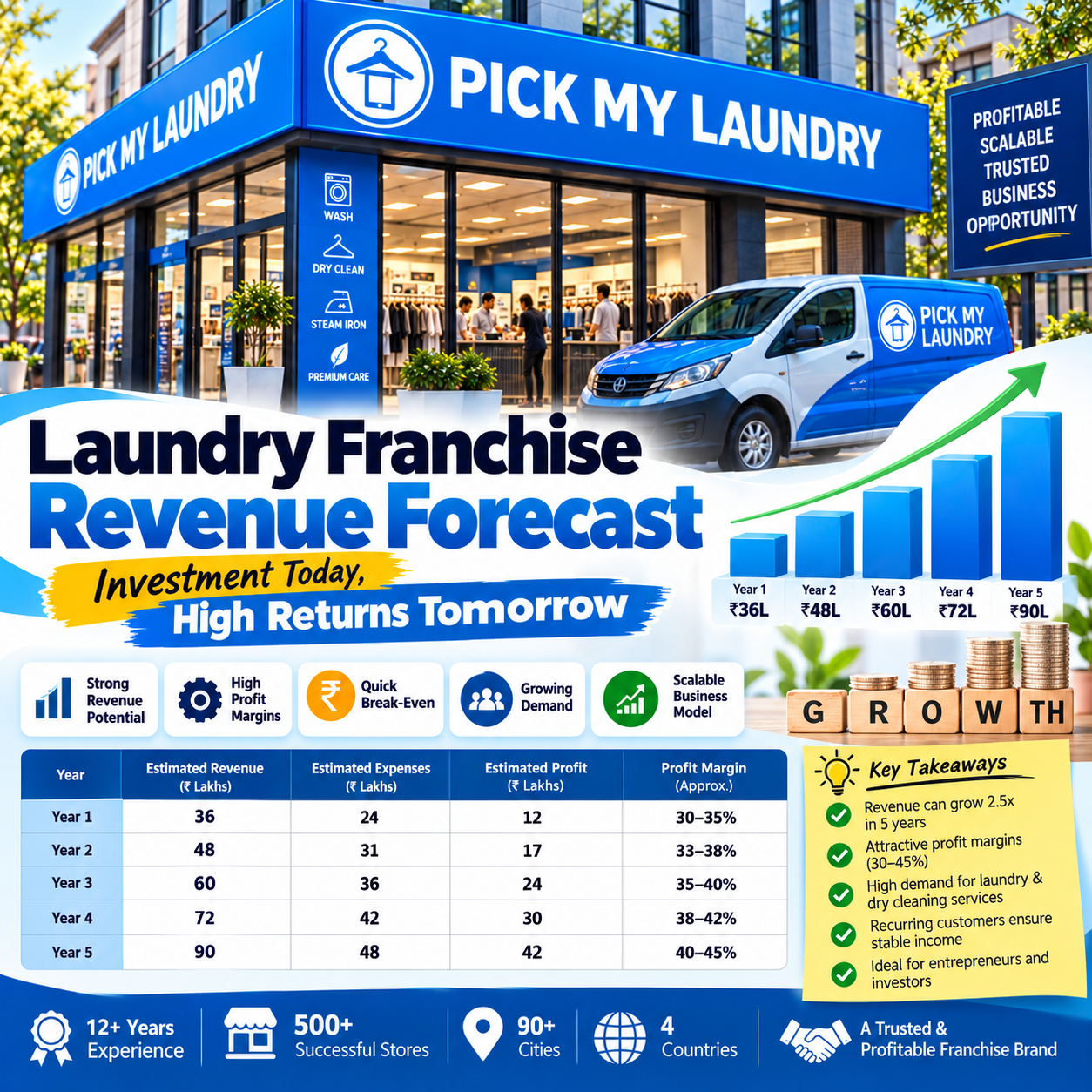
laundry franchise revenue forecast
Introduction
Starting a laundry franchise requires more than selecting a brand and arranging the initial investment. Entrepreneurs also need a financial plan that explains how the business may perform during its first three years.
A laundry franchise revenue forecast helps prospective investors estimate sales, understand operating expenses, plan working capital and evaluate different business scenarios before opening a store.
However, revenue forecasting is not about predicting guaranteed profits. Actual performance depends on factors such as location, local demand, service pricing, customer retention, operating costs, competition and execution.
In this guide, we explain how to create a practical three-year business plan for a laundry and dry-cleaning franchise in India.
What Is a Laundry Franchise Revenue Forecast?
A revenue forecast is an estimate of the sales a business may generate over a specific period.
For a laundry franchise, the forecast typically includes:
-
Monthly customer orders
-
Average order value
-
Revenue from different services
-
Expected customer growth
-
Seasonal demand
-
Repeat purchases
-
Corporate or bulk orders, where applicable
A complete financial plan goes further by estimating expenses, operating profit, cash flow, working capital and potential break-even timing.
The objective is to understand whether the proposed business model appears financially feasible under clearly stated assumptions.
Why Do You Need a Three-Year Business Plan?
A three-year plan helps investors think beyond the store-opening stage.
Year 1: Establish the business. Focus on launching the outlet, acquiring customers, building awareness and improving operational consistency.
Year 2: Improve performance. Evaluate repeat purchases, service mix, pricing, staff productivity and local marketing effectiveness.
Year 3: Plan sustainable growth. Review profitability, cash reserves, operational capacity and whether expansion is financially sensible.
These are planning stages, not guaranteed timelines. Some outlets may grow faster, while others may need more time to establish a stable customer base.
Step 1: Estimate Your Initial Investment
Before forecasting revenue, identify the complete investment required to open and operate the franchise.
Potential costs include:
|
Investment category |
What to include |
|---|---|
|
Franchise fee |
Initial brand or franchise fee |
|
Store setup |
Interiors, signage and furniture |
|
Equipment |
Machinery, tools and related installation |
|
Technology |
Billing, order management and software |
|
Deposits |
Rental and utility deposits |
|
Launch marketing |
Opening promotions and local advertising |
|
Training |
Applicable training and onboarding expenses |
|
Working capital |
Cash reserved for early operating expenses |
Separate one-time expenses from recurring expenses. Also confirm which items are included in the franchise package and which must be paid separately.
Important: Do not treat the entire initial investment as a monthly operating expense. Setup costs, depreciation, loan repayments and cash outflows should be handled appropriately in the financial model.
Step 2: Calculate Monthly Revenue
A simple starting formula is:
Monthly Revenue = Monthly Orders × Average Order Value
For example, assume a hypothetical outlet processes 600 orders in one month, with an average order value of ₹400.
Monthly revenue would be:
600 × ₹400 = ₹2,40,000
Illustrative monthly sales calculator
Orders per month
600
Average order value
₹400
Estimated monthly revenue
₹2,40,000
Annualized revenue at the same monthly sales level: ₹28,80,000
This is a simple sales calculator, not a prediction of what a new franchise will earn. Actual order volumes and average order values must be estimated using local market research and realistic operating assumptions.
Step 3: Forecast Revenue by Service Category
Laundry businesses may earn revenue from several service categories, depending on the franchise model.
Examples include:
-
Regular laundry
-
Dry cleaning
-
Steam ironing
-
Shoe cleaning
-
Bag care
-
Blanket and curtain cleaning
-
Carpet cleaning
-
Corporate or bulk laundry
Create a separate estimate for each category.
|
Service category |
Forecast inputs |
|---|---|
|
Regular laundry |
Orders × average price |
|
Dry cleaning |
Garments × average service price |
|
Premium garment care |
Orders × average price |
|
Specialty cleaning |
Jobs × average price |
|
Corporate contracts |
Contract volume × agreed pricing |
Avoid counting the same order twice. If one customer order contains multiple services, the model should record the revenue correctly at the service or order level.
Step 4: Estimate Operating Expenses
Revenue alone cannot tell you whether the business is profitable.
Your monthly expense forecast should include the costs relevant to your operating model.
Fixed or semi-fixed costs
-
Store rent
-
Salaries
-
Software fees
-
Internet and communication
-
Maintenance contracts
-
Accounting and administration
Variable costs
-
Garment processing
-
Packaging
-
Consumables
-
Pickup and delivery
-
Payment processing
-
Order-related labor
-
Customer acquisition costs
Other financial costs
-
Franchise royalties
-
Marketing contributions
-
Equipment depreciation
-
Interest on business loans
-
Applicable taxes
Not every cost applies to every franchise model. For example, a retail outlet that sends garments to a central processing facility may have a different expense structure from an outlet that processes garments on-site.
Ask the franchisor for a written explanation of the applicable costs.
Step 5: Build Three Financial Scenarios
A useful business plan should not depend on just one optimistic sales estimate.
Build three scenarios:
Conservative scenario
Assume customer acquisition takes longer, order volumes remain modest and operating expenses are higher than expected.
Base scenario
Use your best evidence-based estimates for orders, pricing, repeat customers and expenses.
Upside scenario
Estimate the impact of stronger demand, improved retention or additional corporate business without assuming that growth is guaranteed.
Use the conservative scenario to assess whether you have sufficient cash reserves if sales grow more slowly than planned.
Step 6: Prepare a Three-Year Revenue Forecast
The following example demonstrates how to structure a forecast. All figures are hypothetical and are not actual Pick My Laundry outlet performance data.
Assume the business gradually increases its monthly sales as it develops a customer base.
|
Financial measure |
Year 1 |
Year 2 |
Year 3 |
|---|---|---|---|
|
Average monthly revenue |
₹2.0 lakh |
₹2.8 lakh |
₹3.5 lakh |
|
Annual revenue |
₹24 lakh |
₹33.6 lakh |
₹42 lakh |
|
Annual revenue growth |
— |
40% |
25% |
Illustrative Three-Year Revenue Forecast
Hypothetical annual revenue figures, not actual franchise results.
₹0 lakh₹15 lakh₹30 lakh₹45 lakhYear 1Year 2Year 3
This example assumes higher average monthly sales in each successive year. It does not establish that a particular outlet will achieve these figures.
A real forecast should use a month-by-month ramp-up rather than assuming that the store generates the full year's average sales from its opening month.
Step 7: Calculate Operating Profit
Once you estimate revenue and expenses, calculate the expected operating result.
A simplified formula is:
Operating Profit = Revenue − Operating Expenses
For example, if monthly revenue is ₹3,00,000 and monthly operating expenses are ₹2,40,000:
-
Monthly revenue: ₹3,00,000
-
Monthly operating expenses: ₹2,40,000
-
Simplified operating surplus: ₹60,000
This ₹60,000 figure is not automatically the owner's take-home income or final net profit. Depending on the model, additional adjustments may be needed for depreciation, interest, taxes and other excluded costs.
Be consistent about what your forecast includes.
Step 8: Estimate Break-Even
Break-even analysis helps you understand the sales level required to cover costs.
When expenses are separated into fixed costs and variable costs, a common formula is:
\[ \text{Break-even revenue} = \frac{\text{Fixed costs}}{\text{Contribution margin ratio}} \]
The contribution margin ratio is the share of revenue remaining after variable costs.
For example, if monthly fixed costs are ₹1,20,000 and the contribution margin ratio is 40%:
\[ ₹1,20,000 \div 0.40 = ₹3,00,000 \]
The estimated break-even revenue would be ₹3,00,000 per month under these assumptions.
This calculation should use the actual cost structure of the proposed franchise. If there are multiple services with different margins, a weighted contribution margin may be more appropriate.
Also distinguish between operating break-even and recovering the original investment. They are different milestones.
Step 9: Plan Working Capital and Cash Flow
A business can report a profit on paper and still face cash-flow pressure.
For this reason, your three-year plan should track:
-
Opening cash balance
-
Customer receipts
-
Supplier payments
-
Salaries
-
Rent
-
Marketing expenses
-
Loan repayments
-
Equipment purchases
-
Tax payments
-
Closing cash balance
Allow for slower-than-expected sales, delayed corporate payments, equipment repairs and seasonal changes in demand.
Your working capital reserve should be based on a cash-flow forecast rather than an arbitrary amount.
Step 10: Review Performance Every Month
A three-year business plan should not remain unchanged after the store opens.
Compare actual performance with the forecast every month.
Track metrics such as:
-
Total orders
-
Average order value
-
Revenue by service
-
Repeat-customer rate
-
Customer acquisition cost
-
Gross margin
-
Operating expenses
-
Complaint rate
-
On-time delivery
-
Cash balance
-
Outstanding payments
When performance differs from the forecast, identify the cause and revise your assumptions.
For example, lower revenue might result from fewer orders, a lower average order value or weaker repeat purchases. Each problem requires a different response.
Common Mistakes in Laundry Franchise Forecasting
Avoid these mistakes when preparing your business plan:
-
Using only optimistic sales estimates. Prepare conservative, base and upside scenarios.
-
Ignoring recurring expenses. Include all applicable fees and operating costs.
-
Confusing revenue with profit. Sales are not the same as earnings.
-
Assuming immediate customer growth. Include a realistic launch and ramp-up period.
-
Underestimating working capital. Plan for cash needs during slower months.
-
Treating projections as guarantees. Verify the assumptions behind any financial claims.
-
Ignoring owner involvement. Consider whether the business requires a full-time manager or active owner participation.
-
Expanding too early. Evaluate the first outlet's cash flow and operational stability before committing to another location.
Why Consider Pick My Laundry?
Pick My Laundry operates in the laundry and dry-cleaning franchise sector.
12+ Years of Industry Experience | 500+ Stores | 90+ Cities | Operations Across 4 Countries
Prospective investors can use the franchise evaluation process to understand the proposed business model, applicable investment requirements, operational support and financial assumptions.
Before making a commitment, request the relevant commercial details and prepare your own location-specific forecast. Actual business performance will depend on the terms of the proposed model and how the outlet performs in its market.
Frequently Asked Questions
1. What is a laundry franchise revenue forecast?
It is an estimate of future sales for a laundry franchise, usually combined with expense, profit, cash-flow and break-even projections.
2. How many years should a laundry business plan cover?
A three-year plan is a useful starting point for evaluating the launch period and medium-term growth. A more detailed monthly forecast is especially useful during the first year.
3. How do I estimate laundry franchise revenue?
Estimate monthly order volume and average order value, then calculate revenue across the relevant service categories. Use local demand research and realistic assumptions.
4. Does higher revenue always mean higher profit?
No. Higher sales may also require higher processing, staffing, delivery, marketing and other expenses. Profit depends on both revenue and cost management.
5. How can I calculate break-even for a laundry franchise?
Estimate fixed costs and the contribution margin ratio, then divide fixed costs by the contribution margin ratio. Use assumptions that reflect the actual operating model.
6. Should I include franchise royalties in my forecast?
Yes, if royalties apply to the proposed franchise model. Include all applicable recurring franchise and marketing fees.
7. Can I use the same revenue forecast for every city?
No. Demand, rent, pricing, competition, labor and delivery costs can vary by location. Prepare a forecast for the specific market and proposed outlet.
8. Is the revenue forecast a guarantee of profit?
No. A forecast is a planning tool based on assumptions. Actual results can differ significantly from projections.
Conclusion
A realistic three-year laundry franchise business plan connects revenue estimates with operating expenses, working capital, cash flow and break-even analysis.
Before investing, build conservative, base and upside scenarios, verify the assumptions, and understand the complete franchise agreement and cost structure.
The goal is not to predict the future perfectly. It is to make an informed investment decision and prepare for different business outcomes.
For entrepreneurs exploring a laundry franchise with Pick My Laundry, start by understanding the proposed model, reviewing the applicable costs and building a financial forecast suited to your intended location.
Internal linking suggestions for publishing:
Note: These links point to the blog listing page as a starting point. Replace them with the exact published article URLs when adding internal links.