
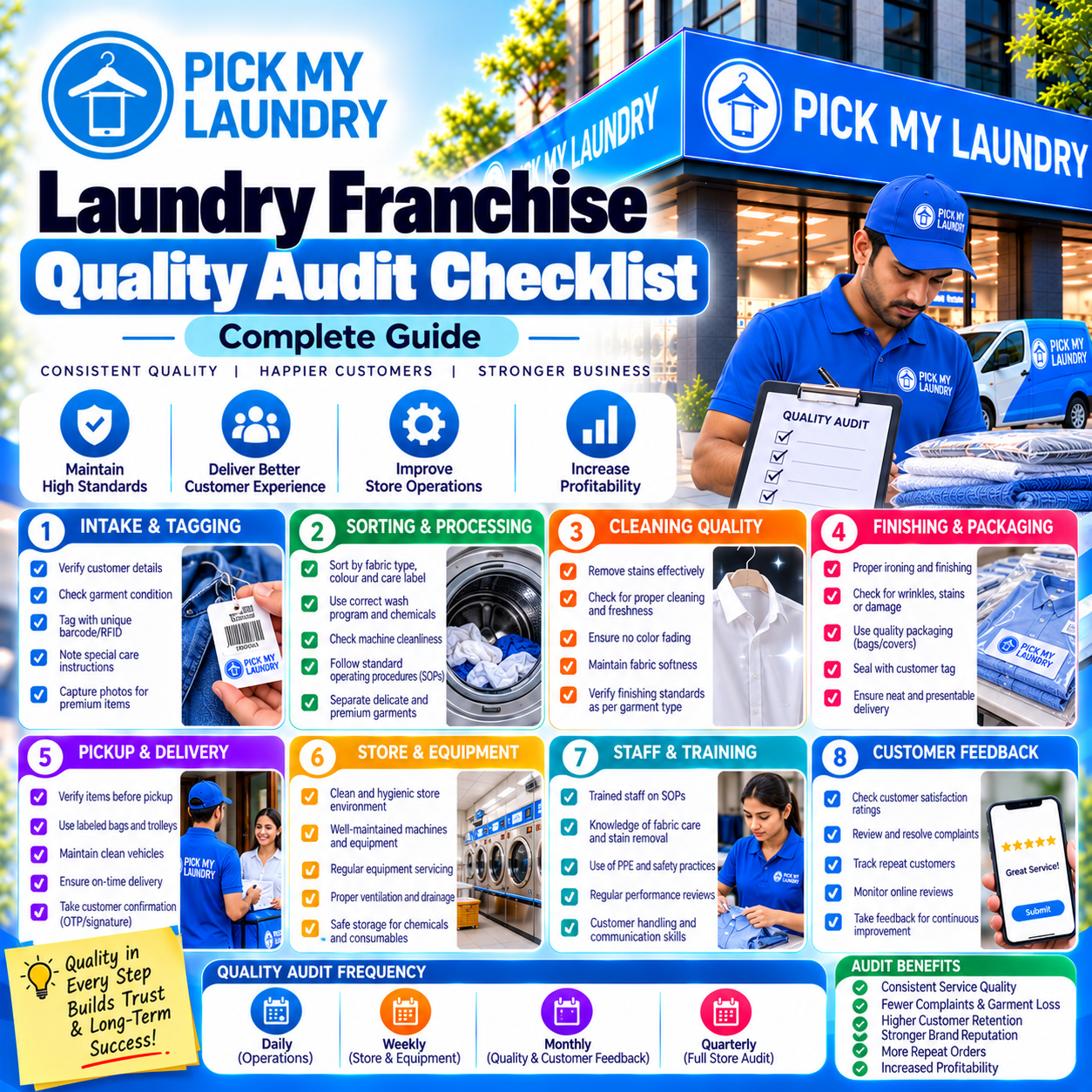
Laundry Franchise Quality Audit Checklist: Complete Guide
Introduction
Quality is one of the most important factors in building a reliable laundry and dry cleaning business. Customers expect their garments to be handled carefully, cleaned according to the requested service, returned on time, and delivered in good condition.
For a laundry franchise owner, maintaining these standards consistently can become more challenging as order volume increases, employees change, and additional services are introduced.
A structured laundry franchise quality audit checklist helps owners review everyday operations, identify service gaps, and correct problems before they become recurring issues.
A quality audit is not simply an inspection of finished garments. It should examine the complete customer journey, including garment receiving, identification, processing, finishing, packaging, delivery, staff training, and complaint resolution.
For Pick My Laundry franchise partners, quality checks should follow the applicable brand procedures, service model, and operating requirements.
Pick My Laundry brings 12+ years of industry experience, 500+ stores, a presence in 90+ cities, and operations across 4 countries.
What Is a Laundry Franchise Quality Audit?
A quality audit is a systematic review of business processes to determine whether the store follows its required service and operational standards.
It helps answer important questions:
-
Are garments being identified and tracked correctly?
-
Are staff following the required processing procedures?
-
Are quality checks completed before order handover?
-
Are promised turnaround times being met?
-
Are customer complaints recorded and resolved?
-
Are equipment and work areas maintained properly?
-
Are staff trained to handle different garment requirements?
The audit should focus on evidence rather than assumptions. For example, instead of asking staff whether garments are checked before delivery, review completed order records and observe the actual inspection process.
A consistent audit process makes it easier to compare performance across weeks or months and verify whether corrective actions are working.
Why Quality Audits Matter for Laundry Franchise Owners
1. Protect Garment Safety
Garments differ in fabric, colour, construction, care instructions, and condition. A consistent inspection process helps employees identify items that need special attention.
Documenting existing damage and care requirements can also reduce misunderstandings between customers and the store.
2. Reduce Order Errors
Missing items, incorrect garment counts, mixed orders, and wrong service instructions can create customer dissatisfaction.
Auditing garment identification, storage, and handover procedures helps owners identify weaknesses in the order-tracking process.
3. Improve Customer Satisfaction
Customers are more likely to trust a business when service quality, communication, and delivery performance are consistent.
Quality audits help owners identify recurring problems and improve the processes that affect customer experience.
4. Improve Staff Accountability
Written procedures make expectations clearer. Audits can show whether employees understand and follow those procedures, and whether additional training is required.
The purpose should be process improvement, not simply assigning blame.
5. Control Avoidable Costs
Reprocessing garments, correcting billing errors, handling complaints, and resolving missing-item cases can consume staff time and business resources.
Tracking the causes of these problems can help the owner reduce avoidable costs and improve operational efficiency.
10 Areas to Include in a Laundry Quality Audit
1. Garment Receiving and Initial Inspection
The first quality checkpoint occurs when a customer hands over garments.
Audit checklist
-
Garments are counted and recorded correctly.
-
Relevant garment descriptions are entered into the order.
-
Care labels are checked where available.
-
Existing stains, damage, or special-care concerns are documented.
-
Customer instructions are recorded.
-
The requested service is confirmed.
-
Order tags or identification labels are attached correctly.
-
The customer receives an order confirmation.
-
Prices and expected turnaround times are communicated clearly.
What should the auditor look for?
Observe the receiving process and compare selected physical orders with the corresponding order records.
Check whether employees follow the same procedure during busy periods as they do when the store is quiet.
If records are frequently incomplete, identify whether the cause is inadequate training, a complicated system, insufficient time, or unclear responsibilities.
2. Garment Identification and Tracking
Garment identification is essential throughout the processing and delivery cycle.
Audit checklist
-
Every order has a unique reference number.
-
Garments remain linked to the correct customer order.
-
Identification labels are legible and secure.
-
Incoming and completed orders are stored separately.
-
Special-care instructions remain visible to the relevant staff.
-
Order status is updated accurately.
-
Handover records are maintained when garments move between locations.
-
Missing-item discrepancies are recorded and investigated.
For stores that send garments to a central processing facility, the audit should include the handover process between the collection outlet and the processing team.
The auditor should verify that the receiving and processing records match and that responsibility for discrepancies is clear.
3. Cleaning and Processing Procedures
Processing requirements depend on the garment, care instructions, requested service, and approved operating procedures.
Not every garment should be treated identically.
Audit checklist
-
Staff follow the applicable care instructions.
-
Garments are sorted according to the approved procedure.
-
Special-care items are identified before processing.
-
Employees follow the approved cleaning method.
-
Equipment is operated according to its instructions.
-
Required safety procedures are followed.
-
Processing issues are recorded.
-
Garments requiring additional review are escalated appropriately.
How to identify process gaps
Review a sample of completed orders and discuss the processing steps with the employees responsible.
Where a problem occurs repeatedly, examine whether the procedure is unclear, equipment requires maintenance, staff training is insufficient, or the service accepted was unsuitable for the garment.
Do not change cleaning methods without following the relevant technical instructions and approved procedures.
4. Finishing, Folding and Packaging
A garment can be processed correctly but still disappoint the customer if finishing and packaging are inconsistent.
Audit checklist
-
Garments are checked after processing.
-
Ironing or finishing follows the requested service.
-
Garments are folded or hung appropriately.
-
Packaging is clean and suitable.
-
Garments are protected during storage and transportation.
-
The completed order count matches the original record.
-
Special instructions are checked before packaging.
-
The correct customer order is prepared for handover.
The required finishing standard may vary by service category. Define what acceptable completion looks like for each service instead of relying only on subjective judgement.
5. Quality Control Before Customer Handover
The final inspection is the last opportunity to identify issues before an order reaches the customer.
Audit checklist
-
The order contains the correct garments.
-
The garment count matches the order record.
-
The requested services have been completed.
-
Garments are checked for visible processing concerns.
-
Special-care instructions have been followed.
-
Packaging and presentation meet the store's standards.
-
The order is marked ready only when appropriate.
-
Delivery or collection details are verified.
If an issue is found, follow the established rework, escalation, or customer communication procedure.
Quality checks should not be skipped merely because the store is busy or an order is due for delivery.
6. Equipment and Workplace Hygiene
Equipment condition and workplace organisation affect both operational reliability and service quality.
Audit checklist
-
Equipment maintenance records are current.
-
Routine cleaning procedures are followed.
-
Employees report unusual equipment behaviour.
-
Work surfaces and storage areas are clean.
-
Chemicals and supplies are stored according to applicable instructions.
-
Required safety equipment is available.
-
Electrical connections and utilities receive appropriate checks.
-
Waste is handled according to applicable requirements.
-
Work areas are organised to prevent garment mix-ups.
Use the manufacturer's maintenance instructions and the business's approved procedures to establish inspection frequencies.
Any unsafe equipment or unresolved safety concern should be escalated promptly rather than treated as an ordinary audit observation.
7. Staff Training and SOP Compliance
Employees should understand not only what to do but also why the procedure matters.
Audit checklist
-
Staff have received role-appropriate training.
-
Employees can explain the garment receiving procedure.
-
Staff understand order tagging and tracking.
-
Employees know how to identify special-care concerns.
-
Customer service procedures are followed.
-
Complaint escalation responsibilities are clear.
-
New employees receive the required training before independent work.
-
Training records are maintained where required.
-
Refresher training is provided when recurring gaps are identified.
During an audit, ask employees to demonstrate important tasks. A signed training sheet alone does not prove that someone can perform the process correctly.
8. Customer Service and Communication
Quality includes the way the business communicates with customers, not just the condition of the garments.
Audit checklist
-
Staff explain prices and services clearly.
-
Turnaround times reflect actual operating capacity.
-
Customers receive accurate order information.
-
Delays are communicated appropriately.
-
Customer enquiries receive professional responses.
-
Complaints are recorded.
-
The store follows its approved resolution process.
-
Customer data is handled responsibly.
-
Marketing messages follow applicable consent requirements.
Review a sample of complaints and customer feedback. Look for repeated issues such as unclear pricing, missed updates, or inaccurate delivery commitments.
9. Pickup, Delivery and Order Handover
For stores that offer pickup and delivery, the audit should cover the additional risks involved in transporting garments.
Audit checklist
-
Pickup and delivery details are recorded accurately.
-
Orders are checked at each required handover.
-
Garments remain associated with the correct order.
-
Packaging protects garments during transit.
-
Delivery status is updated accurately.
-
Customer handover is recorded according to procedure.
-
Delays and failed delivery attempts are documented.
-
Returned or undelivered orders are stored securely.
Where delivery is outsourced, confirm that the handover procedure, tracking information, and responsibility for reporting discrepancies are clearly defined.
10. Billing, Records and Daily Reporting
Accurate records help owners connect service quality with financial and operational performance.
Audit checklist
-
Order prices match the approved service menu.
-
Discounts follow authorised terms.
-
Payments are recorded correctly.
-
Receipts or invoices are issued according to procedure.
-
Refunds and billing adjustments are documented.
-
Completed and pending orders are correctly classified.
-
Complaint and rework records are maintained.
-
Daily totals are reconciled.
-
Access to customer records is appropriately controlled.
The auditor should compare a sample of physical orders with system records and payment entries.
If errors are identified, determine whether they are isolated incidents or evidence of a recurring process problem.
Laundry Franchise Quality Audit Scorecard
A simple scorecard can help owners organise findings and compare audit results over time.
Use the following example as a starting point. The weightings are illustrative and should be adapted to the store's operating model and risk profile.
|
Audit Area |
Suggested Weight |
|---|---|
|
Garment receiving and inspection |
15% |
|
Identification and tracking |
15% |
|
Cleaning and processing procedures |
15% |
|
Finishing and packaging |
10% |
|
Final quality control |
15% |
|
Equipment and hygiene |
10% |
|
Staff training and SOP compliance |
5% |
|
Customer service and communication |
5% |
|
Pickup and delivery |
5% |
|
Billing and records |
5% |
|
Total |
100% |
Score each applicable audit area using a consistent scale, such as 0 for not compliant, 1 for partially compliant, and 2 for compliant. Record evidence and observations alongside the score.
For a weighted score, convert each area's result into a percentage of its possible points, then multiply that percentage by the area's weight.
Important: A high overall score must not hide a critical safety, garment-traceability, or compliance failure. Critical issues should be escalated and corrected regardless of the total score.
How Often Should a Laundry Franchise Conduct Quality Audits?
The ideal frequency depends on order volume, service complexity, staff experience, customer complaints, and previous audit findings.
A practical framework is:
-
Daily: Routine garment checks, order reconciliation, housekeeping, and equipment observations.
-
Weekly: Review selected orders, complaints, rework, pending orders, and SOP compliance.
-
Monthly: Conduct a structured quality audit and review recurring trends.
-
Quarterly: Review broader training needs, operational procedures, maintenance practices, and corrective-action effectiveness.
New stores or stores experiencing recurring problems may require more frequent checks until performance becomes consistent.
Use risk-based sampling: review a larger sample when complaint levels rise, processes change, or serious discrepancies occur.
How to Handle Quality Audit Failures
An audit is valuable only when findings lead to corrective action.
Step 1: Record the Finding
Describe what happened, where it happened, and which procedure or requirement was not met. Include relevant order references or records while protecting customer information.
Step 2: Assess the Risk
Determine whether the issue affects customer garments, safety, compliance, financial records, or ordinary service consistency.
Address urgent risks immediately.
Step 3: Identify the Root Cause
Ask why the issue occurred.
Possible causes include unclear procedures, insufficient training, equipment problems, workload pressure, missing supplies, or gaps in order tracking.
Avoid assuming that an employee is the cause before investigating the process.
Step 4: Assign Corrective Action
Specify the action, responsible person, and completion date.
Examples include retraining staff, correcting an order record, repairing equipment, revising an SOP, or introducing an additional verification step.
Step 5: Verify the Improvement
Repeat the relevant check after the corrective action has been completed.
If the same issue continues, investigate further rather than repeatedly closing the finding without evidence of improvement.
Key Quality Metrics to Track Alongside Audits
Quality audit results should be supported by operational data.
|
Metric |
What It Helps Measure |
|---|---|
|
Rework rate |
Share of completed orders requiring additional work |
|
Complaint rate |
Frequency of orders associated with customer complaints |
|
On-time completion rate |
Share of orders completed within the agreed timeframe |
|
Garment discrepancy rate |
Frequency of missing or mismatched garment incidents |
|
Audit compliance score |
Adherence to defined operating procedures |
|
Corrective-action closure rate |
Share of identified actions completed by their deadlines |
|
Repeat complaint rate |
Whether previously identified problems continue |
Define every metric consistently. For example, establish whether the complaint rate counts individual complaints or orders with at least one complaint.
Do not judge quality solely by customer ratings. Combine customer feedback with order records, process observations, and garment inspection results.
Common Laundry Quality Audit Mistakes
1. Auditing Only When a Complaint Occurs
Reactive inspections may miss problems that have not yet reached the customer. Routine checks can identify process gaps earlier.
2. Focusing Only on Finished Garments
The condition of a completed garment matters, but so do identification, handling, communication, storage, and delivery procedures.
3. Using an Unclear Checklist
Questions such as “Is quality good?” are difficult to score consistently. Use observable criteria that employees and auditors can interpret in the same way.
4. Ignoring Repeated Small Errors
Repeated tagging mistakes, billing discrepancies, or delayed updates may indicate a wider process weakness.
5. Closing Audit Findings Without Verification
Marking an issue as resolved is not the same as proving the corrective action worked. Recheck the process and document the result.
6. Treating Audits Only as Staff Evaluations
Quality audits should improve systems, procedures, and training. A blame-focused approach may discourage employees from reporting genuine problems.
How Pick My Laundry Franchise Owners Can Maintain Consistent Standards
For a franchise business, consistency is important because customers should receive a dependable experience regardless of which outlet they visit.
Pick My Laundry's 12+ years of industry experience, 500+ stores, presence in 90+ cities, and operations across 4 countries provide context for prospective partners evaluating the brand.
Before investing, ask about the quality standards applicable to your chosen model, including:
-
Garment handling and identification procedures
-
Staff training requirements
-
Quality-control responsibilities
-
Approved operating procedures
-
Complaint escalation processes
-
Equipment and maintenance requirements
-
Audit frequency and reporting, where applicable
-
Support available when operational gaps are identified
Confirm the actual requirements and support arrangements with the franchisor. Do not assume every service or audit process is identical across all outlet models.
For an individual store, the objective is to build a repeatable process that protects garments, supports staff, and delivers a reliable customer experience.
Learn more about Pick My Laundry at https://pickmylaundry.in.
Frequently Asked Questions (FAQs)
1. What is a laundry franchise quality audit checklist?
It is a structured list of checks used to review garment handling, processing, order tracking, finishing, customer service, equipment, staff procedures, and operational records.
2. How often should a laundry franchise conduct quality audits?
Many stores can begin with daily operational checks, weekly spot checks, and a structured monthly audit. The schedule should be adjusted according to risk, order volume, complaints, and the applicable franchise procedures.
3. What is the most important quality check in a laundry business?
Garment identification and traceability are critical because every item must remain associated with the correct customer order. However, safe processing, final inspection, accurate billing, and reliable communication are also essential.
4. How can a laundry franchise reduce garment-related complaints?
Use consistent receiving inspections, accurate garment tags, clear service instructions, appropriate processing methods, final quality checks, and documented complaint resolution procedures. Track recurring issues to identify their causes.
5. What should be included in a laundry quality audit report?
Include the audit date, areas checked, evidence reviewed, findings, risk level, corrective actions, responsible persons, deadlines, and verification results. Protect customer information in all audit records.
6. How can I measure laundry service quality?
Track rework, complaints, on-time completion, garment discrepancies, audit compliance, and corrective-action completion. Combine these metrics with direct process observations and customer feedback.
7. Does a high audit score guarantee customer satisfaction?
No. An audit score measures compliance with selected standards at a particular time. Customer satisfaction also depends on expectations, convenience, pricing, communication, and the actual service experience.
Conclusion
A laundry franchise quality audit checklist helps owners turn service standards into repeatable daily practices. By reviewing garment receiving, tracking, processing, finishing, equipment, staff training, customer communication, and records, businesses can identify weaknesses and improve consistency.
The most effective audit process is evidence-based, clearly documented, and followed by corrective action. Owners should review results regularly, investigate recurring problems, and verify that improvements are working.
For a laundry franchise, quality management is not a one-time activity. It is an ongoing process that supports garment safety, customer trust, operational efficiency, and long-term business development.
Explore the Pick My Laundry franchise opportunity to learn more about the available models, investment requirements, and applicable support.
Website: https://pickmylaundry.in
Internal Linking Suggestions
Add contextual links to these related Pick My Laundry blogs:
-
Garment Safety & Quality Control in Professional Dry Cleaning: A Complete Guide — link from the garment inspection and processing sections.
-
Laundry Franchise Opening Day Checklist: Operations, Staff & Customer Readiness — link from the final inspection section.
-
Laundry Franchise Staff Hiring & Training Guide: Roles, Skills, SOPs & Team Structure — link from staff training and SOP compliance.
-
Laundry Franchise Complaint Management: SOPs for Handling Customer Issues — link from corrective action and complaint resolution.
-
Laundry Franchise Monthly KPI Dashboard: Metrics Every Owner Should Track — link from the quality metrics section.
Use the correct published URLs when adding these internal links.