
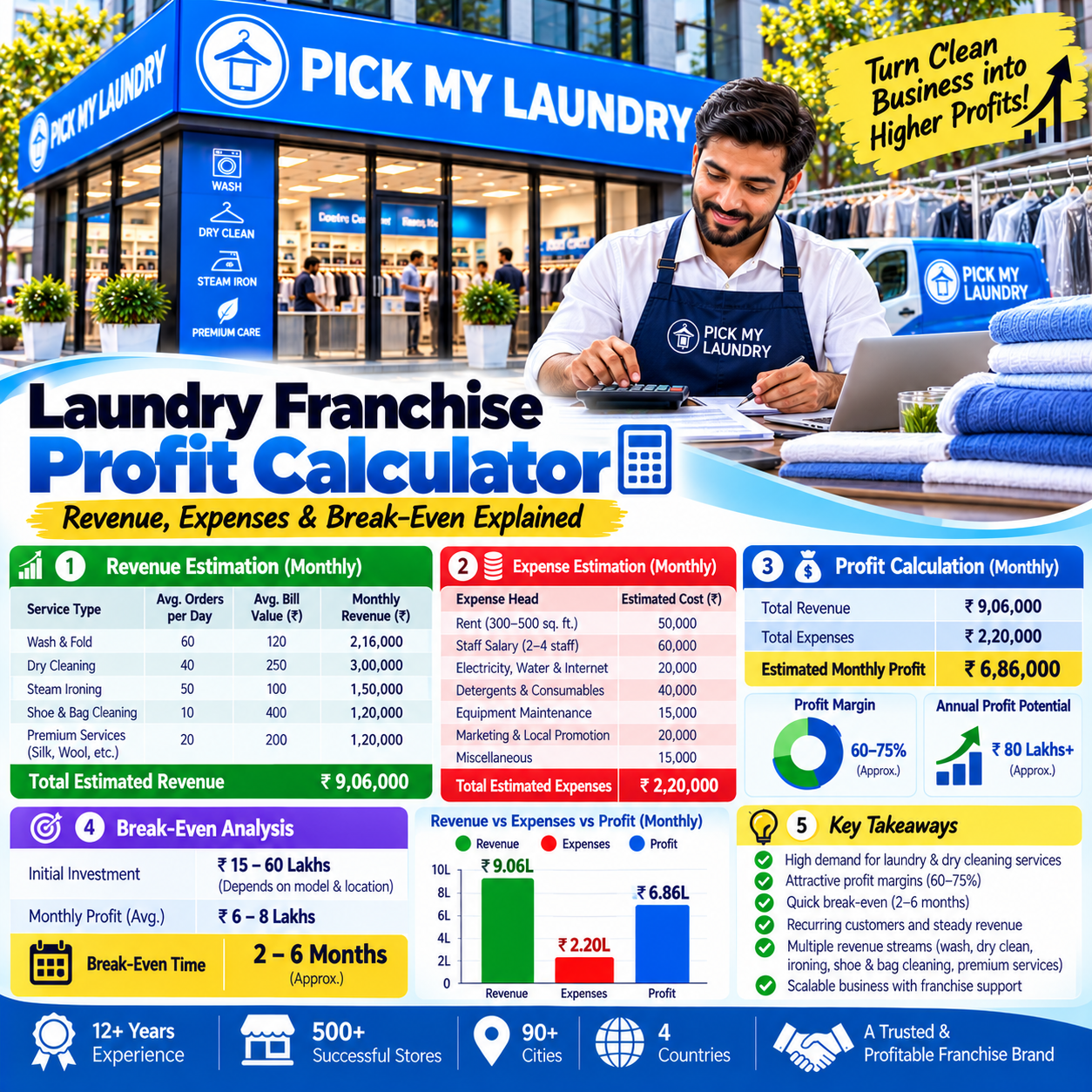
Laundry Franchise Profit Calculator: Revenue, Expenses & Break-Even Explained
Laundry Franchise Profit Calculator: Revenue, Expenses & Break-Even Explained
Considering a laundry franchise in India? One of the most important questions before investing is:
“How do I calculate the potential profitability of a laundry franchise?”
Instead of looking only at a franchise's advertised investment or revenue figures, prospective business owners should understand the underlying unit economics.
A practical laundry franchise profit calculator should consider customer orders, average order value, service mix, variable costs, fixed expenses, working capital and the initial investment.
This guide explains a simple framework you can use to evaluate the financial performance of a laundry franchise.
Important: The examples in this article are illustrative calculations. Actual revenue, expenses, margins and break-even periods can vary by city, location, store format, service mix, pricing, order volume and operating efficiency.
What Is a Laundry Franchise Profit Calculator?
A laundry franchise profit calculator is essentially a financial model that estimates the relationship between:
Orders → Revenue → Costs → Operating Profit → Break-Even → ROI
A basic calculation starts with:
Monthly Revenue = Number of Orders × Average Order Value
Then:
Operating Profit = Revenue − Variable Costs − Fixed Costs
And:
ROI = Annual Operating Profit ÷ Initial Investment × 100
These formulas are simple, but the assumptions behind them are extremely important.
1. Start With Your Expected Order Volume
The first number you need is the estimated number of orders.
For example, suppose an outlet eventually handles:
30 orders per day
If the store operates for 30 days:
30 × 30 = 900 orders/month
This is only an illustration. A new outlet may have a different order volume during its initial months.
When building your financial model, you can create three scenarios:
Conservative scenario
Lower order volume during the initial stage.
Base scenario
A realistic operating assumption based on local market research.
Higher-volume scenario
A stronger order flow after the outlet establishes a customer base.
This approach is more useful than relying on a single revenue number.
2. Calculate Average Order Value
The second important variable is Average Order Value (AOV).
For example:
- Laundry order: ₹400
- Dry-cleaning order: ₹700
- Premium garment-care order: ₹900
The actual AOV depends on the customer's service selection.
A simple formula is:
AOV = Total Monthly Revenue ÷ Total Monthly Orders
For example, if:
Monthly Revenue = ₹4,50,000
and
Monthly Orders = 900
then:
AOV = ₹4,50,000 ÷ 900 = ₹500
So the illustrative average order value is ₹500.
3. Calculate Monthly Revenue
Once you have order volume and AOV:
Monthly Revenue = Monthly Orders × Average Order Value
Using the previous example:
900 × ₹500 = ₹4,50,000
Therefore, the illustrative monthly revenue would be:
₹4.5 lakh
Again, this is not a guaranteed Pick My Laundry revenue figure. It is simply an example showing how the calculation works.
4. Understand Your Service Mix
Laundry businesses can generate revenue from multiple services.
Depending on the outlet and market, these may include:
- Laundry washing
- Wash & fold
- Wash & iron
- Dry cleaning
- Steam ironing
- Shoe cleaning
- Bag cleaning
- Carpet cleaning
- Curtain cleaning
- Sofa cleaning
- Blanket cleaning
- Bed-sheet cleaning
- Pickup and delivery
- Corporate/B2B services
Different services can have different pricing, processing requirements and cost structures.
Therefore, instead of calculating revenue using one service, your financial model should ideally divide revenue by service category.
5. Calculate Variable Costs
Variable costs generally change as business volume changes.
Examples can include:
- Cleaning consumables
- Packaging
- Processing costs
- Transportation associated with orders
- Payment-related charges
- Other order-level expenses
For example, if monthly revenue is:
₹4,50,000
and illustrative variable costs are:
₹1,80,000
then:
Contribution = ₹4,50,000 − ₹1,80,000
Contribution = ₹2,70,000
The contribution amount is then used to cover fixed operating expenses.
6. Calculate Fixed Monthly Expenses
Fixed expenses generally remain relatively stable within a particular operating range.
These may include:
- Store rent
- Salaries
- Software or technology expenses
- Administrative costs
- Base marketing expenses
- Maintenance
- Certain utility expenses
- Other recurring overheads
For example:
| Expense | Illustrative Monthly Amount |
|---|---|
| Rent | ₹50,000 |
| Salaries | ₹80,000 |
| Utilities & operations | ₹25,000 |
| Marketing | ₹20,000 |
| Maintenance & miscellaneous | ₹15,000 |
| Total | ₹1,90,000 |
These are illustrative figures only, not standard PML costs.
7. Calculate Operating Profit
Using the earlier example:
Monthly Revenue: ₹4,50,000
Variable Costs: ₹1,80,000
Fixed Expenses: ₹1,90,000
Therefore:
Operating Profit = ₹4,50,000 − ₹1,80,000 − ₹1,90,000
Operating Profit = ₹80,000/month
Annualized:
₹80,000 × 12 = ₹9,60,000
This is an illustrative operating calculation before considering items such as taxes, financing costs, depreciation or other applicable expenses.
8. How to Calculate Break-Even
Break-even tells you approximately how much revenue or how many orders are required to cover your operating expenses.
The basic formula is:
Break-Even Revenue = Fixed Costs ÷ Contribution Margin %
Suppose:
Fixed Costs = ₹1,90,000
and:
Contribution Margin = 60%
Then:
Break-Even Revenue = ₹1,90,000 ÷ 0.60
Break-Even Revenue ≈ ₹3,16,667/month
This means the illustrative business would need approximately ₹3.17 lakh monthly revenue to cover the assumed fixed costs under these assumptions.
9. Calculate Break-Even Orders
You can also calculate break-even based on orders.
Formula:
Break-Even Orders = Fixed Costs ÷ Contribution per Order
Suppose:
Fixed Costs = ₹1,90,000
and:
Average contribution per order = ₹300
Then:
₹1,90,000 ÷ ₹300 = 633.33
So the business would need approximately:
634 orders/month
Under these illustrative assumptions.
If the outlet operates 30 days:
634 ÷ 30 ≈ 21 orders/day
This shows why order volume and contribution per order are important metrics for a laundry business.
10. Calculate Your Initial Investment
Profitability should not be considered separately from the initial investment.
Your initial investment model may include:
- Franchise-related costs
- Store interiors
- Equipment
- Technology
- Branding
- Security deposit
- Initial inventory
- Launch marketing
- Licences
- Working capital
For example, if the total initial investment is:
₹20 lakh
and the illustrative annual operating profit is:
₹9.6 lakh
then a simple annual return calculation would be:
₹9.6 lakh ÷ ₹20 lakh × 100
Illustrative ROI = 48%
However, this does not mean the investor will actually receive a 48% ROI.
Real-world ROI depends on actual revenue, expenses, taxes, financing, reinvestment, downtime, working capital requirements and other factors.
11. What Is Payback Period?
Payback period estimates how long it could take to recover the initial investment from accumulated cash returns.
A simplified formula is:
Payback Period = Initial Investment ÷ Annual Operating Profit
Using the illustrative numbers:
₹20 lakh ÷ ₹9.6 lakh ≈ 2.08 years
This is approximately 25 months.
But this calculation assumes the same operating profit throughout the period, which may not happen in reality.
A better model should account for:
- Ramp-up period
- Seasonal demand
- Marketing expenses
- Equipment maintenance
- Revenue growth
- Changes in operating costs
- Additional investment
12. Build Three Financial Scenarios
One of the best ways to evaluate a laundry franchise is to avoid depending on one projection.
Create:
Scenario A — Conservative
Lower order volume and cautious revenue assumptions.
Scenario B — Base
Reasonable assumptions based on local research.
Scenario C — Higher Volume
Higher order volume after stronger customer acquisition and operational maturity.
For example:
| Metric | Conservative | Base | Higher Volume |
|---|---|---|---|
| Orders/day | 15 | 30 | 45 |
| AOV | ₹400 | ₹500 | ₹600 |
| Monthly orders | 450 | 900 | 1,350 |
| Monthly revenue | ₹1.8L | ₹4.5L | ₹8.1L |
These numbers are illustrative scenarios, not projections for a specific Pick My Laundry outlet.
13. Don't Forget Customer Acquisition Cost
Getting customers also costs money.
Your financial model should consider:
Customer Acquisition Cost (CAC)
Formula:
CAC = Marketing Spend ÷ New Customers Acquired
For example:
If a business spends:
₹30,000
on marketing and acquires:
100 new customers
then:
CAC = ₹300
The next question is whether those customers make repeat purchases.
That is why customer retention is important for a laundry business.
14. Repeat Customers Can Change the Economics
Laundry and dry-cleaning services can involve recurring customer requirements.
Customers may periodically need:
- Regular laundry
- Office wear cleaning
- Dry cleaning
- Bedding cleaning
- Blanket cleaning
- Shoe cleaning
- Curtain cleaning
- Seasonal garment care
Therefore, financial analysis should consider both:
New Customer Acquisition
and
Repeat Customer Revenue
A business with repeat customers may have a different customer-acquisition profile from a business dependent entirely on new customers.
15. Calculate Revenue Per Customer
Another useful metric is:
Revenue Per Customer = Total Revenue ÷ Number of Customers
Suppose:
Monthly Revenue = ₹4,50,000
and:
Active customers = 600
Then:
₹4,50,000 ÷ 600 = ₹750
The illustrative monthly revenue per customer would therefore be ₹750.
Tracking this metric can help businesses understand customer value over time.
16. Monitor These Laundry Franchise KPIs
After launching, don't rely only on total sales.
Track:
Revenue KPIs
- Daily revenue
- Monthly revenue
- Revenue per store
- Revenue by service
Customer KPIs
- New customers
- Repeat customers
- Average order value
- Customer acquisition cost
Operational KPIs
- Orders per day
- Processing time
- Pickup success rate
- Delivery performance
- Rewash/rework percentage
- Complaint rate
Financial KPIs
- Gross contribution
- Operating expenses
- Operating profit
- Cash flow
- Break-even revenue
17. Common Mistakes When Calculating Laundry Franchise Profit
Mistake 1: Looking only at revenue
High revenue does not automatically mean high profit.
Mistake 2: Ignoring rent
A location with high demand can still create financial pressure if occupancy costs are too high.
Mistake 3: Underestimating working capital
A business needs cash to operate during the ramp-up period.
Mistake 4: Assuming immediate full capacity
New stores generally need time to build awareness and customer demand.
Mistake 5: Using guaranteed ROI figures
Financial performance depends on multiple variables and should be evaluated through assumptions and scenarios.
Mistake 6: Ignoring local competition
Pricing and demand can differ significantly from one market to another.
Laundry Franchise Profit Calculator — Simple Formula
You can use this basic framework:
Step 1
Monthly Orders = Orders Per Day × Operating Days
Step 2
Monthly Revenue = Monthly Orders × Average Order Value
Step 3
Contribution = Revenue − Variable Costs
Step 4
Operating Profit = Contribution − Fixed Expenses
Step 5
Annual Operating Profit = Monthly Operating Profit × 12
Step 6
Simple ROI = Annual Operating Profit ÷ Initial Investment × 100
Step 7
Payback Period = Initial Investment ÷ Annual Operating Profit
This gives you a starting framework for evaluating the economics of a laundry franchise.
Why Pick My Laundry?
Pick My Laundry operates in the laundry and dry-cleaning sector with a network-based business model.
Current brand proof points for this content strategy:
12+ Years of Industry Experience
500+ Stores
90+ Cities
Operations Across 4 Countries
The actual economics of an individual franchise outlet can vary depending on city, property, investment structure, service mix, operating expenses, customer acquisition and other factors.
Therefore, prospective franchise owners should evaluate their own location-specific assumptions rather than relying on a generic profitability figure.
Frequently Asked Questions
Is there a fixed profit for a laundry franchise?
No. Profit can vary depending on revenue, order volume, pricing, service mix, rent, manpower, utilities, marketing, transportation and other operating expenses.
How do I calculate laundry franchise profit?
Start with monthly orders × average order value to calculate revenue. Then subtract variable costs and fixed operating expenses to estimate operating profit.
What is the most important number in a laundry franchise profit calculation?
There isn't one universal number. Order volume, average order value, contribution margin, fixed expenses and initial investment should be evaluated together.
How can I calculate the break-even point?
Use:
Break-Even Revenue = Fixed Costs ÷ Contribution Margin %
You can also calculate break-even orders using:
Break-Even Orders = Fixed Costs ÷ Contribution Per Order
Is ROI guaranteed in a laundry franchise?
No. ROI depends on actual business performance and the assumptions used in the financial model. Any projection should be treated as an estimate rather than a guarantee.
Final Takeaway
A laundry franchise profit calculator should not simply answer “How much can I earn?”
It should help answer:
How much do I invest?
↓
How many orders do I need?
↓
How much revenue can those orders generate?
↓
What are my variable and fixed costs?
↓
When could the outlet reach break-even?
↓
What assumptions drive the financial result?
That approach gives a prospective franchise owner a much clearer framework for evaluating a laundry business opportunity.