
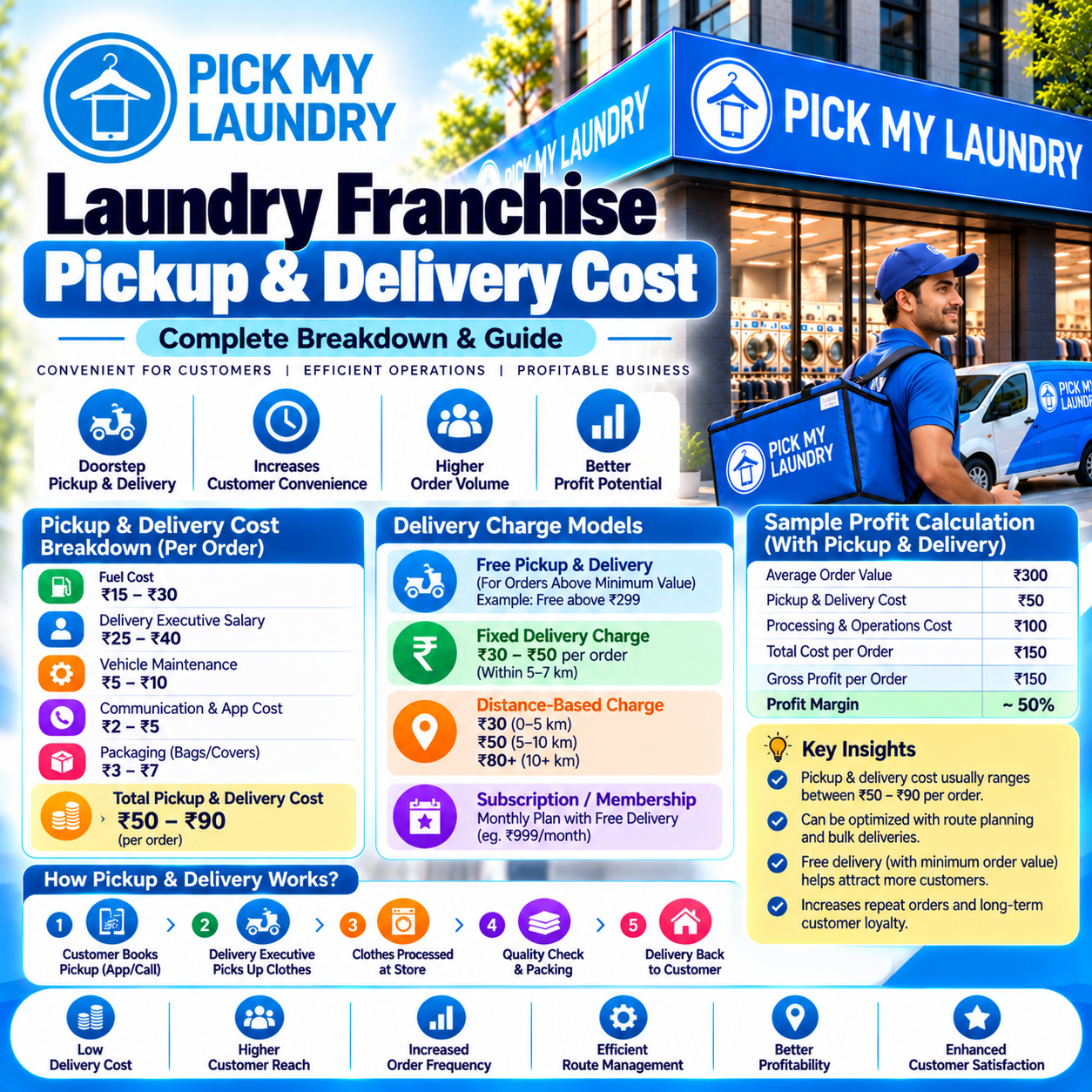
laundry franchise pickup and delivery cost
Introduction
Pickup and delivery can make laundry services more convenient for customers. Instead of travelling to a store, customers can arrange for garments to be collected, processed, and returned according to the service offered by the business.
However, convenience comes with operational costs. Fuel, driver wages, vehicle maintenance, packaging, route planning, failed delivery attempts, and customer communication can all affect the economics of a laundry franchise.
If delivery charges are set without understanding these expenses, a business may attract more orders while earning less contribution from each order.
A laundry franchise pickup and delivery cost analysis helps owners understand how much each trip costs, how many orders can be served efficiently, and when delivery fees or minimum order values may be necessary.
This guide explains how to calculate delivery costs, compare different delivery models, improve route efficiency, and develop a practical pricing approach for a laundry franchise.
Pick My Laundry brings 12+ years of industry experience, 500+ stores, a presence in 90+ cities, and operations across 4 countries. Actual delivery economics will depend on the store's location, service area, order density, operating model, and local costs.
Why Pickup and Delivery Economics Matter
Delivery is not simply an additional service. It is a separate operational activity that needs its own cost tracking and performance measures.
A store may have healthy margins on its laundry processing but lose part of that contribution through inefficient delivery operations.
Understanding delivery economics helps franchise owners:
-
Estimate the cost of serving each order.
-
Decide whether to charge a delivery fee.
-
Set appropriate minimum order values.
-
Plan delivery zones and schedules.
-
Compare in-house and outsourced delivery.
-
Reduce unnecessary trips.
-
Evaluate the profitability of subscription plans.
-
Understand whether delivery promotions are financially sustainable.
The objective is to provide convenient service without allowing logistics costs to grow faster than the value generated by customer orders.
1. Identify All Pickup and Delivery Costs
Before calculating delivery cost per order, identify every expense associated with the service.
Direct delivery costs
These are costs directly associated with operating delivery activities.
Fuel or energy: Petrol, diesel, electricity, or other energy costs used by delivery vehicles.
Driver wages: Salaries, hourly wages, or payments to delivery personnel.
Vehicle maintenance: Servicing, tyres, repairs, and other maintenance expenses.
Vehicle insurance and permits: Applicable insurance, registration, and compliance costs.
Third-party delivery fees: Charges paid to an external logistics provider, where applicable.
Packaging and handling: Additional bags, protective covers, labels, and materials required for transport.
Failed delivery costs: Extra trips, waiting time, or rescheduling when a delivery cannot be completed.
Indirect delivery costs
Some expenses may not be directly linked to an individual trip but still support delivery operations.
Examples include:
-
Route-planning software
-
Dispatch coordination
-
Customer service time
-
Phone and communication expenses
-
Allocated vehicle depreciation or lease costs
-
Delivery administration
Avoid counting the same expense twice. For example, if a delivery contractor's fee already includes fuel and vehicle maintenance, those costs should not be added again to the same calculation unless they are separately incurred.
2. Calculate the Cost Per Delivery Trip
A practical starting point is to calculate the average cost of operating a delivery trip.
Formula:
Delivery Trip Cost = Fuel or Energy + Driver Cost + Vehicle Cost + Other Trip Costs
Consider this illustrative example for one delivery route:
|
Expense |
Example Cost |
|---|---|
|
Fuel |
₹180 |
|
Driver labour allocated to the trip |
₹250 |
|
Vehicle maintenance and depreciation allocation |
₹70 |
|
Other trip-related expenses |
₹50 |
|
Total trip cost |
₹550 |
In this example, the trip costs ₹550.
These figures are illustrative, not market averages or Pick My Laundry operating data. Replace them with actual local costs.
Include the full route
A delivery route may include both collection and return journeys. Calculate the complete route distance and time, including travel back to the store or the next pickup point where applicable.
If a route involves 30 kilometres of total travel, do not calculate fuel costs using only the distance travelled while carrying garments to customers.
3. Calculate Delivery Cost Per Order
A single trip may serve several customer orders. The cost per order depends on how many orders are completed on that trip and how costs are allocated.
Formula:
Delivery Cost Per Order = Total Allocated Delivery Cost ÷ Orders Served
Suppose a route costs ₹550 and serves 10 customer orders.
₹550 ÷ 10 = ₹55 per order
If the same trip serves only five orders:
₹550 ÷ 5 = ₹110 per order
This demonstrates why order density matters. Serving several nearby customers on one route can reduce the average delivery cost per order.
However, increasing the number of stops is not always beneficial. Extra detours, parking delays, customer waiting time, and failed handovers can increase route costs.
4. Calculate the Full Cost of Pickup and Return Delivery
Some laundry services require two separate customer-facing movements: collecting garments and returning the completed order.
The business should account for both movements, including any efficient route consolidation.
For example, assume:
-
Pickup route cost: ₹400
-
Return-delivery route cost: ₹500
-
Orders served across the two routes: 10
Combined route cost:
₹400 + ₹500 = ₹900
Average delivery cost per completed order:
₹900 ÷ 10 = ₹90 per order
This example assumes the two routes collectively serve the same 10 orders and all costs are allocated to those orders.
If collection and return deliveries are combined with other routes, allocate costs consistently and avoid charging the same route expense to multiple orders.
5. Calculate Delivery Cost as a Percentage of Order Revenue
Delivery cost per order becomes more useful when compared with the revenue generated by the order.
Formula:
Delivery Cost Percentage = (Delivery Cost Per Order ÷ Average Order Revenue) × 100
For example:
-
Average order revenue: ₹500
-
Delivery cost per order: ₹90
₹90 ÷ ₹500 × 100 = 18%
In this example, delivery consumes 18% of order revenue before laundry processing costs and other business expenses are considered.
A high percentage may indicate that delivery charges, minimum order values, route density, or delivery scheduling need review.
The appropriate level depends on service margins and the role delivery plays in customer acquisition and retention.
6. Decide Whether to Charge a Delivery Fee
Laundry franchises can use different delivery pricing models depending on customer expectations, competition, order values, and service costs.
Model 1: Fixed Delivery Fee
Charge a defined fee for each eligible pickup or delivery.
Best suited when route costs are relatively predictable within a defined service area.
Model 2: Free Delivery Above a Minimum Order
Charge delivery below a qualifying order value and waive the fee when the order meets the stated threshold.
Can encourage larger orders, provided the extra order contribution covers the delivery cost.
Model 3: Zone-Based Delivery Pricing
Set different fees for defined delivery zones or distances.
Useful when nearby deliveries cost significantly less than trips to distant locations.
Model 4: Subscription-Based Delivery
Include eligible pickups or deliveries in a recurring service package.
Works only when subscription pricing accounts for expected delivery frequency, service costs, and usage limits.
Whichever model you choose, clearly explain delivery eligibility, service areas, time windows, minimum order conditions, and any additional charges.
7. Set a Minimum Order Value for Free Delivery
A minimum order value can help ensure that an order generates enough contribution to cover delivery costs.
A basic approach is to estimate the order revenue needed to cover both delivery and other variable costs.
Illustrative example:
|
Metric |
Example |
|---|---|
|
Average delivery cost |
₹90 |
|
Contribution margin before delivery |
40% |
|
Revenue required to cover delivery cost |
₹225 |
Calculation:
₹90 ÷ 40% = ₹225
At a 40% contribution margin before delivery, an order needs ₹225 in revenue to generate ₹90 in contribution to cover the delivery expense, assuming the margin definition includes all relevant non-delivery variable costs.
This is a simplified break-even calculation. It does not include fixed expenses or a target profit.
For a more conservative policy, account for variations in delivery distance, failed trips, order size, and other costs. Set the minimum using actual route and order data rather than copying a competitor's threshold.
8. Compare In-House Delivery With Outsourcing
A franchise owner may operate a delivery team or use a third-party provider.
|
Factor |
In-House Delivery |
Third-Party Delivery |
|---|---|---|
|
Cost structure |
Wages, vehicle costs and operating expenses |
Contract or per-delivery fees |
|
Operational control |
Usually greater direct control |
Depends on provider agreement |
|
Flexibility |
Depends on staffing and fleet capacity |
Depends on provider availability and terms |
|
Initial investment |
May require vehicles and equipment |
May require less vehicle investment |
|
Customer experience |
Directly managed by the store |
Requires coordination with the provider |
|
Cost visibility |
Requires internal cost allocation |
Depends on fee structure and extra charges |
Neither model is automatically cheaper.
Compare the full cost per successfully completed delivery, including failed attempts, waiting time, dispatch coordination, insurance, and any minimum service commitments.
For outsourced delivery, also review garment handling, proof of handover, tracking, complaint responsibilities, and customer-data safeguards.
9. Improve Delivery Route Efficiency
Route planning is one of the most effective areas to review when delivery costs are rising.
Group nearby orders
Schedule pickups and deliveries in nearby streets or residential areas together when customer expectations allow.
This can reduce unnecessary travel between stops.
Define service zones
Divide the operating area into practical delivery zones based on travel time, demand, and road conditions.
A store may offer more frequent delivery windows in a dense nearby area and scheduled routes for more distant areas.
Use delivery time windows
Instead of promising any-time delivery, offer suitable time windows that allow several nearby orders to be grouped together.
The schedule must still be realistic for customers and operational staff.
Reduce failed delivery attempts
Confirm addresses, contact details, and access instructions. Send appropriate reminders and record delivery outcomes.
A failed delivery may require additional travel and labour, increasing the cost of serving the order.
Review route performance
Track total kilometres, time spent, completed stops, failed attempts, and orders served per route.
Compare routes across different days and time windows to identify opportunities for improvement.
10. Track Delivery KPIs Every Month
Delivery performance should be reviewed alongside overall store performance.
|
KPI |
Calculation or Purpose |
|---|---|
|
Cost per completed delivery |
Delivery cost ÷ successfully completed deliveries |
|
Orders per route |
Orders served by each route |
|
Delivery cost as a share of revenue |
Delivery cost ÷ delivery-related order revenue |
|
On-time delivery rate |
Orders delivered on time ÷ orders due |
|
Failed delivery rate |
Failed attempts ÷ total delivery attempts |
|
Average delivery distance |
Total route kilometres ÷ completed route trips |
|
Average delivery time |
Total delivery time ÷ completed deliveries |
|
Delivery complaints |
Count or rate of complaints relating to delivery |
Use consistent definitions. For example, a delivery attempt is not the same as a successfully completed delivery.
Compare results with previous periods and consider changes in route density, fuel prices, wages, customer demand, and service areas.
Interactive Calculator: Estimate Your Delivery Cost
Use this calculator to estimate the average delivery cost per order and the delivery cost percentage based on your own figures.
Delivery cost estimator
Enter your estimated route cost and order figures.
Cost per route (₹)
₹550
₹100
₹1,500
₹3,000
Orders served per route
10
1
15
30
Average order revenue (₹)
₹500
₹100
₹1,000
₹2,000
Delivery fee collected per order (₹)
₹0
₹0
₹100
₹200
Delivery cost per order
₹55.00
Cost as % of order revenue
11.0%
Estimated delivery cost remaining after the fee
₹55.00 per order
This excludes laundry processing costs and other business expenses. It is an estimate, not net profit.
Reset example figures
Common Pickup and Delivery Cost Mistakes
1. Calculating Fuel but Ignoring Labour
Fuel is only one part of the total cost. Include driver time and other relevant delivery expenses.
2. Counting Only One Leg of the Journey
If a service requires both pickup and return delivery, account for the complete logistics process.
3. Offering Free Delivery Without Calculating Its Cost
Free delivery may support customer acquisition, but the business still pays for the route. Check whether the order's contribution can support the service.
4. Expanding the Service Area Too Quickly
Serving distant customers can increase travel time and cost. Expand zones based on demand density and realistic route economics.
5. Ignoring Failed Deliveries
Repeated unsuccessful attempts can consume labour and vehicle capacity without completing an order.
6. Using Revenue Alone to Evaluate Delivery
A high-revenue order may still be unattractive if it requires a costly individual trip. Review contribution after delivery costs, not just sales.
How Pick My Laundry Franchise Owners Can Manage Delivery Economics
For a laundry franchise, pickup and delivery procedures should match the approved operating model and the needs of the local market.
Before introducing a new delivery zone or pricing policy, review:
-
Expected customer demand
-
Typical order value and service mix
-
Delivery distances and route density
-
Staffing and vehicle costs
-
Third-party delivery terms, if applicable
-
Minimum order requirements
-
Delivery windows and customer expectations
-
Complaint handling and garment handover procedures
Pick My Laundry's 12+ years of industry experience, 500+ stores, presence in 90+ cities, and operations across 4 countries provide context for prospective partners evaluating the business.
However, delivery costs, pricing arrangements, and operational support may differ by franchise model and location. Confirm the applicable requirements with the franchisor and calculate your own local costs before making commitments.
Learn more at https://pickmylaundry.in.
Frequently Asked Questions (FAQs)
1. How do I calculate laundry pickup and delivery cost?
Add the relevant trip expenses, including fuel, labour, vehicle costs, and other applicable charges. Divide the total allocated cost by the number of orders served to estimate delivery cost per order.
2. Should a laundry franchise charge for delivery?
That depends on the service area, customer expectations, order value, and cost structure. A business may charge a fixed fee, use zone-based pricing, or offer free delivery above a qualifying order value.
3. How can I reduce delivery cost per order?
Group nearby orders, plan practical delivery zones, use suitable delivery windows, reduce failed attempts, and monitor route distance and time. Ensure that route consolidation does not compromise agreed service times.
4. Is in-house delivery cheaper than outsourcing?
Not necessarily. Compare the complete cost of each model, including labour, vehicle expenses, contractor fees, failed attempts, coordination, and service reliability.
5. How do I set a minimum order value for free delivery?
Estimate the delivery cost and the contribution generated by an order. Use that information to calculate a minimum value that can support delivery costs, then adjust it for actual operating expenses and your business objectives.
6. Which delivery KPIs should I track?
Start with delivery cost per completed order, orders per route, on-time delivery rate, failed delivery rate, average distance, and delivery complaints.
7. Does free delivery always improve customer acquisition?
No. Free delivery may reduce purchase friction, but its effect depends on customer behaviour, promotion design, and cost. Measure incremental orders and contribution rather than assuming that more orders automatically mean higher profit.
Conclusion
Pickup and delivery can improve convenience for laundry customers, but the service needs careful cost management.
By calculating route costs, understanding cost per order, setting appropriate delivery terms, improving route density, and tracking delivery KPIs, franchise owners can make better-informed logistics decisions.
The goal is not simply to deliver more orders. It is to serve customers reliably while keeping the cost of delivery aligned with the value each order generates.
Explore the Pick My Laundry franchise opportunity to learn more about available franchise models, investment requirements, and applicable support.
Website: https://pickmylaundry.in
Internal Linking Suggestions
Add contextual links to these related Pick My Laundry blogs:
-
Laundry Franchise Unit Economics: Revenue, Costs, Margins & ROI Explained — link from delivery contribution and cost analysis.
-
Laundry Franchise Pricing Strategy: How to Set Prices for Your Market — link from delivery fee and minimum order value.
-
Laundry Franchise Customer Lifetime Value: Why Repeat Customers Matter — link from subscription and retention discussions.
-
Laundry Franchise Monthly KPI Dashboard: Metrics Every Owner Should Track — link from delivery performance metrics.
-
Laundry Franchise Garment Loss Prevention: Tracking, Sorting & Handover — link from the pickup and delivery handover section.
Use the correct published URLs when adding these internal links.