
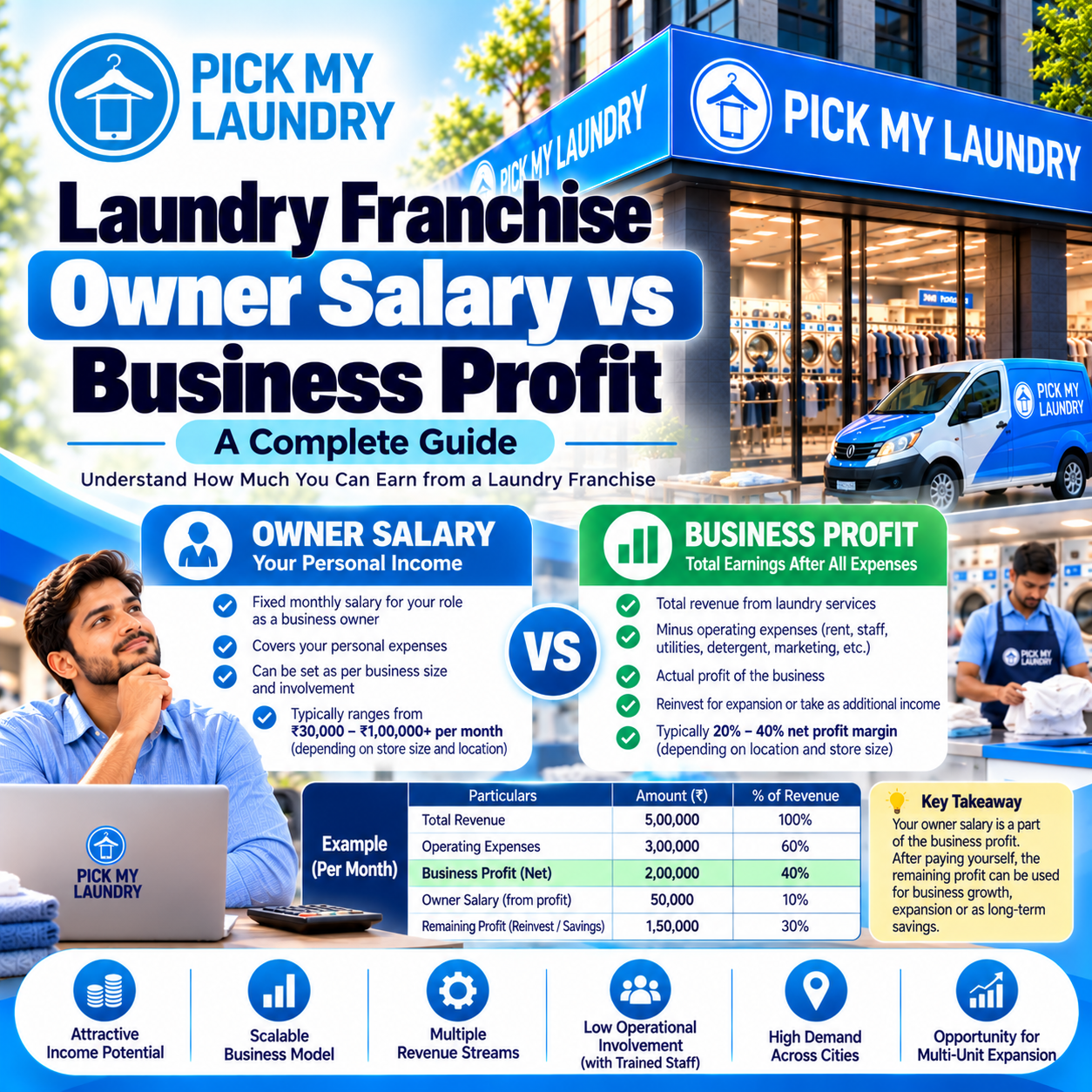
laundry franchise owner salary vs business profit laundry franchise
Introduction
When considering a laundry franchise, one of the most important questions is: How much money can the owner actually earn?
Many aspiring entrepreneurs focus on estimated monthly revenue or advertised profit figures. However, revenue, business profit and the money an owner takes home are three different things.
A laundry franchise may generate substantial sales, but the owner must account for operating expenses, franchise fees, financing costs, taxes and the amount of money that needs to remain in the business.
Understanding the difference between laundry franchise owner salary vs business profit helps investors create realistic financial expectations and make better decisions about withdrawals, reinvestment and expansion.
This guide explains how owner compensation works, how to calculate business profit and which financial factors should be considered before investing in a laundry or dry-cleaning franchise in India.
1. What Is Business Revenue?
Business revenue is the total amount generated from providing services before deducting expenses.
A laundry franchise may earn revenue from services such as:
-
Regular laundry
-
Dry cleaning
-
Steam ironing
-
Shoe cleaning
-
Bag care
-
Blanket and curtain cleaning
-
Carpet cleaning
-
Corporate or bulk laundry orders
For example, suppose a hypothetical laundry outlet generates ₹4,00,000 in monthly sales.
That ₹4,00,000 is the business's revenue. It is not the owner's salary or profit.
The outlet must first pay the expenses required to deliver its services and operate the business.
2. What Is Laundry Franchise Business Profit?
Business profit is the amount remaining after deducting the relevant expenses from revenue.
Expenses may include:
-
Rent
-
Employee salaries
-
Garment processing costs
-
Packaging and consumables
-
Pickup and delivery
-
Electricity and water
-
Marketing
-
Franchise royalties, where applicable
-
Software and maintenance
-
Accounting and administration
A simplified formula is:
\[ \text{Operating Profit}=\text{Revenue}-\text{Operating Expenses} \]
For a more complete financial picture, also account for depreciation, loan interest, taxes and other applicable costs.
The exact calculation depends on which expenses have already been included in the operating-profit figure.
3. What Is a Laundry Franchise Owner's Salary?
An owner's salary is compensation paid to the owner for working in the business, where the legal structure and accounting arrangements permit it.
For example, an owner who manages staff, supervises operations, handles customer issues and monitors sales may receive compensation for those responsibilities.
However, owner compensation depends on the business structure and applicable tax and accounting rules.
-
In a company structure, a working director may receive salary or other permitted compensation.
-
In a proprietorship, the owner's drawings are generally not treated as a salary expense in the same way as employee wages.
-
In a partnership or other structure, the treatment depends on the applicable arrangement and rules.
This distinction matters because an owner's withdrawal from the business does not automatically represent an operating expense or business profit.
Before deciding how to pay yourself, consult an accountant familiar with your business structure.
4. Revenue vs Operating Profit vs Owner Income
|
Financial term |
Meaning |
|---|---|
|
Revenue |
Total sales generated |
|
Gross profit |
Revenue minus the applicable direct costs |
|
Operating profit |
Earnings after relevant operating expenses |
|
Net profit |
Profit after applicable expenses, financing costs and taxes, depending on the accounting measure used |
|
Owner salary |
Compensation for the owner's work, where applicable |
|
Owner drawings |
Money withdrawn by an owner; not necessarily a business expense |
|
Cash flow |
Money entering and leaving the business |
These terms should not be used interchangeably.
For example, a business might show an accounting profit while having limited available cash because customers have not paid their invoices or the business has recently purchased equipment.
5. Illustrative Monthly Financial Example
Consider a hypothetical laundry franchise with the following monthly figures.
Illustrative outlet finances
Monthly revenue
₹4,00,000
Illustrative operating expenses
Rent
₹45,000
Employee salaries
₹85,000
Processing and consumables
₹1,10,000
Pickup and delivery
₹25,000
Marketing and software
₹20,000
Utilities and maintenance
₹25,000
Other operating costs
₹15,000
Total operating expenses
₹3,25,000
Operating profit
₹75,000
This hypothetical example excludes any costs not listed, such as depreciation, loan interest and taxes. It is not actual Pick My Laundry financial data or a profit guarantee.
In this example, the outlet generates ₹4 lakh in revenue and ₹75,000 in operating profit before the additional adjustments noted above.
The owner should not automatically treat the entire ₹75,000 as personal spending money. Some funds may be required for taxes, loan obligations, working capital, equipment replacement or business growth.
6. How Much Should a Franchise Owner Pay Themselves?
There is no universal salary amount that applies to every laundry franchise owner.
The appropriate compensation depends on:
-
Monthly revenue
-
Operating profitability
-
Cash flow
-
Business structure
-
Owner responsibilities
-
Loan repayments
-
Working capital requirements
-
Tax obligations
-
Plans for expansion
A practical approach is to create a monthly financial policy.
First, calculate the outlet's operating costs. Next, estimate taxes, debt obligations and essential reinvestment needs. Then determine whether the remaining cash flow can support regular owner compensation.
During the launch phase, an owner may need to keep withdrawals conservative until the business develops a more predictable financial pattern.
7. Active Owner vs Investor Owner
Not every franchise owner participates in daily operations to the same extent.

Active owner
An active owner may manage staff, customer service, sales, local marketing and daily operations. Compensation may reflect the owner's work, subject to the business structure and accounting treatment.

Investor or manager-led owner
An owner who delegates daily operations may need to budget for a store manager or other supervisory staff. The business should account for those costs when evaluating its profitability.
An investor-operated model may reduce the owner's daily workload, but it does not eliminate management responsibilities or guarantee higher returns.
When comparing the two models, include the cost of the owner's time and the cost of hiring someone else to perform that work.
8. Understand the Difference Between Salary and Drawings
Suppose an owner withdraws ₹40,000 from a proprietorship each month.
That withdrawal does not automatically mean the business incurred ₹40,000 in salary expense. It is generally treated as an owner's drawing rather than employee compensation.
This affects financial reporting.
If you want to understand the true cost of operating the outlet, consider the work performed by the owner as well as the cash withdrawn.
For example, if the business would need to hire a manager to replace the owner's daily responsibilities, the estimated manager salary can be useful when comparing the outlet with a manager-operated business.
This helps you assess whether the business remains attractive after accounting for the cost of professional management.
9. Factors That Affect Owner Income
Location and rent
An outlet in a high-demand area may have stronger sales opportunities, but high rent can reduce the amount of profit retained.
Average order value
A suitable service mix and pricing strategy may increase revenue per order. However, premium services can also carry additional processing costs.
Repeat customers
Returning customers can reduce dependence on acquiring entirely new customers for every order.
Operating efficiency
Consistent order tracking, garment handling and staff training can help reduce avoidable mistakes and rework.
Marketing costs
Advertising should be evaluated using qualified enquiries, customer conversions and repeat purchases—not only impressions or clicks.
Franchise terms
Royalties, marketing contributions, technology charges and other contractual fees can affect operating profitability.
Owner involvement
An owner who works full-time may perform tasks that would otherwise require paid staff. That difference should be considered when evaluating the business's economic performance.
10. How to Calculate the Owner's Potential Income
Use this sequence when building your financial model:
-
Estimate monthly sales.
-
Deduct direct processing and service-delivery costs.
-
Deduct operating expenses.
-
Calculate operating profit.
-
Account for depreciation and financing costs where applicable.
-
Estimate taxes with professional guidance.
-
Identify required working capital and reinvestment.
-
Determine the amount available for owner compensation or distributions under the applicable structure.
Do not calculate owner income simply by multiplying monthly revenue by an assumed profit percentage unless you have evidence supporting that margin.
11. Build Your Own Financial Estimate
Use this calculator to explore how changes in revenue and expenses affect the operating profit of a hypothetical laundry outlet.
Monthly profit estimator
Adjust the figures to model different business scenarios.
Monthly revenue
₹4,00,000
Monthly operating expenses
₹3,25,000
Estimated operating profit
₹75,000
Operating margin
18.8%
This calculator excludes unlisted costs and does not estimate taxes, final net profit, owner drawings or guaranteed take-home income.
Use verified costs and location-specific sales estimates before making an investment decision.
12. Common Financial Mistakes Franchise Owners Should Avoid
-
Treating revenue as personal income.
-
Withdrawing too much cash from the business.
-
Ignoring taxes and loan repayments.
-
Failing to separate business and personal expenses.
-
Forgetting the cost of a replacement manager.
-
Assuming projected profit is guaranteed.
-
Neglecting equipment replacement and maintenance.
-
Expanding before the existing outlet has sufficient financial stability.
A separate business bank account, regular bookkeeping and periodic financial reviews can help reduce these risks.
Why Consider Pick My Laundry?
Pick My Laundry operates in the laundry and dry-cleaning franchise sector.
12+ Years of Industry Experience | 500+ Stores | 90+ Cities | Operations Across 4 Countries
Prospective franchise investors should review the applicable investment requirements, franchise terms, recurring expenses and operational responsibilities before deciding whether the business suits their financial goals.
Prepare a location-specific financial forecast and consult an accountant about owner compensation, taxes and the appropriate accounting treatment for your business structure.
Frequently Asked Questions
1. Is laundry franchise revenue the same as owner income?
No. Revenue is total sales before expenses. Owner income depends on the business's financial results, compensation arrangements, tax obligations and the amount of money available for withdrawal or distribution.
2. Can a laundry franchise owner receive a salary?
Depending on the business structure, a working owner may receive salary or other permitted compensation. In a proprietorship, owner drawings are generally treated differently from employee salaries.
3. Should I withdraw all the profit from my laundry business?
Not necessarily. The business may need cash for working capital, equipment maintenance, taxes, debt payments and future growth.
4. Does a higher monthly turnover mean a higher owner salary?
No. Higher revenue can also bring higher operating expenses. Owner compensation depends on the resulting financial performance and the business's cash requirements.
5. How should I compare an active-owner model with a manager-operated outlet?
Include the cost of a paid manager in the manager-operated model. Compare the resulting business profit and also consider the time and responsibilities required from the owner.
6. What expenses should be considered before estimating owner income?
Consider processing costs, rent, salaries, utilities, marketing, delivery, franchise fees, maintenance, software, financing costs and taxes as applicable.
7. How can I estimate laundry franchise owner income before investing?
Prepare a location-specific financial forecast using realistic sales assumptions, verified expense estimates and the proposed franchise agreement. Treat projections as estimates rather than guaranteed results.
Conclusion
Understanding the difference between laundry franchise owner salary and business profit is essential when evaluating a franchise opportunity.
Revenue measures sales, profit measures financial performance, and owner income depends on the business structure, compensation arrangements and available funds.
Before investing, estimate all applicable expenses, plan for working capital, account for your own management responsibilities and avoid treating projected profit as guaranteed personal income.
For prospective Pick My Laundry franchise owners, a realistic financial plan can help clarify the capital required, the responsibilities involved and the conditions under which the business may support sustainable owner income.