
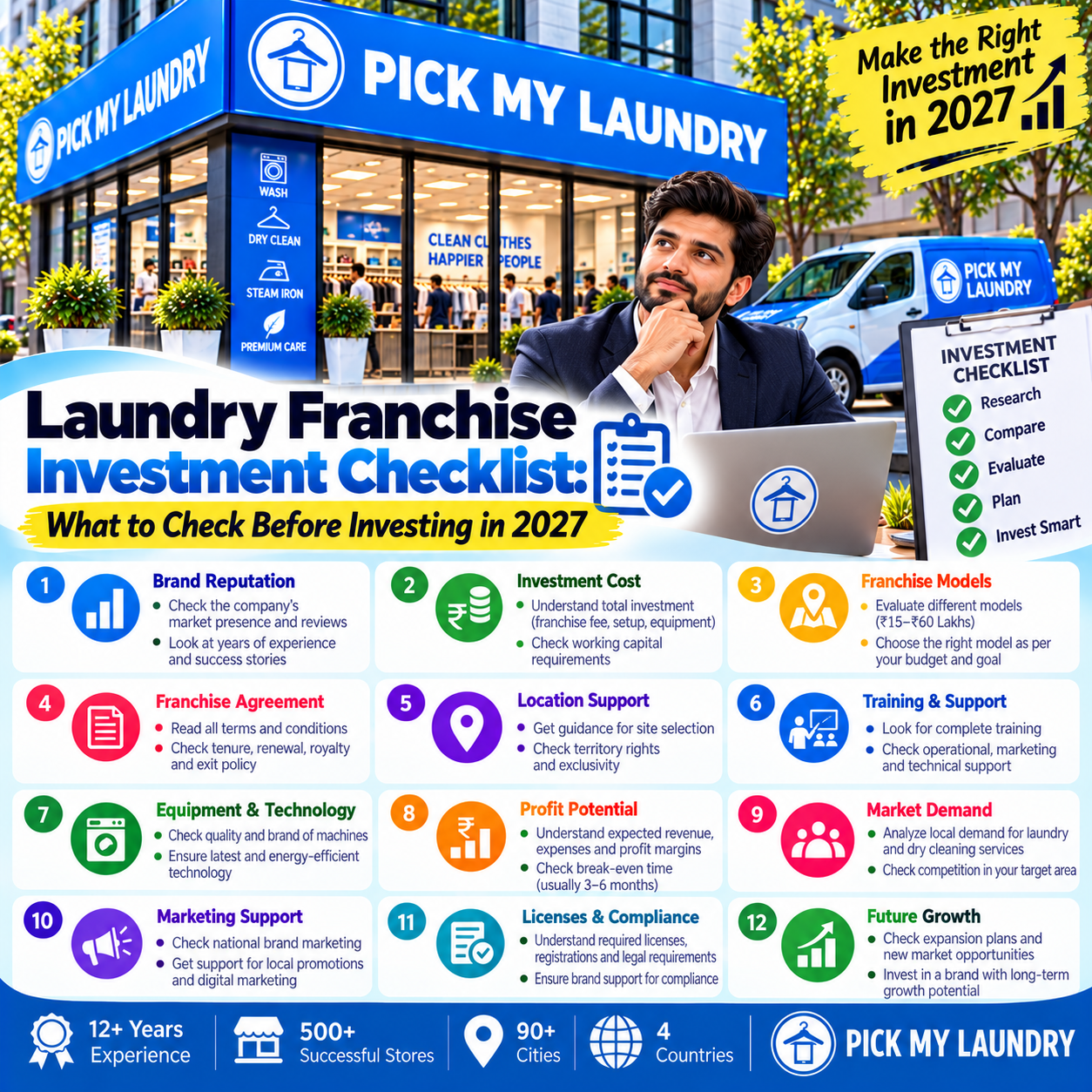
Laundry Franchise Investment Checklist: What to Check Before Investing in 2027
Laundry Franchise Investment Checklist: What to Check Before Investing in 2027
Starting a laundry or dry-cleaning business through a franchise can involve several decisions beyond simply looking at the advertised investment amount. Before committing capital, a prospective franchise owner should understand the business model, setup requirements, operating expenses, location, training, technology, marketing support and terms of the franchise agreement.
A structured laundry franchise investment checklist can make this evaluation easier and help investors ask the right questions before making a decision.
For entrepreneurs considering a laundry business opportunity in India in 2027, this guide explains the major areas that should be reviewed before investing.
1. Understand the Total Investment, Not Just the Starting Cost
One of the first things to check is the complete investment requirement.
The headline franchise investment may not represent every expense involved in starting and operating the outlet.
Your evaluation should consider:
- Franchise-related fees
- Store setup and interiors
- Laundry equipment
- Dry-cleaning equipment
- Technology and software
- Signage and branding
- Initial inventory and packaging
- Staff recruitment
- Training
- Licences and registrations
- Marketing and launch activities
- Security deposits
- Rent and property-related expenses
- Initial working capital
Ask the franchisor for a detailed investment structure and clarify which costs are included and which are additional.
2. Check the Franchise Business Model
Different franchise systems can have different ownership and operational structures.
Before investing, understand:
- Who owns the outlet?
- Who manages daily operations?
- Who hires employees?
- Who controls pricing?
- Who handles marketing?
- What technology is provided?
- What operational responsibilities remain with the franchise owner?
- How are franchise fees and other charges structured?
A clear understanding of the model helps you determine whether the business structure matches your expectations.
3. Evaluate the Location Carefully
Location can directly affect customer accessibility, pickup and delivery efficiency and local visibility.
Before finalizing a property, evaluate:
Customer density
Look for areas with sufficient residential, working-professional, student or commercial demand.
Accessibility
Check whether customers and delivery staff can easily reach the location.
Visibility
A visible location can make it easier for local customers to recognize the brand.
Parking and pickup access
For a pickup-and-delivery-focused business, vehicle accessibility can be particularly important.
Competition
Study nearby laundry, dry-cleaning and specialized garment-care businesses.
Rent
Compare the property's rent with the expected business potential of the area.
A good-looking property is not automatically a good business location. The location should be evaluated against the intended customer base and operating model.
4. Understand the Required Store Size and Layout
Before signing a property agreement, understand the operational space required for the proposed franchise format.
Consider areas for:
- Customer reception
- Garment receiving
- Sorting
- Processing
- Quality checking
- Packaging
- Storage
- Dispatch
- Staff operations
The layout should support an organized movement of garments through different stages of the process.
5. Review Equipment Requirements
Laundry businesses depend heavily on appropriate equipment and operational infrastructure.
Ask:
- What equipment is required?
- Which machines are included in the investment?
- Who supplies the equipment?
- Who handles installation?
- What is the expected maintenance process?
- Are spare parts readily available?
- What happens if a machine stops working?
- Are there equipment specifications or capacity requirements?
Do not evaluate equipment only on purchase price. Maintenance, downtime and operational suitability should also be considered.
6. Calculate Working Capital Requirements
A new outlet may require working capital during its initial operating period.
Working capital can be needed for:
- Salaries
- Rent
- Utilities
- Packaging
- Consumables
- Transportation
- Marketing
- Maintenance
- Software
- Other regular operating expenses
Before investing, prepare a realistic working-capital plan rather than allocating the entire budget to store setup.
7. Understand Monthly Operating Expenses
Your checklist should include recurring expenses.
Typical categories may include:
| Expense Category | What to Evaluate |
|---|---|
| Rent | Monthly property cost |
| Salaries | Number and type of employees |
| Utilities | Electricity and water requirements |
| Packaging | Bags, covers and related materials |
| Transportation | Pickup and delivery |
| Maintenance | Equipment and infrastructure |
| Marketing | Local and digital campaigns |
| Technology | Software/platform-related costs |
| Consumables | Cleaning and operational materials |
Actual costs can vary significantly by location, outlet format, service mix and operating scale.
8. Study the Revenue Model
Before investing, understand how the laundry franchise generates revenue.
Possible revenue streams can include:
- Laundry services
- Dry cleaning
- Steam ironing
- Shoe cleaning
- Bag cleaning
- Carpet cleaning
- Sofa and curtain cleaning
- Blanket and bed-sheet cleaning
- Pickup and delivery
- Corporate/B2B services
A diversified service portfolio can create multiple customer use cases, but each service should be evaluated based on local demand and operational requirements.
9. Understand the Break-Even Calculation
Do not rely only on a general statement that a business can become profitable.
Ask for the assumptions behind any financial projection.
A basic break-even calculation involves comparing:
Fixed Costs + Variable Costs + Required Investment
against
Revenue and Contribution Margin
Important numbers to understand include:
- Average order value
- Orders per day
- Average monthly revenue
- Variable cost per order
- Fixed monthly expenses
- Contribution margin
- Monthly cash flow
- Estimated break-even point
Financial examples should be treated as projections rather than guaranteed results.
10. Review the Franchise Agreement Carefully
The franchise agreement is one of the most important documents to review before signing.
Pay attention to:
- Agreement duration
- Renewal conditions
- Franchise fees
- Royalty or recurring charges, if applicable
- Territory rights
- Branding requirements
- Marketing obligations
- Supplier requirements
- Exit conditions
- Transfer conditions
- Termination clauses
- Dispute-resolution provisions
- Restrictions on operating similar businesses
For significant investments, professional legal advice can help you understand contractual obligations before signing.
11. Verify Training and Operational Support
A franchise can provide value through systems, training and operational guidance.
Ask what support is actually included.
For example:
- Initial staff training
- Store setup guidance
- Operational SOPs
- Quality-control procedures
- Technology onboarding
- Customer-service training
- Marketing guidance
- Launch support
- Ongoing operational assistance
Also ask how long the support continues after launch.
12. Evaluate Technology Infrastructure
Modern laundry businesses can use technology to manage orders, customer information, payments, pickup and delivery and operational tracking.
When evaluating a franchise, ask whether the system provides:
- Order management
- Customer database
- Digital invoices
- Payment integration
- Order status tracking
- Pickup and delivery management
- Customer notifications
- Reporting
- Store-level performance information
Technology should be evaluated according to the actual operational needs of the outlet.
13. Check Marketing Support
A new outlet needs a customer-acquisition strategy.
Ask the franchisor:
- Is launch marketing provided?
- Are digital campaigns supported?
- Is local marketing guidance available?
- Are creatives provided?
- Is Google Business Profile support available?
- Is social media support included?
- Is there a brand-level marketing strategy?
- Who pays for local advertising?
You should clearly understand the difference between brand-level marketing support and store-level marketing responsibilities.
14. Examine the Brand's Existing Network
Brand experience can be one of the factors considered during franchise due diligence.
For Pick My Laundry, the current brand positioning provided for future content is:
12+ Years of Industry Experience | 500+ Stores | 90+ Cities | Operations Across 4 Countries
A prospective franchise investor can also examine:
- Existing locations
- Service portfolio
- Brand presence
- Operating model
- Customer experience
- Technology
- Franchise support
- Geographic presence
Numbers and claims should always be evaluated against the latest information available from the franchisor.
15. Study the Local Market Before Investing
Even an established brand does not eliminate the importance of local market research.
Study:
Residential demand
How many potential customers live within the intended service area?
Working population
Are there offices, professionals and businesses nearby?
Competitors
What services and prices are competitors offering?
Customer preferences
Do customers prefer doorstep pickup, store visits or both?
Service demand
Which services appear most relevant locally?
Delivery potential
Can pickup and delivery be managed efficiently?
16. Ask About Customer Acquisition
Before investing, understand how customers are expected to reach the store.
Potential channels include:
- Google Search
- Google Maps
- Local SEO
- Social media
- Paid advertising
- Residential communities
- Referral programs
- Corporate partnerships
- Local business partnerships
- Offline promotions
The key question is not simply “Will marketing be done?”
Instead ask:
Who does what, who pays for it and how will performance be measured?
17. Understand Staff Requirements
A laundry outlet may require different operational roles depending on the business format.
Potential responsibilities include:
- Store management
- Customer service
- Laundry processing
- Dry cleaning
- Steam ironing
- Quality control
- Packaging
- Pickup and delivery
Before investing, understand the expected manpower requirement and whether recruitment or training support is provided.
18. Check Quality-Control Systems
Garment care is a critical part of a professional laundry and dry-cleaning operation.
Ask about:
- Garment inspection
- Order tagging
- Sorting
- Stain identification
- Processing procedures
- Quality checks
- Packaging
- Customer complaint handling
- Damaged-garment procedures
A clearly defined quality-control process can help maintain consistency.
19. Understand Pickup & Delivery Operations
If the business includes doorstep pickup and delivery, evaluate the logistics carefully.
Consider:
- Delivery radius
- Vehicle requirements
- Delivery staff
- Route planning
- Order scheduling
- Customer communication
- Packaging
- Delivery tracking
- Fuel and transportation costs
A strong pickup-and-delivery process can be important for customer convenience, but it also adds operational complexity.
20. Compare the Opportunity With Your Own Business Goals
Finally, evaluate whether the franchise opportunity fits your personal business objectives.
Consider:
- Available investment
- Desired involvement
- Business experience
- Preferred city
- Available property
- Time commitment
- Expected operating responsibilities
- Growth plans
- Risk tolerance
- Long-term business goals
There is no universal franchise structure that suits every investor.
Laundry Franchise Investment Checklist — Quick Version
Before moving forward, make sure you have answers to these questions:
☑ What is the complete investment?
☑ What costs are included?
☑ What additional expenses should I budget for?
☑ How much working capital is required?
☑ What franchise model is being offered?
☑ What are the agreement terms?
☑ What are the renewal and exit conditions?
☑ What location requirements apply?
☑ What equipment is required?
☑ What manpower is needed?
☑ What training is provided?
☑ What technology is included?
☑ What marketing support is available?
☑ How are customers acquired?
☑ What quality-control systems are followed?
☑ How does pickup and delivery work?
☑ What are the recurring operating expenses?
☑ How should break-even be calculated?
☑ What assumptions support financial projections?
☑ Who should review the franchise agreement?
Why Pick My Laundry?
Pick My Laundry operates across the laundry and dry-cleaning segment with a network-based business model.
The brand's current proof points for this content strategy are:
12+ Years of Industry Experience
500+ Stores
90+ Cities
Operations Across 4 Countries
The franchise evaluation process should still be based on the specific outlet location, investment structure, agreement terms, operating plan and financial assumptions applicable to the prospective franchise owner.
Frequently Asked Questions
1. What should I check before investing in a laundry franchise?
Review the complete investment, franchise model, location, working capital, monthly expenses, equipment, staff requirements, training, marketing, technology, agreement terms and expected operating responsibilities.
2. How much investment is required for a laundry franchise?
The investment varies according to the franchise format, location, property, equipment, interiors, working capital and other requirements. Investors should request the latest detailed investment breakdown directly from the franchisor.
3. Is a laundry franchise suitable for a first-time entrepreneur?
It can be considered by first-time entrepreneurs, but the decision should depend on available capital, involvement level, location, business understanding and the support structure offered by the franchise.
4. What is franchise due diligence?
Franchise due diligence means researching the franchisor, business model, costs, agreement, operations, support, market opportunity and financial assumptions before making an investment decision.
5. Should I check the franchise agreement before investing?
Yes. The agreement defines important rights and obligations. For a significant investment, consider having the agreement reviewed by an appropriately qualified professional.
6. What makes a laundry franchise investment different from an independent laundry business?
A franchise generally involves operating under an established brand and business system, while an independent business owner develops their own brand, processes and operating system. The actual differences depend on the specific franchise agreement and business model.
Final Thoughts
Investing in a laundry franchise should begin with research rather than assumptions.
A proper investment checklist helps you understand the complete financial requirement, local market, operational model, technology, support system, agreement terms and customer-acquisition strategy before committing capital.
For entrepreneurs exploring a laundry business opportunity in 2027, the objective should be to build a clear picture of investment, operations, revenue potential, responsibilities and risks before taking the next step.
Explore Pick My Laundry Franchise
If you are evaluating a laundry franchise opportunity, review the franchise model, investment requirements and available locations, then submit an enquiry to discuss your specific requirements.
Pick My Laundry — 12+ Years of Industry Experience | 500+ Stores | 90+ Cities | Operations Across 4 Countries.