
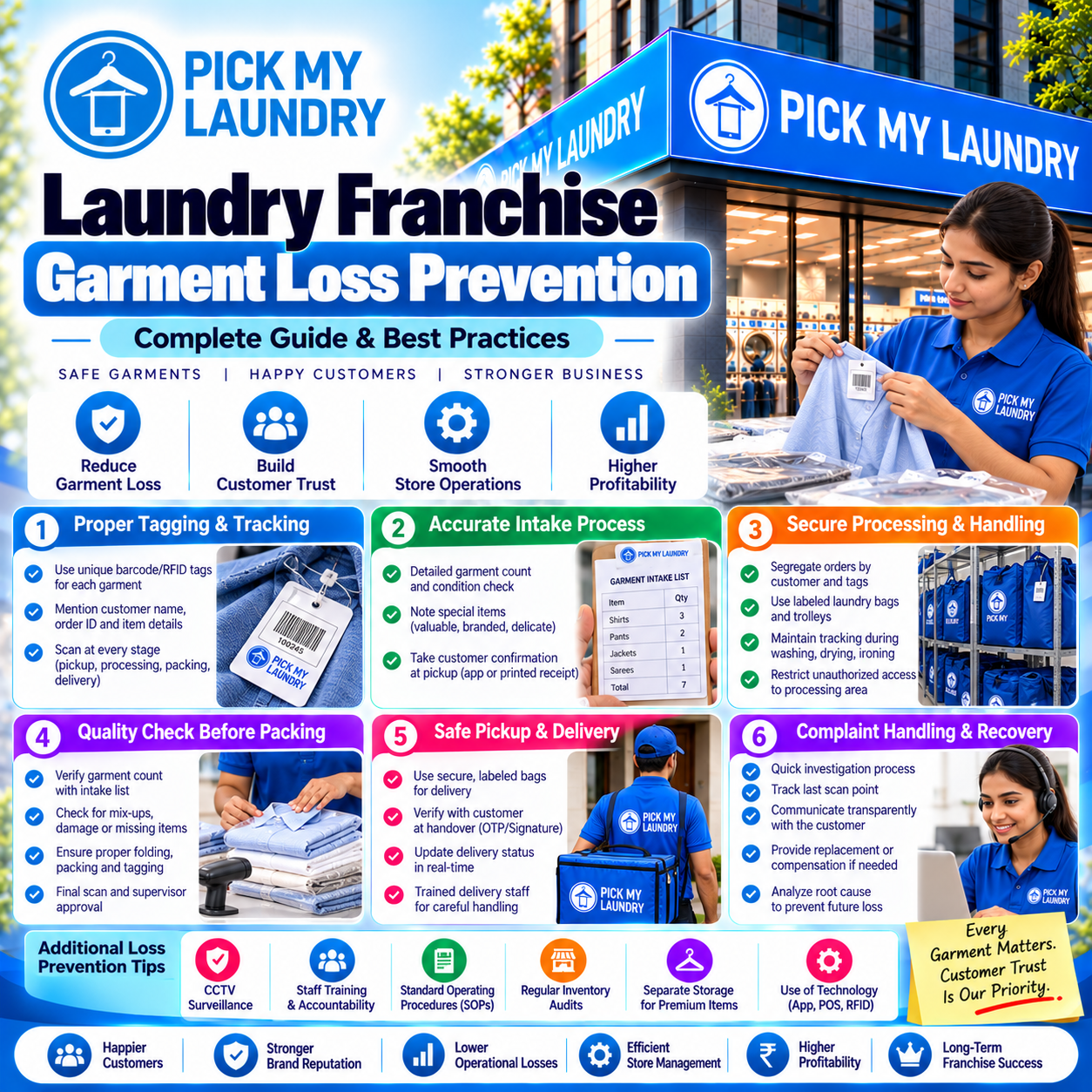
laundry franchise garment loss prevention
Introduction
Garment loss is a serious operational concern for laundry and dry cleaning businesses. A missing shirt, an incorrectly packed order, or a garment handed to the wrong customer can lead to complaints, additional costs, and reduced customer confidence.
For a laundry franchise, the challenge becomes more important as order volume grows and multiple employees handle garments at different stages. Without a reliable tracking process, it can be difficult to determine where an item was received, processed, stored, transferred, or handed over.
A structured laundry franchise garment loss prevention system helps owners maintain control of customer garments from the moment they enter the store until they are returned.
The objective is straightforward: every garment should be identifiable, linked to the correct order, stored in the appropriate location, and checked at every important handover.
This guide explains practical procedures for reducing missing garments, preventing order mix-ups, improving staff accountability, and handling discrepancies professionally.
Pick My Laundry brings 12+ years of industry experience, 500+ stores, a presence in 90+ cities, and operations across 4 countries. Individual franchise owners should follow the procedures applicable to their particular outlet and operating model.
What Is Garment Loss Prevention in a Laundry Business?
Garment loss prevention refers to the systems and procedures used to reduce the risk of customer garments becoming misplaced, mixed up, incorrectly transferred, or handed to the wrong person.
It involves more than keeping clothes in a storage area. A complete system should cover the entire order journey.
Typical control points include:
-
Garment receiving and counting
-
Order creation and tagging
-
Sorting and processing
-
Movement between work areas
-
Transfers to central processing facilities
-
Quality inspection and packaging
-
Storage of completed orders
-
Customer collection or delivery
-
Investigation of missing-item complaints
A garment should remain traceable even when several employees or facilities are involved.
Why Garments Go Missing in Laundry Businesses
Understanding common causes helps owners choose the right preventive measures.
1. Incorrect Garment Counting
If the number of garments is recorded incorrectly at receiving, employees may not notice a discrepancy until the customer collects the order.
2. Missing or Unclear Tags
A detached, illegible, or incorrectly attached tag can separate a garment from its original order.
3. Mixing Customer Orders
Garments from different customers may become mixed during sorting, processing, finishing, or packaging if separation procedures are not followed.
4. Poor Storage Organisation
When completed garments are placed wherever space is available, staff may struggle to locate the correct order quickly.
5. Incomplete Handover Records
Transfers between outlets, processing facilities, delivery personnel, and customers create opportunities for discrepancies if quantities and order references are not checked.
6. Manual Recordkeeping Errors
Handwritten notes, duplicate order numbers, incomplete entries, and delayed status updates can make garment tracking difficult.
7. Rushed Operations
During busy periods, employees may skip counting, tagging, or verification steps. A well-designed process should remain practical even when order volumes increase.
10 Strategies to Prevent Garment Loss in a Laundry Franchise
1. Create a Standard Garment Receiving Procedure
The receiving counter is the first control point in the garment tracking process.
Every incoming order should be checked and recorded before garments move into processing.
Receiving checklist
-
Count the garments received.
-
Record a suitable description of each item.
-
Identify garments requiring special handling.
-
Document visible damage or relevant concerns.
-
Record the requested service.
-
Create a unique order reference.
-
Attach identification tags according to the approved procedure.
-
Confirm the order details with the customer.
-
Provide an order receipt or confirmation.
For high-value, delicate, or unusual garments, use any additional identification and inspection steps required by the store's procedures.
The purpose is to create a reliable record of what the customer actually handed over.
2. Use a Unique Order Number
Every customer order should have a unique identifier that links the physical garments to the digital or written record.
The order number should appear wherever necessary, including:
-
Order records
-
Garment tags or labels
-
Processing lists
-
Storage records
-
Handover documents
-
Customer receipts
-
Delivery records
Avoid using only a customer's name as the primary identifier. Different customers may share the same name, and names alone do not reliably distinguish individual orders.
If an order contains multiple garments, the system should make it clear which items belong to that order and how many were received.
3. Implement a Reliable Garment Tagging System
Garment tags are essential for maintaining identification throughout the workflow.
Depending on the store's process, identification may use printed labels, barcode tags, reusable identifiers, or another suitable method.
A reliable system should ensure that:
-
Tags are readable.
-
The identifier matches the correct order.
-
Tags remain associated with garments throughout the required process.
-
Employees can verify the order without guessing.
-
Damaged or missing tags are replaced through a documented procedure.
-
Tag replacement does not create duplicate or conflicting records.
The tagging method should be suitable for the garment and the cleaning process. Follow approved procedures to avoid damaging fabrics or leaving residue.
Manual versus digital tracking
|
Feature |
Manual Tracking |
Digital Tracking |
|---|---|---|
|
Initial setup |
Often simpler |
May require software and equipment |
|
Order identification |
Depends on clear written records |
Can use unique IDs, barcodes, or supported scanning |
|
Status updates |
Require manual entry |
May be updated through a connected workflow |
|
Reporting |
May require manual compilation |
May support automated reporting |
|
Common risk |
Illegible or incomplete entries |
Incorrect data entry or system failures |
Digital tracking is not automatically error-free. Staff training, accurate data entry, backup procedures, and physical verification remain important.
4. Separate Orders at Every Processing Stage
A well-organised workflow reduces the risk of garments becoming mixed.
Create clearly designated areas for:
-
Newly received garments
-
Orders awaiting inspection
-
Garments awaiting processing
-
Items currently being processed
-
Orders awaiting quality checks
-
Completed garments awaiting packaging
-
Orders ready for customer collection
-
Orders scheduled for delivery
-
Orders requiring investigation
Use clear labels and follow the store's approved layout.
Avoid placing unidentified garments on shared tables or leaving completed orders in general processing areas. When an item cannot be identified, place it in a designated hold area and investigate its order reference before moving it further.
5. Follow a Garment Counting Process
Counting should occur at key stages rather than only when the customer first places an order.
For example:
-
Count garments at receiving.
-
Verify quantities before transfer to another facility.
-
Confirm receipt at the processing location.
-
Check the order after processing.
-
Verify quantities during final packaging.
-
Confirm the order before customer collection or delivery.
Not every business needs the same number of checkpoints. The process should reflect its service model, risk, and operating complexity.
For bulk orders, hotel linen, uniforms, or business-to-business laundry, use an appropriate counting method such as bundle records or itemised batch lists. Ensure that the chosen method can identify discrepancies at a useful level.
6. Maintain Handover Records
A handover occurs whenever responsibility for garments passes from one person, department, location, or delivery partner to another.
Every important transfer should have a clear record.
Handover checklist
-
Confirm the order reference.
-
Verify the garment or package count.
-
Check the packaging and visible condition.
-
Record the sending and receiving parties.
-
Record the date and time according to the procedure.
-
Note discrepancies before accepting the handover.
-
Update the order status.
-
Retain the required confirmation or transfer record.
For a store using a central processing facility, this procedure should apply to transfers in both directions.
If a discrepancy is identified, document it immediately rather than allowing the order to continue through the workflow without investigation.
7. Organise Completed-Order Storage
Completed garments should be stored in a way that makes retrieval straightforward and prevents accidental handover.
Storage best practices
-
Assign defined storage areas.
-
Group orders using a consistent system.
-
Keep order references visible.
-
Separate customer collection orders from delivery orders where appropriate.
-
Avoid placing garments from different orders together without clear identification.
-
Restrict access where needed.
-
Conduct periodic checks of long-pending orders.
-
Investigate unidentified items promptly.
A shelf, rack, or storage section can be assigned a location code, provided the system is maintained and staff know how to use it.
The objective is to find the correct order without opening unrelated packages or relying on individual memory.
8. Verify Every Order Before Customer Handover
The final handover is another critical control point.
Before releasing an order, staff should verify that the correct garments are being provided to the correct customer.
Customer collection procedure
-
Request the relevant order reference or follow the approved identity-verification procedure.
-
Retrieve the matching order.
-
Confirm the order details.
-
Verify the garment or package count.
-
Check the order status and payment requirements.
-
Record the collection or handover.
-
Provide the appropriate receipt or confirmation.
For delivery orders, use the approved recipient-verification and delivery-record process.
Never release an order solely because someone recognises a garment or claims to know the customer.
9. Train Employees on Garment Accountability
A tracking system works only when staff follow it consistently.
Training should explain:
-
Why garments must remain identifiable
-
How to create and update order records
-
How to attach and replace tags
-
How to separate different orders
-
How to record handovers
-
What to do when a garment cannot be identified
-
How to report missing items
-
Who is responsible for investigating discrepancies
Employees should be encouraged to report mistakes immediately. A delayed report can make it harder to locate an item or determine where it went missing.
Use practical demonstrations and refresher training to verify that employees understand the procedures.
10. Conduct Daily Garment Reconciliation
Garment reconciliation means comparing the expected order contents with the actual garments or packages present at a particular stage.
At the end of the day, review:
-
Orders received
-
Orders transferred for processing
-
Orders returned from processing
-
Orders completed
-
Orders collected by customers
-
Orders dispatched for delivery
-
Pending and unidentified items
Investigate any discrepancy rather than carrying it forward into the next day's workload.
Reconciliation can be especially valuable before a store closes, when there is an opportunity to check work areas, storage racks, transfer records, and pending orders.
Example: A Simple Garment Tracking Workflow
1. Receive and Count
Record each garment and confirm the order details.
2. Tag and Register
Assign a unique order reference and identify the garments.
3. Sort and Process
Keep orders separated and follow the approved workflow.
4. Inspect and Reconcile
Verify the garment count and resolve discrepancies.
5. Store and Handover
Keep the completed order identifiable until collection or delivery is confirmed.
At each stage, the order reference should connect the physical garments with the relevant order record.
How Technology Can Reduce Garment Loss
Technology can improve traceability when it is integrated into the actual workflow.
Depending on the store's requirements and available systems, useful tools may include:
-
Laundry order management software
-
Barcode or QR-code labels
-
Digital garment count records
-
Processing-status updates
-
Storage location tracking
-
Delivery and handover confirmation
-
Discrepancy reporting
-
Customer order notifications
Before adopting a system, evaluate the setup cost, ease of use, support arrangements, staff training, and compatibility with the franchise's existing procedures.
A basic system that employees use consistently can be more effective than a sophisticated system that is poorly implemented.
What to Do When a Garment Goes Missing
Even with preventive controls, a discrepancy may occur. The response should be prompt, documented, and professional.
Step 1: Confirm the Discrepancy
Recheck the original order record, garment count, tag, and package contents. Confirm that the item has not been recorded under another description or order.
Step 2: Pause Unnecessary Transfers
Where practical, prevent the remaining garments in the affected order from being transferred or handed over until the discrepancy is understood.
Step 3: Check the Last Known Location
Review the last verified handover, processing record, storage location, and delivery status.
Step 4: Review Relevant Records
Check order logs, transfer documents, reconciliation records, and other appropriate evidence. Use authorised access and handle customer information responsibly.
Step 5: Inform the Responsible Manager
Escalate the issue according to the store's complaint and incident procedures. Assign responsibility for the investigation and record the actions taken.
Step 6: Communicate With the Customer
Acknowledge the concern, explain that the issue is being investigated, and provide a realistic update timeframe.
Avoid blaming the customer or promising an outcome before the facts are established.
Step 7: Resolve and Prevent Recurrence
Follow the applicable business policy and legal obligations to determine an appropriate resolution. Record the root cause and introduce corrective actions where necessary.
Key Metrics to Monitor Garment Loss Prevention
Laundry franchise owners can track a small set of indicators to understand whether their garment controls are working.
|
Metric |
What It Measures |
|---|---|
|
Garment discrepancy rate |
Frequency of orders with a count or identification mismatch |
|
Missing-item incident rate |
Frequency of reported missing-garment incidents |
|
Order tracking compliance |
Share of sampled orders with complete required tracking records |
|
Handover verification rate |
Share of required transfers with documented verification |
|
Unidentified garment count |
Number of garments awaiting identification |
|
Discrepancy resolution time |
Time taken to investigate and resolve a recorded discrepancy |
|
Repeat incident rate |
Whether similar problems recur after corrective action |
Define each metric consistently. For example, decide whether the missing-item rate is calculated per order or per garment, and keep the same method across reporting periods.
Do not rely on the incident count alone. A store with more orders may have more incidents simply because its order volume is higher. Compare rates as well as absolute counts.
Common Garment Loss Prevention Mistakes
1. Relying on Memory
Employees should not be expected to remember which garment belongs to which customer. Use reliable order records and identifiers.
2. Tagging Only the Outer Package
If the package is opened during processing, the garment-level identification method must still support traceability as required by the operating procedure.
3. Skipping Counts During Busy Periods
A rushed receiving or dispatch process can introduce errors that become difficult to trace later. Keep essential verification steps practical and consistent.
4. Moving Garments Without Recording the Transfer
Every important handover should have a defined record so the business can establish where an order was last verified.
5. Keeping Unidentified Items in General Storage
Place unidentified garments in a designated area and investigate them promptly. Leaving them among completed orders increases the chance of further confusion.
6. Failing to Investigate Repeated Discrepancies
Recurring incidents may indicate a wider issue with staffing, tagging, storage, training, or software. Look for root causes instead of treating every case as isolated.
How Pick My Laundry Franchise Owners Can Establish Garment Controls
A franchise outlet should establish garment tracking and handover procedures that match its service model.
Before opening or changing an operational process, discuss the applicable requirements with the franchisor. Important areas to clarify include:
-
Approved order identification methods
-
Garment receiving and counting procedures
-
Processing-facility handovers
-
Completed-order storage
-
Delivery confirmation
-
Missing-item reporting and escalation
-
Staff training requirements
-
Recordkeeping and quality checks
Pick My Laundry's 12+ years of industry experience, 500+ stores, presence in 90+ cities, and operations across 4 countries provide context for prospective partners assessing the brand.
However, a franchise owner should confirm the actual operating procedures, technology, and support included in the specific franchise arrangement. Consistent execution at the individual store remains essential.
Learn more at https://pickmylaundry.in.
Frequently Asked Questions (FAQs)
1. How can a laundry business prevent garments from getting lost?
Use accurate receiving counts, unique order references, reliable garment tags, separate storage areas, documented handovers, and final checks before customer collection or delivery.
2. Is a digital garment tracking system necessary?
Not every store needs the same technology. A well-maintained manual system may suit a small operation, while digital tracking can help manage more complex workflows. The important requirement is reliable identification and traceability.
3. Why is garment tagging important in a laundry franchise?
Tagging links each garment to its correct order. It helps employees identify garments during processing, storage, transfers, and handover, reducing the risk of order mix-ups.
4. What should staff do if a garment is missing?
Verify the order details, check the last recorded location, review handover and processing records, notify the responsible manager, and communicate professionally with the customer. Document the resolution and corrective actions.
5. How can a laundry franchise improve handover accuracy?
Verify order references and garment counts at each important transfer. Record who sent and received the order, note discrepancies, and update the order status according to the approved procedure.
6. How often should garment reconciliation be performed?
The frequency depends on order volume and the operating model. Daily reconciliation is a useful starting point for many stores, with additional checks at important transfers and whenever a discrepancy is suspected.
7. What is the difference between a garment discrepancy and a confirmed loss?
A discrepancy means the recorded and observed garment counts or identities do not match. A confirmed loss is established only after appropriate checks show that the garment cannot be located or accounted for.
Conclusion
Garment loss prevention depends on a consistent system of identification, counting, sorting, tracking, storage, and handover verification.
Laundry franchise owners should establish clear procedures, train employees, maintain reliable records, and investigate discrepancies promptly. Technology can improve visibility, but it must be supported by accurate data entry and consistent physical checks.
The goal is to make every garment traceable throughout the customer journey and ensure that every order is returned to the correct customer.
Explore the Pick My Laundry franchise opportunity to learn more about the available models, investment requirements, and applicable support.
Website: https://pickmylaundry.in
Internal Linking Suggestions
Add contextual links to these related Pick My Laundry blogs:
-
Laundry Franchise Quality Audit Checklist: How to Maintain Service Standards — link from garment inspection and quality checks.
-
Garment Safety & Quality Control in Professional Dry Cleaning: A Complete Guide — link from the garment receiving and processing sections.
-
Laundry Franchise Opening Day Checklist: Operations, Staff & Customer Readiness — link from the store's handover and tracking procedures.
-
Laundry Franchise Complaint Management: SOPs for Handling Customer Issues — link from the missing-garment investigation section.
-
Laundry Franchise Monthly KPI Dashboard: Metrics Every Owner Should Track — link from the garment loss prevention metrics section.
Use the correct published URLs when adding these internal links.