
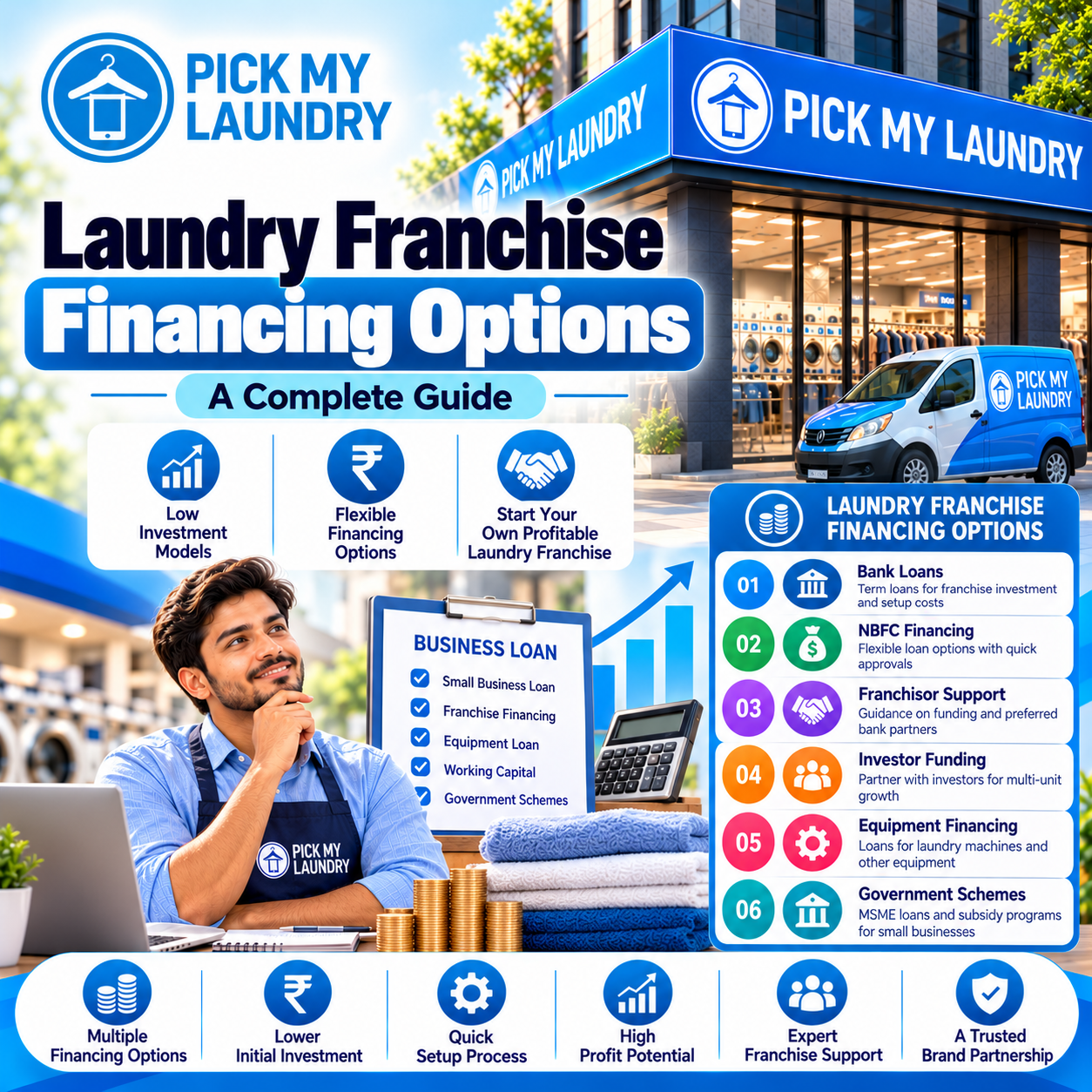
laundry franchise financing options
Introduction
Starting a laundry franchise requires financial planning before you select a location, sign a franchise agreement or purchase equipment. Even when a business opportunity appears promising, choosing the right funding method can make a significant difference to your cash flow and financial flexibility.
Entrepreneurs generally consider three broad options: self-funding, business loans and investor capital. Some combine these sources to cover the initial investment while retaining enough working capital to operate the business.
The right approach depends on your available savings, credit profile, business plan, expected expenses and ability to handle financial risk.
This guide explains the main laundry franchise financing options in India, the advantages and limitations of each method, and the questions to consider before investing in a Pick My Laundry franchise.
1. Understand Your Total Funding Requirement
Before choosing a funding source, estimate how much money you actually need.
A franchise investment may include more than the initial franchise fee.

Consider these expense categories:
|
Expense category |
What to evaluate |
|---|---|
|
Franchise fee |
Initial franchise charges |
|
Store setup |
Interiors, signage and furniture |
|
Equipment |
Machinery and installation, if required |
|
Property |
Rental deposit and initial rent |
|
Technology |
Billing and order-management systems |
|
Recruitment |
Hiring and staff training |
|
Marketing |
Launch promotions and local advertising |
|
Registrations |
Applicable licenses and registrations |
|
Working capital |
Cash for ongoing operating expenses |
|
Contingency |
Reserve for unexpected costs |
The actual requirements depend on the franchise model. A retail collection outlet may have a different setup budget from a store that processes garments on-site.
Ask the franchisor for a written investment breakup, clearly identifying what is included and what must be paid separately.
2. Option One: Self-Funding Your Laundry Franchise
Self-funding means using your own savings or other personal funds to finance the business.
This may suit entrepreneurs who have sufficient capital available and prefer not to take on a business loan or bring in an external investor.
Advantages of self-funding
-
No business-loan EMI on the amount funded from your savings.
-
No interest expense on that funded portion.
-
Greater independence in business decisions.
-
No need to negotiate an investor's ownership share.
-
Potentially simpler financial arrangements.
Limitations of self-funding
-
Your personal savings may be exposed to business risk.
-
You may have less money available for emergencies.
-
Funding the entire setup can leave insufficient working capital.
-
Other personal financial goals may be affected.
Practical tip: Avoid investing every available rupee in the initial setup. Keep personal emergency savings separate from the capital reserved for the business.
3. Option Two: Business Loans for a Laundry Franchise
A business loan can help fund eligible setup costs or other business requirements, depending on the lender's terms.
However, loan approval is not automatic. Lenders may assess your credit history, income, existing liabilities, business plan, repayment capacity, collateral requirements and other eligibility criteria.

Potential financing routes
-
Business term loans
-
Loans for eligible equipment purchases
-
Working-capital facilities
-
Secured business loans
-
Eligible government-supported lending schemes through participating lenders
The availability, eligibility and permitted uses of each facility must be confirmed with the lender.
Questions to ask before taking a loan
-
What is the effective interest rate?
-
What is the loan processing fee?
-
Is collateral required?
-
What is the repayment period?
-
What will the EMI be?
-
Are there prepayment charges?
-
When does repayment begin?
-
What happens if business revenue develops more slowly than expected?
Do not select a loan based only on the amount offered. Evaluate the total repayment cost and whether the business can support the EMI under a conservative sales scenario.
4. Option Three: Investor Capital
Investor funding involves obtaining capital from another person or entity in exchange for an agreed financial arrangement.
Depending on the structure, an investor may receive an ownership stake, a share of agreed returns or another contractual benefit.
Potential advantages
-
Reduces the amount of personal capital required.
-
May avoid or reduce reliance on debt.
-
Can provide access to business expertise or useful connections.
-
May allow the founder to preserve some personal liquidity.
Potential limitations
-
You may need to share ownership or economic returns.
-
Major decisions may require agreement between stakeholders.
-
Investor expectations can create pressure for growth.
-
Disputes can arise if roles and responsibilities are unclear.
Before accepting investor money, document the investment amount, ownership, responsibilities, decision-making authority, profit distribution and exit terms.
Seek independent legal and accounting advice before finalizing the arrangement.
5. Compare the Three Financing Options
|
Factor |
Self-funding |
Business loan |
Investor capital |
|---|---|---|---|
|
Personal capital needed |
Usually higher |
May be lower |
May be lower |
|
Interest expense |
None on own funds |
Usually applicable |
Depends on structure |
|
Ownership dilution |
Usually none |
Usually none |
Possible |
|
Repayment obligation |
No loan EMI |
Contractual repayments |
Depends on agreement |
|
Decision-making |
Generally more independent |
Subject to loan terms |
May be shared |
|
Main risk |
Personal savings exposure |
Repayment pressure |
Ownership and control trade-offs |
There is no universally best financing option. Choose based on your finances, risk tolerance and the specific terms available to you.
6. Consider a Combination of Funding Sources
Some entrepreneurs use a combination of personal savings and external funding rather than relying on one source.
For example, an investor might use personal capital for part of the setup, a suitable loan for eligible equipment and a separate cash reserve for working capital.
This can spread the funding requirement across sources, but it also introduces multiple obligations.
Before combining sources, confirm:
-
Total amount required
-
Loan repayment schedule
-
Investor ownership or return expectations
-
Available working capital after setup
-
Total monthly financial commitments
-
Emergency funding arrangements
Do not borrow more than your business plan can reasonably support.
7. Calculate the Impact of a Business Loan
Understanding the EMI before borrowing is essential.
For an ordinary reducing-balance loan with a fixed monthly interest rate, the EMI can be estimated using:
\[ EMI=\frac{P \times r(1+r)^n}{(1+r)^n-1} \]
Where:
-
\(P\) is the loan principal.
-
\(r\) is the monthly interest rate.
-
\(n\) is the total number of monthly payments.
The following calculator illustrates the relationship between loan amount, interest rate and repayment period.
Business loan EMI calculator
Illustrative calculation; actual lender terms and charges may differ.
Loan amount
₹10,00,000
Annual interest rate
12%
Repayment period
5 years
Estimated monthly EMI
₹22,244
Total payments
₹13,34,667
Estimated interest
₹3,34,667
Use the calculator to test different scenarios. It assumes a fixed interest rate and regular monthly repayments and excludes processing fees, insurance and other potential charges.
8. Keep Working Capital Separate
One of the most important financing decisions is how much cash to retain after opening the outlet.
Your funding plan should account for:
-
Rent
-
Salaries
-
Processing costs
-
Packaging and consumables
-
Utilities
-
Marketing
-
Franchise fees, where applicable
-
Delivery costs
-
Loan repayments
-
Unexpected expenses
A business that uses all its available capital for setup may struggle to meet routine expenses before customer sales stabilize.
Prepare a monthly cash flow forecast and stress-test it against slower sales and delayed payments.
9. Prepare a Business Plan Before Applying for Funding
A clear business plan can help you understand the commercial feasibility of the proposed franchise and support discussions with lenders or investors.
Include:
Business overview
Describe the proposed laundry franchise, operating model and target customer groups.
Location analysis
Explain the local demand, competition, rental costs and expected service area.
Investment breakdown
List setup costs, equipment, deposits, fees and working capital.
Revenue assumptions
Estimate customer orders, average order value, service mix and sales growth using realistic local assumptions.
Expense forecast
Include rent, payroll, processing, delivery, marketing and other applicable costs.
Cash flow and repayment plan
Show how the business is expected to meet operating expenses and any financing obligations.
Risk assessment
Explain how you would respond to slower sales, increased expenses or operational disruption.
Treat financial projections as estimates, not guaranteed returns.
10. Investigate Eligible Government-Supported Financing
Depending on your eligibility, business structure and the lender's current offerings, government-supported lending programs may be worth investigating.
Before relying on any scheme, verify the current eligibility rules, loan limits, permitted activities, guarantee arrangements and application process directly through official government resources or participating lenders.
Do not assume that a franchise investment automatically qualifies for a subsidy, collateral-free loan or special interest rate.
Also distinguish between a loan guarantee, a direct loan and a subsidy. These are different forms of support with different conditions.
11. Common Financing Mistakes to Avoid
-
Underestimating the total setup cost.
-
Using personal emergency savings without a reserve.
-
Borrowing without calculating the EMI.
-
Assuming the lender will approve the requested amount.
-
Ignoring working capital.
-
Accepting investor money without a written agreement.
-
Relying on optimistic revenue forecasts.
-
Ignoring processing fees and other financing charges.
-
Using funds for expenses that the lender does not permit.
-
Making a commitment before reviewing the franchise agreement.
A careful funding decision starts with understanding the full cost of opening and operating the business.
Why Consider Pick My Laundry?

Pick My Laundry operates in the laundry and dry-cleaning franchise sector.
12+ Years of Industry Experience | 500+ Stores | 90+ Cities | Operations Across 4 Countries
If you are considering a Pick My Laundry franchise, request the applicable investment breakdown, understand which setup costs are included and prepare a financial plan for your intended location.
Your funding decision should be based on verified commercial terms, available capital and a realistic assessment of your ability to meet operating expenses and repayment obligations.
Frequently Asked Questions
1. What are the main financing options for a laundry franchise in India?
The main options include personal savings, eligible business loans, investor capital and combinations of these sources.
2. Can I start a laundry franchise with a business loan?
Potentially, subject to the lender's eligibility criteria, approval process, permitted use of funds and repayment requirements.
3. Is self-funding better than taking a loan?
Self-funding avoids loan interest on the amount invested, but it exposes personal capital to business risk. A loan preserves some personal funds but creates repayment obligations.
4. Can I bring an investor into my laundry franchise?
That depends on the franchise agreement and your proposed business structure. Confirm any franchisor approval requirements and document the investment arrangement properly.
5. Should I finance the entire setup with a loan?
Not automatically. Assess your repayment capacity, working capital needs and the business's ability to handle slower-than-expected sales before deciding how much to borrow.
6. What documents might a lender request?
Requirements vary, but may include identity and address documents, bank statements, financial records, a business plan, cost estimates and information about the proposed franchise. Ask the lender for its current checklist.
7. Does a laundry franchise guarantee loan approval or business profit?
No. Loan approval depends on the lender's assessment, and business results depend on operating performance, costs, demand and other factors.
Conclusion
Choosing the right laundry franchise financing option means balancing available capital, borrowing costs, ownership preferences and the need for working capital.
Self-funding may offer greater independence, business loans may help spread the initial funding requirement, and investor capital may reduce reliance on personal savings. Each option has different costs and risks.
Before investing in a Pick My Laundry franchise, calculate the complete setup requirement, compare financing alternatives, review the agreement and build a conservative cash flow forecast.
The aim is not simply to arrange enough money to open the store. It is to finance the business in a way that allows it to operate sustainably.