
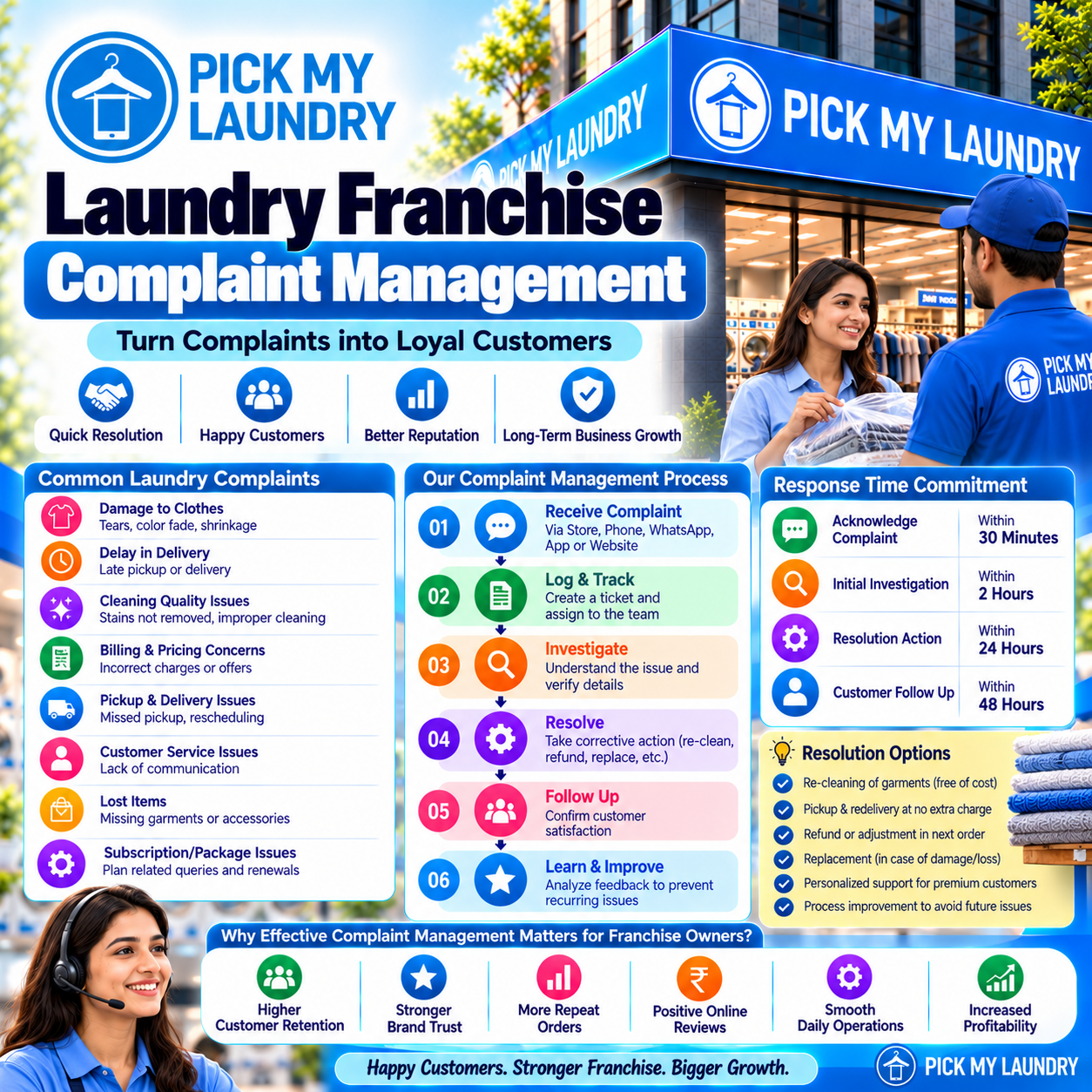
laundry franchise complaint management
Introduction
Customer complaints are an unavoidable part of running a laundry or dry cleaning business. A customer may report a delayed order, an incorrect bill, a missing garment, an unsatisfactory cleaning result, or damage discovered after collection.
How a laundry franchise handles these situations can influence customer trust, online reviews, repeat bookings, and the store's reputation.
Ignoring complaints or responding defensively can make a small problem more difficult to resolve. On the other hand, a structured complaint management process helps staff understand what happened, communicate clearly, document the issue, and take appropriate corrective action.
A laundry franchise complaint management SOP provides a consistent procedure for handling customer concerns from the first report through final resolution.
This guide explains how laundry franchise owners can create practical complaint-handling procedures, train employees, document incidents, and use customer feedback to improve service quality.
Pick My Laundry brings 12+ years of industry experience, 500+ stores, a presence in 90+ cities, and operations across 4 countries. Each franchise owner should follow the complaint-handling procedures applicable to their specific outlet and franchise agreement.
What Is Complaint Management in a Laundry Business?
Complaint management is the process of receiving, recording, investigating, resolving, and reviewing customer complaints.
In a laundry business, complaints may relate to several stages of the customer journey:
-
Garment receiving and order recording
-
Cleaning and finishing quality
-
Garment identification and tracking
-
Order completion and delivery
-
Pricing and billing
-
Customer communication
-
Refunds, rework, or other remedies
A proper system ensures that every complaint is acknowledged, assigned to a responsible person, investigated, and resolved according to the business's policies and applicable requirements.
Complaint management should not focus only on closing individual cases. It should also identify recurring problems and prevent them from happening again.
Why Complaint Management Matters for a Laundry Franchise
1. Protects Customer Trust
Customers want their garments handled carefully and their concerns taken seriously. A professional response shows that the business is willing to investigate and address legitimate problems.
2. Supports Customer Retention
A customer who experiences a problem may still consider using the store again if the issue is handled fairly and professionally. However, retention is not guaranteed, and the quality of the resolution matters.
3. Helps Protect Brand Reputation
Unresolved complaints can lead to negative reviews and public criticism. A consistent process helps owners respond accurately, avoid unnecessary arguments, and demonstrate a commitment to service quality.
4. Identifies Operational Weaknesses
Repeated complaints about delays, billing, garment tagging, or cleaning quality may indicate a process problem rather than an isolated mistake.
5. Improves Staff Accountability
A documented procedure helps employees understand when they can resolve an issue themselves and when they should escalate it to a manager.
7 Common Complaints in Laundry and Dry Cleaning Businesses
1. Delayed Orders
Customers may complain when garments are not ready by the agreed date.
Possible causes include equipment downtime, processing backlogs, transport delays, inaccurate turnaround promises, or staffing shortages.
2. Garment Damage
A customer may report colour changes, shrinkage, fabric damage, missing buttons, or other concerns.
The business should review the garment's condition at receiving, recorded care instructions, processing details, and applicable service procedures before deciding on a resolution.
3. Missing or Mixed-Up Garments
Customers may report that an item is missing or that their order contains another customer's garment.
These complaints require prompt investigation of garment counts, order tags, storage records, processing transfers, and handover documentation.
4. Unsatisfactory Cleaning Results
A customer may report that a stain remains or that the garment does not appear as expected.
Staff should explain cleaning limitations accurately, review the service performed, and determine whether inspection, additional treatment, or another remedy is appropriate.
5. Incorrect Billing
A customer may dispute a price, discount, quantity, or additional charge.
The store should compare the bill with the approved price list, order record, and advertised promotional terms.
6. Poor Customer Service
Customers may report rude communication, unclear explanations, or a lack of updates.
These issues may require coaching, clearer service scripts, and better communication procedures.
7. Pickup and Delivery Problems
Late pickups, missed deliveries, incorrect addresses, or poor handover records can create frustration.
The store should check the booking details, dispatch records, communication history, and delivery partner's handover information.
A 7-Step Complaint Resolution SOP for Laundry Franchise Owners
1
Listen and acknowledge
Allow the customer to explain the issue without interruption. Acknowledge the concern politely without making assumptions about fault.
2
Record the complaint
Capture the order number, issue category, relevant garment details, customer explanation, and preferred contact method.
3
Assess urgency
Prioritise issues involving garment safety, missing items, significant damage concerns, imminent deadlines, or unresolved customer distress.
4
Investigate the facts
Review order records, garment inspection notes, processing details, billing, and handover records as relevant.
5
Offer an appropriate resolution
Follow the applicable policy, agreement, and legal requirements. Explain the available options clearly.
6
Confirm the outcome
Inform the customer of the decision and next steps. Record the resolution and confirm whether any further action is required.
7
Prevent recurrence
Identify the root cause, assign corrective action, and verify whether the change reduces repeat complaints.
How to Handle Different Laundry Customer Complaints
SOP 1: Delayed Order Complaint
Step 1: Verify the order number and promised completion time.
Step 2: Check the actual processing or delivery status.
Step 3: Identify the reason for the delay.
Step 4: Inform the customer of the current status and provide a realistic revised estimate.
Step 5: Escalate repeated or significant delays to the responsible manager.
Step 6: Record the cause and review whether the original turnaround promise was realistic.
Example response:
“We apologise that your order is taking longer than expected. We are checking its current status and will update you with a realistic completion time. Thank you for your patience.”
Do not promise an immediate delivery unless the team has confirmed that it can meet the commitment.
SOP 2: Garment Damage Complaint
Garment damage complaints require careful handling because the cause may not be immediately clear.
Step 1: Listen to the customer's explanation and record the affected garment.
Step 2: Review the original receiving record and any documented pre-existing damage.
Step 3: Inspect the garment, where appropriate, and document the reported issue.
Step 4: Review the requested service, care instructions, processing records, and relevant staff or facility handovers.
Step 5: Escalate the case when the facts are unclear or the potential impact is significant.
Step 6: Explain the findings and applicable resolution options to the customer.
Step 7: Record the outcome and identify any preventive action.
Do not automatically accept or reject responsibility before investigating. Any compensation, repair, refund, or other remedy should follow the applicable policy and legal obligations.
SOP 3: Missing Garment Complaint
Step 1: Confirm the original order details and garment count.
Step 2: Check the tagging system, storage area, and completed-order records.
Step 3: Review transfers between the outlet, processing facility, and delivery team.
Step 4: Record the last verified location and responsible handover.
Step 5: Assign the investigation to a designated manager.
Step 6: Update the customer according to the agreed communication schedule.
Step 7: Document the final outcome and review the tracking process for gaps.
Do not ask the customer to repeat information unnecessarily when it is already available in the order record.
SOP 4: Unsatisfactory Cleaning Result
Step 1: Identify the garment and the service requested.
Step 2: Ask the customer what result they expected and what remains unsatisfactory.
Step 3: Review care instructions, inspection notes, and the cleaning method used.
Step 4: Determine whether further inspection or additional treatment is appropriate.
Step 5: Explain realistic options and limitations.
Step 6: Record any rework or other agreed resolution.
Not all stains can be removed safely. Staff should avoid promising a result that the garment's fabric, construction, or stain characteristics may not permit.
SOP 5: Billing or Discount Complaint
Step 1: Review the order receipt and service details.
Step 2: Compare the charge with the approved price list.
Step 3: Check any applicable offer terms, exclusions, or minimum order conditions.
Step 4: Correct verified billing errors according to the store's procedure.
Step 5: Explain the calculation clearly to the customer.
Step 6: Record the adjustment and identify any system or training issue.
Ensure that advertised offers and billing procedures use consistent terms.
Create a Complaint Register for Your Laundry Franchise
Every complaint should be recorded in a central register or appropriate business system.
A useful complaint record includes:
|
Field |
Information to Record |
|---|---|
|
Complaint ID |
Unique complaint reference |
|
Order number |
Related customer order |
|
Date received |
When the complaint was reported |
|
Complaint category |
Delay, damage, missing item, billing, etc. |
|
Description |
Customer's reported concern |
|
Assigned person |
Employee or manager responsible |
|
Priority |
Urgency based on the issue |
|
Investigation |
Relevant findings and evidence |
|
Resolution |
Action taken or decision made |
|
Status |
Open, under review, or closed |
|
Follow-up |
Next action and target date |
|
Root cause |
Identified process or service issue, where established |
Restrict access to complaint records appropriately. Store customer information only as needed for legitimate business purposes and follow applicable privacy requirements.
Set Complaint Response and Resolution Targets
Customers should know when they can expect an update. Internally defined response targets help employees manage cases consistently.
The following are illustrative internal targets, not industry standards or guarantees:
|
Complaint Type |
Suggested Initial Action |
|---|---|
|
Billing discrepancy |
Verify during the interaction where possible |
|
Delayed order |
Check status and communicate an update promptly |
|
Missing garment |
Begin a documented traceability investigation promptly |
|
Garment damage |
Arrange review and escalate according to severity |
|
General service complaint |
Acknowledge, record, and assign responsibility |
For each category, define a realistic time for the first response, the next update, and resolution where possible. Complex cases may require longer investigation, so communicate delays rather than allowing the customer to hear nothing.
How to Measure Complaint Management Performance
Tracking complaint data helps owners identify recurring problems and determine whether corrective actions are working.
1. Complaint Rate
Complaint Rate = Orders With at Least One Complaint ÷ Completed Orders × 100
This measures the proportion of completed orders associated with complaints during a defined period.
2. First Response Time
Measure the time between receiving a complaint and providing the first meaningful response.
A quick acknowledgement is useful, but it should not be mistaken for a completed investigation.
3. Resolution Time
Measure how long it takes to resolve a complaint according to a consistent definition.
Review the median as well as the average if a small number of complex cases cause unusually long delays.
4. Repeat Complaint Rate
Track how often the same customer or the same issue category generates another complaint during a defined period.
This can help identify recurring service problems.
5. Rework Rate
Rework Rate = Orders Requiring Additional Work ÷ Completed Orders × 100
Review the reasons for rework to understand whether the underlying issue relates to processing, inspection, customer expectations, or another factor.
6. Corrective-Action Completion Rate
Measure the proportion of corrective actions completed by their agreed deadlines.
Completion should include verification where necessary, rather than simply marking an action as finished.
Train Staff to Handle Complaints Professionally
Employees should be trained to remain calm, listen carefully, and avoid arguments.
Essential staff guidelines
-
Let the customer finish explaining the issue.
-
Acknowledge the concern without making unsupported admissions or denials.
-
Ask relevant questions politely.
-
Record facts accurately.
-
Avoid blaming another employee or facility before the investigation.
-
Never promise an unauthorised refund or compensation.
-
Explain what happens next and when the customer can expect an update.
-
Escalate issues beyond the employee's authority.
-
Protect the customer's personal information.
-
Document the outcome.
Staff should know which complaints they can resolve independently and which require approval from a manager or franchisor.
How to Respond to Negative Online Reviews
A customer may post a complaint on a public review platform before contacting the store directly.
A professional response should acknowledge the concern, avoid revealing private order details, and invite the customer to contact the business through an appropriate channel.
Example response:
We're sorry to hear about your experience and appreciate you bringing this to our attention. We take customer concerns seriously and would like to understand what happened so we can review the matter. Please contact our store through the official contact details and share your order reference privately so our team can assist you.
Avoid arguing publicly, sharing customer information, or promising a specific outcome before the facts are established.
The objective is to demonstrate professionalism while moving the detailed investigation into an appropriate private channel.
Common Complaint Management Mistakes
Ignoring Complaints
A complaint that receives no response can become more difficult to resolve. Acknowledge it, assign responsibility, and provide an update.
Making Promises Without Checking the Facts
Unrealistic delivery commitments or unauthorised compensation offers can create further problems. Verify the situation before making a commitment.
Failing to Document the Case
Without records, employees may repeat investigations, lose important details, or provide inconsistent explanations.
Treating Every Complaint as an Isolated Event
Repeated complaints about the same process may indicate a systemic problem. Analyse patterns across orders, employees, and service categories.
Closing Complaints Too Early
A case should be closed only when the required action has been completed and the outcome has been documented according to the store's procedure.
Focusing Only on Public Reviews
Private complaints, direct calls, and in-store concerns are also important. Use a consistent process across all customer contact channels.
How Pick My Laundry Franchise Owners Can Build a Complaint Management System
A franchise owner should establish a clear process for receiving complaints, investigating issues, escalating complex cases, and recording resolutions.
Before opening a store, clarify the complaint-handling requirements that apply to the selected franchise model.
Important areas include:
-
Standard customer service procedures
-
Garment damage and missing-item escalation
-
Refund and rework policies
-
Customer communication standards
-
Complaint recordkeeping
-
Staff training
-
Quality audits
-
Brand-level escalation, where applicable
Pick My Laundry's 12+ years of industry experience, 500+ stores, presence in 90+ cities, and operations across 4 countries provide context for prospective franchise partners evaluating the business.
However, owners should confirm the actual complaint management procedures and support arrangements provided under the applicable franchise agreement.
Learn more at https://pickmylaundry.in.
Frequently Asked Questions (FAQs)
1. How should a laundry franchise handle customer complaints?
Listen to the customer, record the concern, assess urgency, investigate relevant records, offer an appropriate resolution, communicate the outcome, and take corrective action where needed.
2. What should I do if a customer reports damaged clothes?
Record the complaint, review the garment's original condition and care instructions, inspect relevant records, investigate the circumstances, and follow the applicable resolution policy and legal requirements.
3. How can a laundry business handle missing garments?
Verify the order details, check garment tags and storage, review processing and handover records, assign an investigation, and keep the customer informed until the issue is resolved.
4. Should a laundry franchise refund every unhappy customer?
Not necessarily. The appropriate response depends on the facts, applicable policy, franchise agreement, and legal obligations. Options may include a correction, rework, refund, or other appropriate remedy, depending on the circumstances.
5. How quickly should a laundry business respond to complaints?
The store should define response targets based on the complaint type and operational capacity. Urgent garment-related concerns may need immediate escalation, while complex cases may require additional investigation.
6. How can complaint management improve customer retention?
Professional communication, fair investigation, and appropriate resolution can help preserve trust. Retention is not guaranteed, so owners should also address the underlying causes of complaints.
7. What is a complaint management SOP?
A complaint management SOP is a documented procedure that explains how employees receive, record, investigate, escalate, resolve, and review customer concerns.
Conclusion
Complaint management is an essential part of running a professional laundry franchise. Delays, garment damage concerns, missing items, billing disputes, and service complaints require a consistent and documented response.
A clear SOP helps staff investigate issues fairly, communicate realistic expectations, and resolve complaints according to the applicable policies. Tracking complaint categories and root causes also helps owners identify recurring weaknesses and improve service quality.
The goal is not simply to close complaints. It is to create a process that protects customer trust, supports employees, and reduces the likelihood of the same problem happening again.
Explore the Pick My Laundry franchise opportunity to learn more about available models, investment requirements, and applicable support.
Website: https://pickmylaundry.in
Internal Linking Suggestions
Add contextual links to these related Pick My Laundry blogs:
-
Laundry Franchise Quality Audit Checklist: How to Maintain Service Standards — link from the section about root-cause analysis and quality improvement.
-
Laundry Franchise Garment Loss Prevention: Tracking, Sorting & Handover — link from missing-garment complaint handling.
-
Laundry Franchise Monthly KPI Dashboard: Metrics Every Owner Should Track — link from complaint performance metrics.
-
Garment Safety & Quality Control in Professional Dry Cleaning: A Complete Guide — link from garment damage and cleaning-result complaints.
-
Laundry Franchise Customer Lifetime Value: Why Repeat Customers Matter — link from customer retention.
Use the correct published URLs when adding these internal links.