
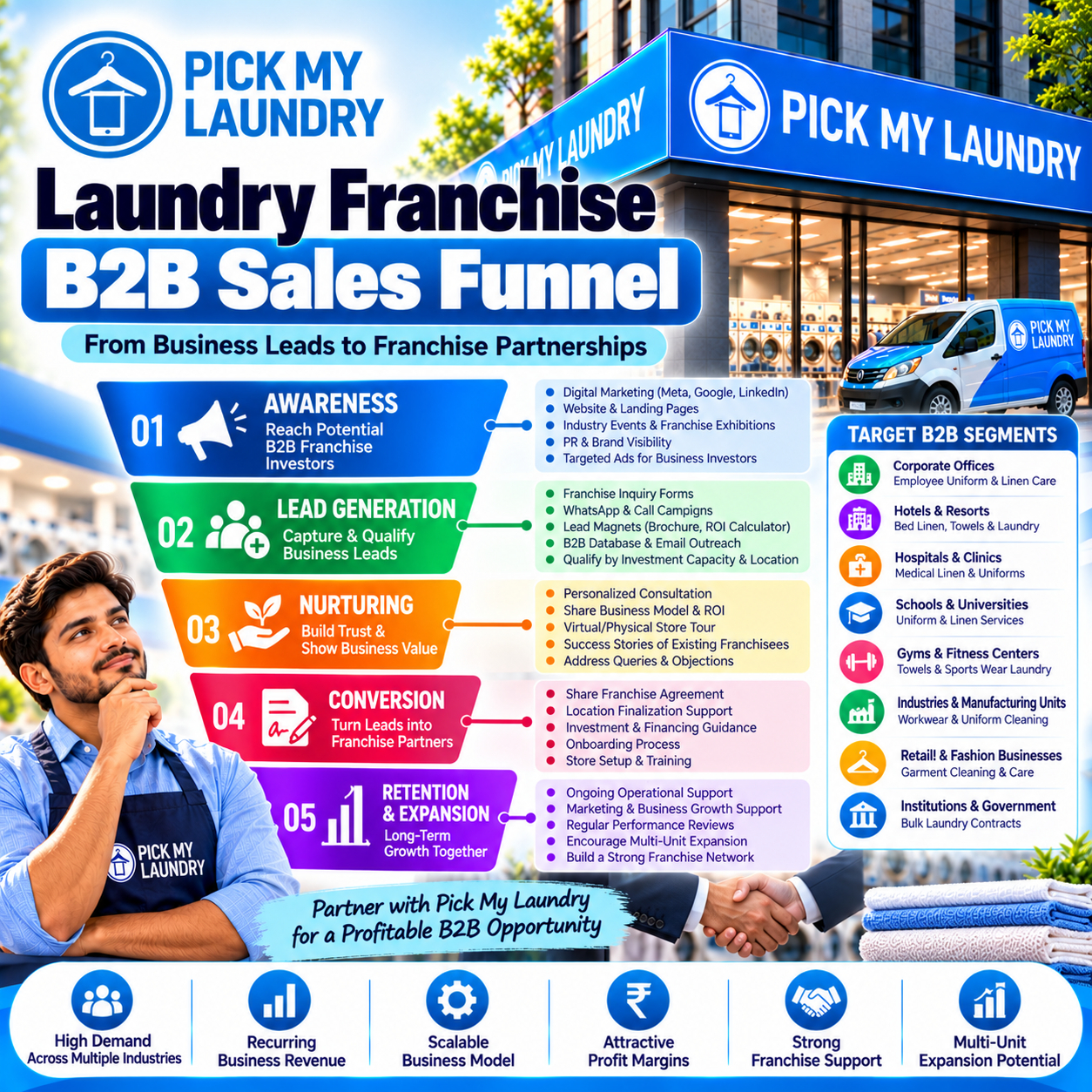
laundry franchise B2B sales funnel
Introduction
A laundry franchise can serve more than individual households and walk-in customers. Depending on its equipment, processing capacity, service capabilities, and local demand, it may also serve businesses that require regular laundry or garment-care services.
Potential B2B customers include hotels, salons, gyms, spas, clinics, hostels, serviced apartments, restaurants, uniform-based businesses, and other organisations with recurring textile-care requirements.
However, winning a corporate customer usually requires a different approach from attracting an individual customer. Business clients may evaluate pricing, processing capacity, hygiene procedures, pickup schedules, turnaround times, garment tracking, invoicing, and service reliability before signing a contract.
This is where a laundry franchise B2B sales funnel becomes useful. It provides a structured process for identifying potential clients, generating enquiries, qualifying leads, presenting a suitable proposal, negotiating terms, and converting opportunities into ongoing business.
For laundry franchise owners, a well-managed sales funnel can create opportunities to build business relationships and diversify revenue sources. Results depend on local demand, service capability, pricing, and consistent execution—not simply the number of leads generated.
1. What Is a B2B Sales Funnel for a Laundry Franchise?
A B2B sales funnel is the journey a business prospect follows from first learning about your laundry service to becoming a paying corporate customer.
Unlike individual customers, business buyers often need to compare providers, consult colleagues, review budgets, test service quality, and obtain approval before making a decision.
A typical laundry B2B sales funnel includes six stages:
01
Lead generation
Identify businesses with recurring laundry requirements.
02
Lead qualification
Check service needs, order volume, location, budget, and decision-makers.
03
Discovery and assessment
Understand garment types, collection frequency, quality expectations, and timelines.
04
Proposal and trial
Present pricing, service terms, and an appropriate trial where feasible.
05
Negotiation and contract
Agree on rates, service levels, billing, responsibilities, and payment terms.
06
Onboarding and retention
Start operations, monitor performance, and develop the relationship.
The purpose of the funnel is to make sales activity measurable. Instead of contacting businesses randomly, the franchise owner can track how many prospects move from one stage to the next and identify where opportunities are being lost.
2. Identify the Right B2B Customers
Not every business is a suitable client for every laundry franchise. Start with organisations whose needs match your store's capabilities.
Hotels and guest houses
Hotels and guest houses may require regular processing of bedsheets, pillowcases, towels, uniforms, and other textiles. Before approaching them, check whether your operation can handle their expected volume, turnaround times, and quality requirements.
Salons, spas, and gyms
These businesses may need recurring cleaning for towels, robes, uniforms, and similar items. Their requirements can be suitable for local service arrangements when the order volume and collection schedule are practical.
Hostels and paying guest accommodations
Student hostels, paying guest accommodations, and managed residences may generate repeat laundry demand. Understand whether they need individual garment care, linen processing, or a combination of services.
Clinics and healthcare-related businesses
Some clinics and healthcare facilities require specialised handling procedures for textiles. Approach these prospects only if your facility can meet their applicable hygiene, segregation, handling, and processing requirements. Do not claim specialised healthcare compliance without verifying it.
Restaurants and food-service businesses
Restaurants may need regular cleaning for uniforms, aprons, and selected linen items. Service arrangements should account for stains, fabric types, expected volume, and pickup frequency.
Uniform-based businesses
Companies with staff uniforms may require recurring laundry or dry-cleaning services. These prospects can be worth evaluating when garment-care needs and order sizes match your operational capacity.
Practical tip: Build a focused list of local prospects instead of contacting every business in the area. A smaller list of relevant prospects is often more useful than a large list with little potential.
3. Build a Local B2B Lead Generation System
Lead generation is the first stage of the funnel. The objective is to create a reliable list of relevant businesses and identify the people responsible for choosing their laundry provider.
Use Google Search and Google Maps
Search for relevant business categories in your service area, such as hotels, gyms, salons, hostels, and serviced apartments.
Record business names, locations, available contact details, business type, and potential laundry needs. Verify details before outreach and comply with applicable privacy and communication rules.
Visit local business clusters
Industrial areas, hotel districts, commercial markets, and neighbourhoods with many hostels or salons may offer opportunities for in-person prospecting.
A brief visit can help you understand the business's requirements and identify the appropriate person to contact.
Build referral relationships
Potential referral sources may include hospitality suppliers, property managers, uniform providers, facility managers, and other professionals who work with businesses that need laundry services.
Keep referral arrangements transparent and ensure they comply with applicable rules and brand policies.
Use your website to attract corporate enquiries
Create a dedicated B2B or commercial laundry service page if the franchise is authorised and equipped to provide these services.
The page should explain:
-
Which business categories you serve.
-
What types of textiles and garments you accept.
-
Your service area and collection arrangements.
-
How businesses can request a quotation.
-
How to contact the store for an assessment or trial.
Avoid listing services that the store cannot reliably deliver.
Use targeted outreach
Contact relevant businesses with a concise, personalised message. Explain why your service may suit their requirements and invite them to discuss their laundry needs.
Avoid sending generic bulk messages that ignore the prospect's business type.
4. Qualify Leads Before Spending Too Much Time
Not every enquiry will become a profitable contract. Lead qualification helps you focus on opportunities that fit the store's service capacity and commercial objectives.
Ask prospects questions such as:
-
What types of garments, towels, uniforms, or linen need processing?
-
Approximately how much laundry do you generate per day or week?
-
How frequently do you need collection and delivery?
-
What turnaround time do you expect?
-
What problems do you currently experience with your provider?
-
Who approves the service provider and commercial terms?
-
What are your invoicing and payment requirements?
-
When would you like the service to begin?
Use the answers to assess whether the lead is a good fit.
For example, a prospect may offer high order volume but require processing times that your store cannot meet. Another may have a smaller order volume but be located close to your store, making collections more economical.
Evaluate both revenue potential and the operational cost of fulfilling the contract.
5. Conduct a Discovery Meeting
Once a prospect is qualified, arrange a call, meeting, or site assessment.
The purpose is to understand the customer's requirements before quoting a price.
Assess the service requirements
Document the types of items, approximate quantities, fabric types, stain concerns, packaging needs, and collection frequency.
Understand the current problem
Ask whether the business is dissatisfied with its current provider because of delayed delivery, inconsistent quality, poor communication, billing issues, or another problem.
This helps you present a relevant solution rather than relying entirely on discounts.
Confirm the expected service level
Discuss realistic turnaround times, order tracking, escalation procedures, collection schedules, and responsibilities for identifying or reporting damaged items.
Any service commitment should be supported by your actual operational capacity.
Calculate the commercial feasibility
Estimate the cost of processing the expected volume, including labour, utilities, detergents, packaging, transport, specialist treatments, and reprocessing where relevant.
If the order requires additional equipment, staff, or delivery capacity, include those implications in the assessment.
6. Prepare a Professional B2B Proposal
A corporate proposal should make it easy for the decision-maker to understand the service, cost, and terms.
Include the following sections:
|
Proposal section |
What to include |
|---|---|
|
Business overview |
Franchise/store details and relevant capabilities |
|
Scope of service |
Garments, textiles, and treatments covered |
|
Estimated volume |
Expected quantity and frequency |
|
Pricing |
Per-item, per-kilogram, or agreed package rates |
|
Pickup and delivery |
Schedule, service area, and associated charges |
|
Turnaround time |
Realistic processing and delivery commitments |
|
Quality procedures |
Sorting, tracking, inspection, and complaint handling |
|
Billing terms |
Invoice frequency, payment deadline, and taxes where applicable |
|
Contract terms |
Duration, cancellation, changes, and responsibilities |
|
Next steps |
Trial, approval, onboarding, and start date |
Keep the pricing transparent. If a quote depends on volume, fabric type, stain treatment, or special handling, state those conditions clearly.
Should you offer a trial?
A trial can help a prospect assess service quality before entering into a longer-term agreement.
Where practical, agree on a limited trial with a defined quantity, scope, price, and evaluation criteria. Record the outcome and ask for feedback before preparing the final proposal.
Do not offer a free trial automatically. Evaluate its cost and commercial purpose first.
7. How to Price Corporate Laundry Contracts
B2B pricing should be based on service requirements and actual fulfilment costs rather than the competitor's price alone.
Common pricing approaches include:
-
Per-kilogram pricing: Suitable for certain bulk laundry categories where weight is a useful billing unit.
-
Per-item pricing: Useful for uniforms, garments, and items with distinct processing requirements.
-
Recurring package pricing: An agreed monthly price for a defined service scope and volume.
-
Tiered volume pricing: Different rates for clearly specified volume bands.
-
Custom contract pricing: A tailored rate based on the customer's service mix, frequency, logistics, and other requirements.
Before approving a quote, consider:
-
Direct processing costs.
-
Pickup and delivery expenses.
-
Labour and capacity requirements.
-
Packaging and specialist treatment costs.
-
Expected reprocessing or complaint-related costs.
-
Administrative and billing requirements.
-
The contribution needed to support the business's fixed expenses.
A large contract is not necessarily a profitable contract. High volume at unsustainable prices can strain staff, equipment, and cash flow.
8. Convert Proposals Into Signed Contracts
After submitting a proposal, follow up professionally and systematically.
Set the next step before ending the meeting
Ask when the decision-maker expects to review the proposal and whether any additional information is required.
Respond to objections with evidence
If a prospect raises concerns about price, explain the service scope, quality controls, collection arrangements, and other relevant value. Avoid making unsupported claims about superior quality or guaranteed savings.
Offer alternatives where feasible
If the full proposal is outside the customer's budget, consider a smaller service scope, different collection frequency, or a limited pilot. Only offer changes that remain operationally and commercially viable.
Confirm the contract terms in writing
Before starting service, document the agreed rates, quantities or billing method, pickup schedule, turnaround time, payment terms, service exclusions, complaint process, and contract duration.
For larger or more complex agreements, obtain appropriate legal or professional review.
9. Onboard the Customer and Retain the Contract
Winning the contract is only the beginning. Reliable delivery and clear communication determine whether the relationship continues.
Create a standard onboarding checklist covering:
-
Customer contact and escalation details.
-
Approved service list and pricing.
-
Collection and delivery timetable.
-
Order identification and tracking procedures.
-
Garment and textile handling requirements.
-
Invoice format and billing contact.
-
Complaint and reprocessing procedures.
-
Regular service review meetings.
Assign responsibility for each task. Make sure the operational team understands the agreement before the first collection.
Track recurring issues and address them early. A customer who repeatedly experiences missing items, delayed orders, or unclear invoices may reconsider the relationship even if the original price was attractive.
Where appropriate, review service performance with the customer monthly or quarterly and discuss changes in volume, scheduling, and requirements.
10. Measure Your B2B Sales Funnel
A sales funnel should be reviewed using measurable indicators.
|
KPI |
Why it matters |
|---|---|
|
New prospects contacted |
Measures outreach activity |
|
Qualified leads |
Shows how many prospects match your service capabilities |
|
Meetings booked |
Measures engagement with potential buyers |
|
Proposals submitted |
Tracks commercial opportunities |
|
Proposal conversion rate |
Shows how effectively proposals become contracts |
|
Average sales cycle |
Measures the time taken to win business |
|
Customer acquisition cost |
Estimates the cost of winning a new customer |
|
Contract contribution |
Shows revenue remaining after relevant fulfilment costs |
|
On-time delivery rate |
Tracks operational reliability |
|
Contract renewal rate |
Measures customer retention |
Review the funnel monthly. If many prospects are contacted but few agree to meetings, your targeting or outreach may need improvement. If meetings are frequent but proposals do not convert, review service fit, pricing, proposal quality, and decision-making requirements.
A basic spreadsheet or customer relationship management system can help track prospect details, follow-up dates, current sales stage, proposal value, and next actions.
11. Common B2B Sales Mistakes to Avoid
Laundry franchise owners should avoid these common mistakes:
-
Contacting businesses without checking whether their needs match the store's capabilities.
-
Quoting prices before understanding volume, textile types, and delivery requirements.
-
Offering discounts without calculating fulfilment costs.
-
Promising turnaround times that operations cannot consistently meet.
-
Failing to follow up after submitting a proposal.
-
Starting service without written commercial terms.
-
Ignoring payment delays and their effect on working capital.
-
Accepting more volume than the store can process reliably.
-
Failing to review customer satisfaction and contract performance.
A repeatable sales process helps reduce avoidable mistakes and makes it easier to build a sustainable corporate customer base.
12. How Pick My Laundry Franchise Owners Can Approach B2B Growth
Pick My Laundry has 12+ years of industry experience, 500+ stores, presence in 90+ cities, and operations across 4 countries.
These brand milestones provide context for prospective franchise partners evaluating the business. However, each store's B2B opportunities depend on its location, permitted service offerings, processing capabilities, local competition, and customer demand.
Before pursuing corporate contracts, franchise owners should confirm the services they are authorised to offer, the support available from the brand, and any requirements for pricing, marketing, and contract approvals.
A practical starting point is to identify a small group of suitable local businesses, understand their needs, prepare cost-based proposals, and measure the results. Expand the sales effort as the store develops the capacity to serve additional clients reliably.
To explore the franchise opportunity, visit Pick My Laundry.
Frequently Asked Questions
1. What is a B2B sales funnel in the laundry business?
It is a structured process for identifying potential business customers, qualifying their needs, presenting proposals, negotiating contracts, and retaining clients.
2. Which businesses can become B2B laundry customers?
Potential clients include hotels, hostels, salons, gyms, spas, restaurants, serviced apartments, and businesses that need recurring garment or textile care. Suitability depends on the laundry store's capabilities and applicable handling requirements.
3. How can a laundry franchise generate corporate leads?
Lead generation methods include local business research, Google Maps, business visits, referrals, a dedicated commercial service webpage, and targeted outreach to relevant decision-makers.
4. How should a laundry business quote a corporate client?
Estimate the expected volume and service requirements, calculate processing and delivery costs, determine a sustainable price, and clearly document service scope, turnaround times, billing, and exclusions.
5. How long does it take to close a corporate laundry contract?
There is no universal timeline. Small businesses may decide relatively quickly, while larger organisations may require multiple meetings, trial runs, procurement approval, and contract review.
6. How can a laundry franchise retain B2B customers?
Maintain consistent quality, meet agreed collection and delivery schedules, communicate clearly, resolve issues promptly, provide accurate invoices, and review service performance regularly.
7. Should a laundry franchise accept every corporate contract?
No. The franchise owner should assess profitability, capacity, logistics, payment terms, service requirements, and brand policies before committing.
Conclusion
A structured B2B sales funnel can help a laundry franchise move from random prospecting to a more measurable process for winning corporate clients. The key stages are identifying suitable businesses, qualifying their needs, preparing realistic proposals, agreeing on clear contracts, and delivering reliable service.
The objective should not be to win the largest possible contract at any price. It should be to develop customer relationships that fit the store's capabilities and contribute sustainably to its business.
For franchise information and business enquiries, visit pickmylaundry.in.
Internal Linking Suggestions
Link this blog to related articles on your website:
-
Laundry Franchise Customer Acquisition Cost: How to Measure Marketing ROI — use the published URL for Blog #19.
-
Laundry Franchise Customer Lifetime Value: Why Repeat Customers Matter — use the published URL for Blog #20.
-
Laundry Franchise Pricing Strategy: How to Set Prices for Your Market — use the published URL for Blog #18.
-
Laundry Franchise Cash Flow Management: A Practical Guide for Store Owners — use the published URL for Blog #10.
-
Digital Marketing Strategy for a Laundry & Dry Cleaning Business in India —
/digital-marketing-strategy-laundry-dry-cleaning-business
Verify that each destination URL is live before publishing.