
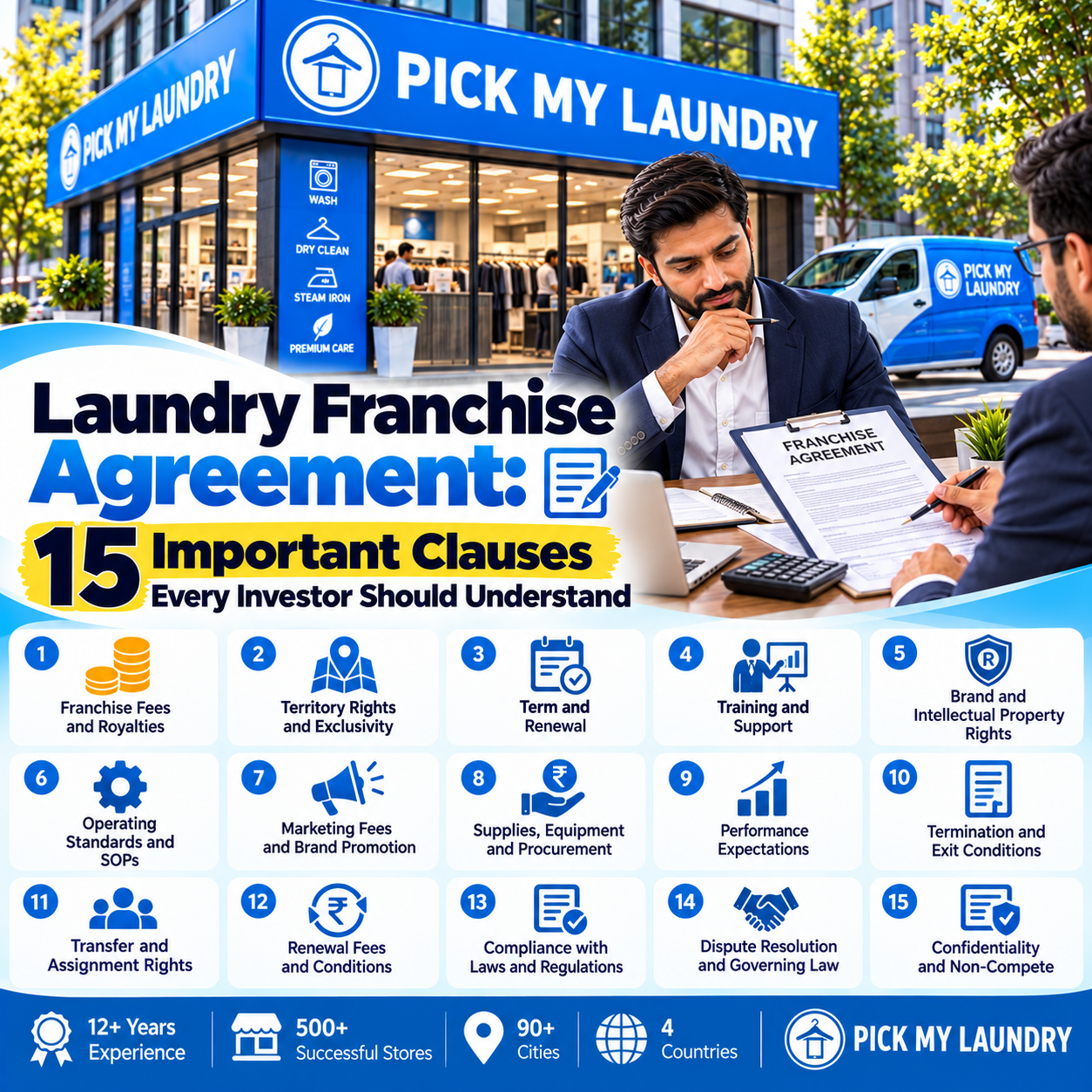
Laundry Franchise Agreement: 15 Important Clauses Every Investor Should Understand
Laundry Franchise Agreement: 15 Important Clauses Every Investor Should Understand
Choosing a laundry franchise is not only a financial decision. It is also a contractual relationship between the franchise owner and the franchisor.
The franchise agreement defines the rights, responsibilities, restrictions and obligations of both parties. It can cover everything from the use of the brand name and store standards to fees, territory, training, marketing, renewal and termination.
For someone considering a laundry franchise agreement, understanding these provisions before signing is essential.
This guide explains 15 areas that prospective franchise investors should carefully review.
Important: This article is an educational checklist, not legal advice. Franchise agreements can differ significantly. For a significant investment, consider having the actual agreement reviewed by a qualified legal professional before signing.
1. Franchise Fee
The first clause to understand is the franchise fee.
The agreement should clearly explain:
- Amount payable
- Payment schedule
- Taxes, if applicable
- What the fee covers
- Whether it is refundable
- Conditions attached to payment
Do not assume that the franchise fee represents the entire investment.
The total project cost can also include:
- Store setup
- Equipment
- Interiors
- Technology
- Property deposit
- Staff
- Marketing
- Working capital
2. Total Investment & Additional Costs
A franchise agreement may not list every cost involved in establishing and operating the outlet.
Before signing, ask for a complete investment breakdown.
Check whether you will separately pay for:
- Equipment
- Interiors
- Signage
- Software
- Training
- Marketing
- Packaging
- Maintenance
- Renewals
- Transportation
- Other operational requirements
The goal is to understand the total financial commitment, not just the franchise fee.
3. Franchise Term
The agreement should specify how long the franchise relationship will remain valid.
Check:
- Initial term
- Start date
- End date
- Conditions for continuation
- Renewal procedure
- Notice period
A longer agreement does not automatically mean a better arrangement. What matters is understanding the rights and obligations throughout the term.
4. Renewal Conditions
Don't only check the initial agreement period.
Read the renewal clause carefully.
Questions to ask include:
- Can the agreement be renewed?
- How far in advance must renewal be requested?
- Is there a renewal fee?
- Can the franchisor change commercial terms at renewal?
- Are there performance requirements?
- Can the renewal be refused under specific circumstances?
Understanding renewal conditions can help you plan the business beyond the initial contract period.
5. Territory & Location Rights
Some franchise agreements may define a geographic territory or operating area.
If applicable, understand:
- Territory boundaries
- Whether exclusivity is provided
- Whether another outlet can open nearby
- Online-order implications
- Delivery-area rules
- Expansion rights
Do not assume that opening one outlet automatically gives permanent exclusivity over an entire city or locality.
The exact rights should be confirmed in writing.
6. Brand & Trademark Usage
A franchise typically involves permission to use the franchisor's brand.
The agreement may define how you can use:
- Brand name
- Logo
- Signage
- Store design
- Marketing materials
- Uniforms
- Digital assets
- Website references
- Social-media branding
It may also specify what happens to these assets when the agreement ends.
This section is particularly important because the franchisee generally does not own the franchisor's intellectual property simply by operating a franchise.
7. Store Design & Branding Standards
A franchise may require stores to follow specific brand standards.
These can include:
- Exterior signage
- Interior design
- Colours
- Furniture
- Customer counter
- Equipment placement
- Uniforms
- Packaging
- Promotional material
Before investing in a property, understand whether the proposed location can accommodate the required format.
8. Operational Standards & SOPs
The agreement may require the franchisee to follow defined operating procedures.
These can relate to:
- Garment receiving
- Tagging
- Sorting
- Processing
- Quality control
- Packaging
- Customer service
- Pickup and delivery
- Complaint handling
Standardization can help maintain consistency across outlets, but it also means the franchise owner may have less freedom to change processes independently.
9. Training & Support
Check what training and support the franchisor is contractually required to provide.
Possible areas include:
- Initial training
- Staff training
- Store-opening support
- Technology training
- Operational guidance
- Marketing assistance
- Quality-control support
- Refresher training
Important questions include:
Who receives training?
How long does training continue?
Where is training conducted?
Is ongoing support included or separately charged?
Do not rely only on verbal promises. Important commitments should be reflected in the applicable documentation.
10. Marketing Responsibilities
Marketing responsibilities can be divided between the franchisor and franchisee.
The agreement may address:
- Brand-level campaigns
- Local advertising
- Digital marketing
- Promotional materials
- Social media
- Launch campaigns
- Marketing fees
- Required participation in campaigns
Understand:
Who creates the campaign?
Who pays for it?
Who manages it?
Is participation mandatory?
This can prevent misunderstandings after launch.
11. Royalty & Recurring Fees
Some franchise models involve recurring payments.
Depending on the agreement, these could include:
- Royalty
- Technology fees
- Marketing contributions
- Renewal fees
- Service charges
- Other recurring charges
The agreement should explain how these charges are calculated and when they are payable.
If a fee is percentage-based, understand exactly what amount the percentage is applied to.
12. Equipment & Supplier Requirements
A franchise agreement may specify approved equipment, suppliers or procurement procedures.
Check:
- Required equipment
- Approved suppliers
- Maintenance arrangements
- Replacement procedures
- Spare parts
- Consumables
- Packaging requirements
If you are required to purchase from specific suppliers, understand how those requirements affect your operating costs.
13. Pricing & Service Standards
A franchise owner may not always have complete freedom to change prices or services.
Check whether the agreement or related operating documents address:
- Pricing
- Discounts
- Promotions
- Service categories
- Quality standards
- Turnaround expectations
- Customer policies
If you want significant pricing flexibility, understand what the franchise structure permits before signing.
14. Termination & Exit Conditions
One of the most important sections is what happens if the franchise relationship ends.
Review:
- Termination rights
- Notice period
- Breach conditions
- Cure period, if applicable
- Outstanding payments
- Removal of branding
- Equipment ownership
- Customer data
- Digital assets
- Signage removal
- Post-termination restrictions
Also understand the difference between:
Voluntary exit
and
Termination due to contractual breach
The financial and operational consequences can differ.
15. Dispute Resolution
The agreement should explain how disputes are handled.
Depending on the contract, this section may address:
- Negotiation
- Mediation
- Arbitration
- Courts
- Jurisdiction
- Applicable law
- Notice procedures
Because the actual provisions can vary, prospective franchisees should understand the applicable dispute-resolution mechanism before signing.
16. Post-Termination Restrictions
Some franchise agreements may contain provisions that continue after termination.
These can potentially relate to:
- Brand usage
- Confidential information
- Customer data
- Business systems
- Intellectual property
- Similar businesses
- Territory
- Employees
Read these clauses carefully because their effects may continue after the franchise relationship ends.
17. Customer Data & Technology
Modern laundry businesses can collect customer information through:
- Online orders
- Apps
- POS systems
- Websites
- Payments
- Loyalty programs
- Pickup and delivery
The agreement or technology terms may explain:
- Who controls customer data
- How data is used
- What systems must be used
- What happens to data after termination
- Technology access after the agreement ends
This area is increasingly important for technology-enabled businesses.
18. Insurance, Liability & Risk
Check whether the franchisee is responsible for specific insurance or liability requirements.
Depending on the business and agreement, these could relate to:
- Property
- Employees
- Equipment
- Customers
- Garments
- Vehicles
- Third-party claims
Ask the franchisor to clearly explain which risks are covered by the franchisee and which are handled elsewhere.
19. Performance Requirements
Some franchise agreements may contain performance-related requirements.
These could potentially involve:
- Store opening deadlines
- Minimum operating standards
- Brand compliance
- Reporting
- Quality standards
- Marketing participation
- Payment obligations
Understand what happens if a requirement is not met.
20. Documents You Should Review Alongside the Agreement
Don't review the franchise agreement in isolation.
Depending on the franchise structure, you may also need to review:
- Investment proposal
- Fee schedule
- SOP documentation
- Brand guidelines
- Equipment list
- Training details
- Marketing commitments
- Technology terms
- Property requirements
- Supplier information
- Financial projections
Make sure important commercial promises are consistent with the actual contractual documents.
Laundry Franchise Agreement Checklist
Before signing, confirm that you understand:
☐ Franchise fee
☐ Total investment
☐ Recurring fees
☐ Agreement duration
☐ Renewal terms
☐ Territory
☐ Brand usage
☐ Store standards
☐ Equipment requirements
☐ Supplier requirements
☐ Training
☐ Marketing responsibilities
☐ Technology
☐ Pricing rules
☐ Quality standards
☐ Performance requirements
☐ Customer data
☐ Insurance/liability
☐ Termination conditions
☐ Post-termination restrictions
☐ Dispute resolution
Questions to Ask the Franchisor Before Signing
Here is a practical list you can take into your franchise discussion:
Financial Questions
- What is the complete investment?
- What is included in the quoted investment?
- Are there recurring fees?
- Are there marketing or technology charges?
- What additional working capital should I maintain?
Operational Questions
- What training is included?
- What SOPs are provided?
- What equipment is required?
- Who handles maintenance?
- What manpower is recommended?
Commercial Questions
- Who controls pricing?
- What territory rights are provided?
- Are there restrictions on suppliers?
- What marketing support is included?
- What performance requirements apply?
Contract Questions
- How long is the agreement?
- What are the renewal conditions?
- What are the termination conditions?
- What happens when the agreement ends?
- What dispute-resolution mechanism applies?
Pick My Laundry Franchise: What Prospective Investors Should Evaluate
Pick My Laundry's current brand proof points for this content strategy are:
12+ Years of Industry Experience
500+ Stores
90+ Cities
Operations Across 4 Countries
For a prospective franchise owner, these network-level figures are only one part of the evaluation.
The investor should also review:
- Applicable franchise investment
- Outlet location
- Business model
- Operational responsibilities
- Training
- Technology
- Marketing support
- Agreement terms
- Working capital
- Local market conditions
The latest contractual documents should always take priority over general promotional content when evaluating the actual obligations of a franchise relationship.
Frequently Asked Questions
What is a laundry franchise agreement?
It is the contractual document that defines the relationship between a laundry franchisor and franchisee, including rights, responsibilities, fees, brand usage, operational standards and other terms.
Should I get a franchise agreement reviewed by a lawyer?
For a significant business investment, having the actual agreement reviewed by a qualified legal professional can help you understand contractual obligations and potential risks.
Does a franchise agreement guarantee profits?
No. A franchise agreement governs the business relationship; it does not guarantee revenue or profit.
What is the most important clause in a franchise agreement?
There is no single clause that is universally the most important. Investors should review the entire agreement, particularly financial obligations, territory, term, renewal, operations, termination and post-termination provisions.
Can franchise terms be negotiated?
That depends on the franchisor and the specific agreement. Any negotiated changes should be properly documented rather than relying on verbal commitments.
What happens when a franchise agreement expires?
The outcome depends on the agreement. It may provide for renewal, expiry, renegotiation or other procedures. Review the renewal and expiry clauses before signing.
Final Takeaway
A laundry franchise agreement is much more than a document confirming that you can use a brand name.
It can define:
Investment → Brand Usage → Territory → Operations → Training → Marketing → Technology → Fees → Renewal → Exit
Before signing, understand every major financial and operational obligation and make sure important promises are documented.
For a substantial investment, professional legal and financial review can be a valuable part of the due-diligence process.