
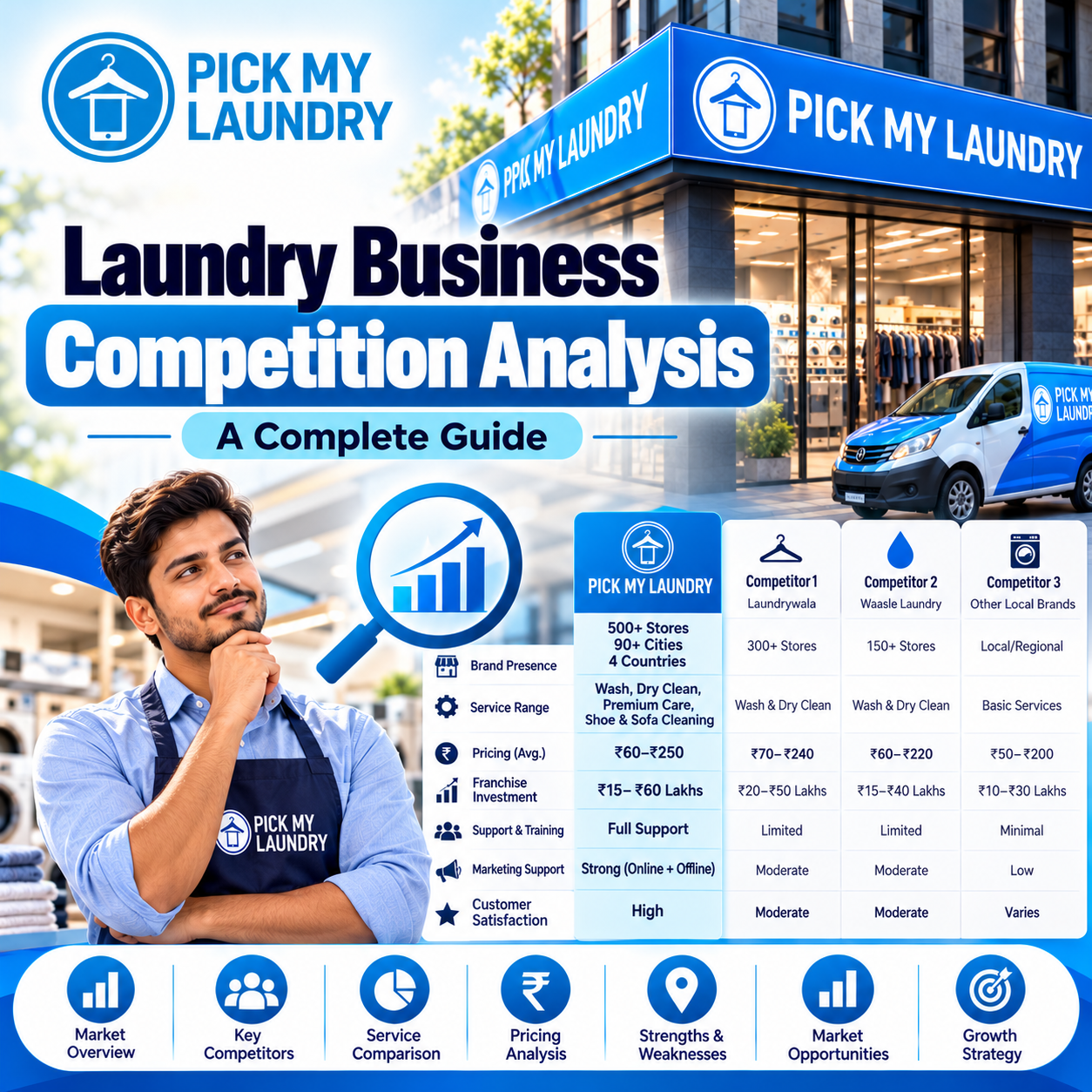
laundry business competition analysis
Introduction
Starting a laundry franchise requires more than choosing a brand and selecting a commercial property. You also need to understand the businesses already serving your target customers.
A laundry business competition analysis helps you evaluate local laundry providers, compare their services and pricing, understand customer expectations, and identify opportunities to differentiate your business.
For entrepreneurs considering Pick My Laundry, competitor research can help determine which services to promote, how to position the outlet, and what to consider when preparing a location-specific business plan.
The goal is not simply to offer lower prices than every competitor. It is to understand the market and build a business that delivers value while maintaining sustainable operating economics.
1. Identify Your Direct and Indirect Competitors
Begin by identifying the businesses customers may choose instead of your proposed outlet.
Direct competitors
These may include:
-
Local laundry shops
-
Dry-cleaning businesses
-
Laundry outlets offering pickup and delivery
-
Professional garment-care providers
-
Other franchise-operated laundry stores
Indirect competitors
These may include:
-
Customers washing clothes at home
-
Self-service laundry facilities, where available
-
Residential laundry services
-
Informal ironing providers
-
Building-based or neighborhood garment-care services
Understanding both groups helps you identify the alternatives customers already use.
For example, your potential customer may not be choosing between two professional laundry outlets. They may be deciding whether professional laundry service offers enough convenience to justify the cost compared with washing clothes at home.
2. Map Competitors in Your Target Location
Research competitors within the area your proposed store can realistically serve.
Use Google Maps, local searches, business websites and location visits to create a list of relevant providers.
Record:
|
Research factor |
What to investigate |
|---|---|
|
Location |
Distance from your proposed outlet |
|
Service area |
Neighborhoods and delivery coverage |
|
Service mix |
Laundry, dry cleaning and specialty care |
|
Pricing |
Rates, packages and additional charges |
|
Customer reviews |
Common strengths and complaints |
|
Convenience |
Pickup, delivery and accessibility |
|
Online presence |
Website, reviews and search visibility |
|
Customer segment |
Households, professionals or businesses |
Do not assume every business within a city competes directly with your outlet. Focus on providers serving similar customers in the same practical service area.
3. Compare Services Offered by Competitors
Different laundry businesses may specialize in different services.
Some focus on regular laundry and ironing, while others emphasize dry cleaning, premium garment care or business-to-business orders.
Investigate whether competitors offer:
-
Regular laundry
-
Dry cleaning
-
Steam ironing
-
Shoe cleaning
-
Bag care
-
Blanket and curtain cleaning
-
Carpet cleaning
-
Pickup and delivery
-
Corporate laundry services
Compare the services that are relevant to your proposed franchise model.
A service gap may represent an opportunity, but first determine whether customers actually need that service and whether your outlet can deliver it profitably.
4. Analyze Competitor Pricing
Pricing research helps you understand what customers encounter in the local market.
Compare rates for similar services, taking care to distinguish between different garment types, service levels and delivery conditions.
Competitor pricing worksheet
Record verified prices during your local research.
Service being compared
Regular laundry
Dry cleaning
Steam ironing
Pickup and delivery
Competitor A price (₹)
Competitor B price (₹)
Competitor C price (₹)
Copy pricing notes
Do not automatically set your prices below competitors. Instead, consider service quality, processing costs, convenience, customer expectations and the margin required to cover operating expenses.
5. Study Customer Reviews and Complaints
Customer reviews can reveal what people value and where service providers may be falling short.
Look for recurring themes, such as:
-
Delayed delivery
-
Unclear pricing
-
Poor communication
-
Garment handling concerns
-
Inconsistent service quality
-
Difficult complaint resolution
-
Convenient pickup and delivery
-
Friendly customer service
Treat reviews as useful signals rather than definitive proof. A small number of reviews may not represent the overall customer experience.
The purpose is to identify customer expectations that your business can realistically meet.
6. Evaluate Competitors' Online Presence
Many customers research local services before placing an order.
Assess how competitors appear in local search results and on map listings.
Review:
-
Google Business Profile information
-
Business hours and contact details
-
Customer reviews and responses
-
Website quality
-
Service-specific pages
-
Location-specific content
-
Social media activity
-
Online booking or enquiry options
This research can help you identify ways to improve your own digital presence.
For Pick My Laundry, location-specific website content, accurate business information, useful service pages and genuine customer feedback can all support local discoverability.
7. Identify Gaps in the Local Market
After comparing competitors, look for areas where customers may be underserved.
Potential opportunities could include:
-
More convenient pickup and delivery
-
Clearer service pricing
-
Better communication about order status
-
Improved complaint handling
-
Specialized garment-care services
-
Convenient payment options
-
Business-focused service packages
-
More reliable customer support
However, do not assume a missing service is automatically a business opportunity. A competitor may not offer it because demand is limited or delivery costs are too high.
Validate each opportunity by talking to customers and evaluating the economics before investing in additional services.
8. Build a Competitive Positioning Strategy
Your positioning should explain why customers should consider your business.
Instead of relying only on discounts, focus on the value your proposed outlet can deliver.
Possible positioning areas include:
Convenience: Simple order placement and convenient pickup and delivery, where available.
Service quality: Consistent procedures for garment identification, handling and quality checks.
Transparency: Clear pricing, service terms and turnaround expectations.
Customer experience: Responsive communication and organized complaint resolution.
Service range: Offering relevant laundry, dry-cleaning and specialty services supported by the operating model.
Choose a positioning strategy that reflects your actual capabilities. Avoid making claims about turnaround times, technology or services unless they are supported by the franchise offering.
9. Understand the Competitor's Target Customer
Two laundry businesses may operate in the same neighborhood but serve different customer segments.
One may focus on budget-conscious households, while another may cater to customers who prioritize premium garment care.
Investigate:
-
Typical customer groups
-
Service preferences
-
Pricing expectations
-
Order frequency
-
Preferred booking methods
-
Pickup and delivery needs
-
Customer feedback
This information helps you decide which customers to target and how to communicate your offering.
10. Compare Locations Before Finalizing Your Outlet
Competitor analysis should be combined with property and market research.
A location with fewer competitors may still be unattractive if it has limited demand. A busier area may be viable if there is enough demand to support several providers.
Compare potential locations using:
-
Customer density
-
Competitor proximity
-
Property rent
-
Visibility and accessibility
-
Delivery feasibility
-
Local search demand
-
Nearby residential communities
-
Potential corporate customers
Also confirm any territory restrictions or location approval requirements in the franchise agreement.
11. Create a Competitor Evaluation Scorecard
Use a consistent framework to compare competitors and your proposed market position.
Competitor scorecard
Rate one competitor from 1 (weak) to 5 (strong) using your research. For pricing, a higher score means better value relative to the service offered.
Service range
3/5
Pricing competitiveness
3/5
Customer reviews
3/5
Pickup and delivery
3/5
Local search visibility
3/5
Location accessibility
3/5
Weighted score
3.00 / 5
Use this as a comparison aid, not a definitive ranking or a measure of business profitability. Apply the same criteria to each competitor.
12. Turn Competition Research Into a Business Plan
Competitor research becomes valuable when it informs practical decisions.
Use your findings to define:
-
Your target customer segment.
-
The services you intend to offer.
-
Your pricing approach.
-
Your local marketing strategy.
-
Your expected customer acquisition channels.
-
Your investment and working capital requirements.
-
Your expected monthly order volume.
-
Your operating costs and break-even assumptions.
Prepare conservative, base and upside scenarios instead of relying on one optimistic revenue estimate.
This makes it easier to evaluate whether your proposed outlet can compete sustainably.
Why Consider Pick My Laundry?
Pick My Laundry operates in the laundry and dry-cleaning franchise sector.
12+ Years of Industry Experience | 500+ Stores | 90+ Cities | Operations Across 4 Countries
Entrepreneurs considering a Pick My Laundry franchise should assess local competitors, understand the applicable franchise model, review the investment requirements and determine how the proposed outlet can meet customer needs in its target market.
Use independent market research alongside the franchisor's commercial details before making an investment decision.
Frequently Asked Questions
1. What is laundry business competition analysis?
It is the process of researching local laundry providers, comparing services and prices, reviewing customer feedback and identifying opportunities to differentiate your business.
2. How do I find laundry competitors in my city?
Use Google Maps, local search results, business websites, customer reviews and visits to relevant neighborhoods to identify providers serving your target market.
3. Should my laundry franchise charge less than competitors?
Not necessarily. Pricing should reflect customer expectations, service quality, operating expenses and the margin needed to run the business sustainably.
4. Can customer reviews help identify market opportunities?
Yes. Recurring feedback may reveal concerns about convenience, communication, turnaround times or service quality. Validate these findings before making business decisions.
5. How often should I review competitor activity?
Review the market periodically and whenever you are considering changes to pricing, services, marketing or location strategy. The frequency depends on how quickly your local market changes.
6. Does having fewer competitors guarantee business success?
No. Fewer competitors may reflect limited demand rather than an attractive opportunity. Evaluate customer demand, costs and operational feasibility together.
7. How can Pick My Laundry stand out in a competitive market?
The appropriate strategy depends on the proposed outlet and its capabilities. Focus on relevant services, customer experience, consistent operating procedures, local visibility and clear communication.
Conclusion
Laundry business competition analysis helps you understand your local market, assess customer expectations and identify opportunities to build a differentiated service offering.
Research competitor locations, pricing, services, reviews and online visibility. Combine these findings with customer research and financial planning before finalizing your business location.
For entrepreneurs considering Pick My Laundry, the goal is to understand the market well enough to make an informed investment decision and build a sustainable local business.