
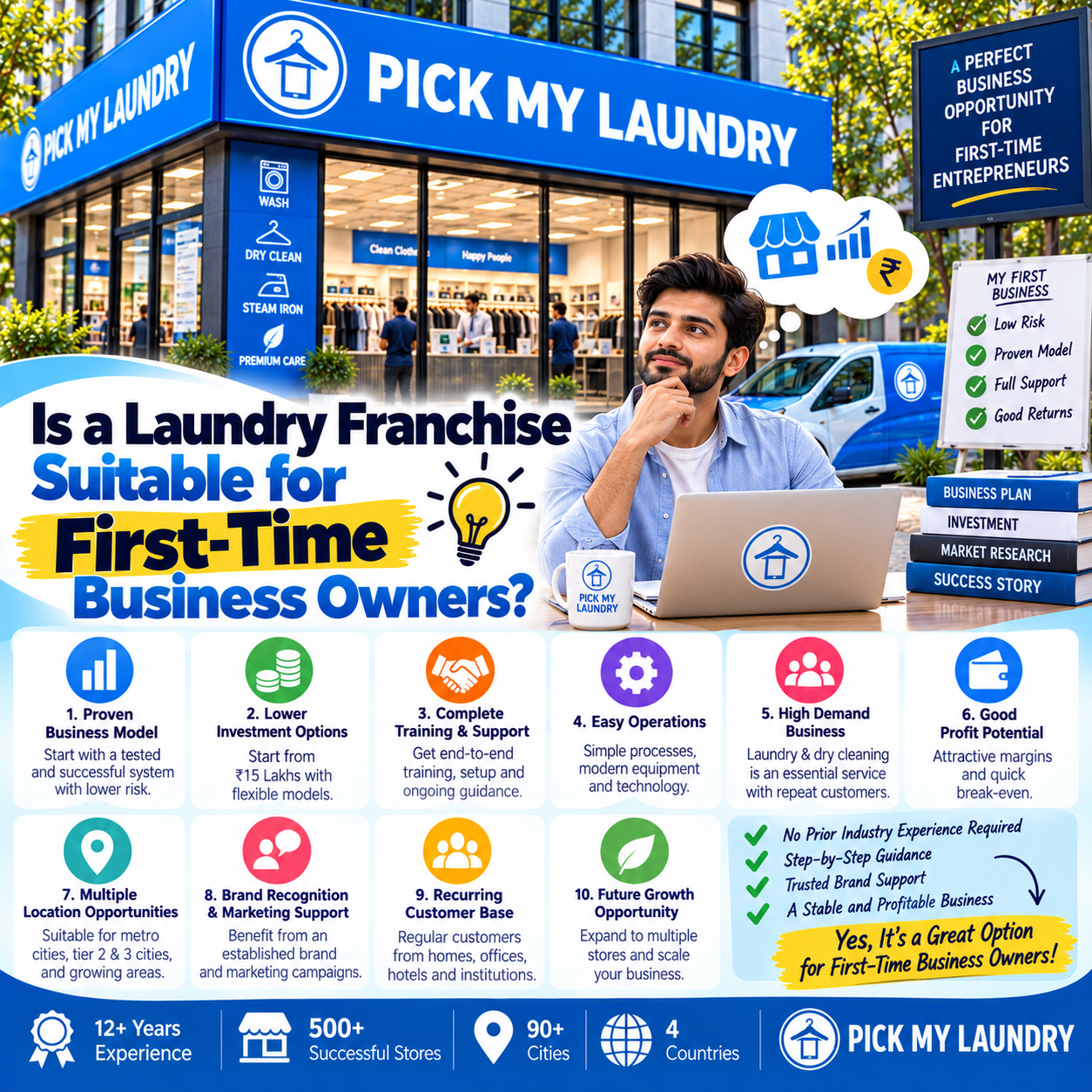
Is a Laundry Franchise Suitable for First-Time Business Owners?
Is a Laundry Franchise Suitable for First-Time Business Owners?
Starting your first business can be both exciting and challenging. For many first-time entrepreneurs, the biggest questions are not only how much to invest, but also:
- Do I need previous laundry experience?
- Who will train my staff?
- How will I manage daily operations?
- How will I get customers?
- What technology will I need?
- How much working capital should I keep?
- Can I manage the business if I am not technically experienced?
A laundry franchise for first-time business owners can provide a structured way to enter the industry, but it is still a real business that requires planning, management and financial discipline.
This guide explains what first-time entrepreneurs should understand before considering a laundry franchise in India.
Important: A franchise does not eliminate business risk or guarantee revenue or profit. Actual results depend on factors such as location, investment, customer demand, pricing, operating expenses, service quality and management.
1. Do You Need Laundry Industry Experience?
One of the biggest concerns for first-time entrepreneurs is lack of industry experience.
You may not necessarily need years of experience in laundry operations to explore the business, but you should be prepared to learn the business and actively manage the outlet.
You need to understand:
- Customer requirements
- Garment handling
- Order processing
- Staff management
- Quality control
- Customer service
- Local marketing
- Financial management
- Pickup and delivery
- Inventory and supplies
A franchise system can potentially provide training and operating procedures, depending on the agreement.
2. Why First-Time Entrepreneurs Consider Franchising
Building an independent business requires developing many systems from the ground up.
A franchise may provide an existing framework covering areas such as:
Brand → SOPs → Training → Technology → Marketing → Operations
The exact support differs between franchise companies and agreements.
For a first-time entrepreneur, the important question is therefore:
“What exactly will the franchisor provide, and what will I be responsible for?”
That question should be answered before making an investment.
3. Understand the Complete Investment
A first-time entrepreneur should never evaluate a franchise only by looking at the advertised starting investment.
Your financial plan should include:
- Franchise-related costs
- Property deposit
- Rent
- Store interiors
- Equipment
- Branding
- Technology
- Staff recruitment
- Training
- Initial marketing
- Packaging
- Consumables
- Transportation
- Working capital
Keep a separate working-capital reserve instead of putting the entire available budget into store setup.
4. Learn How the Laundry Business Makes Money
Before starting, understand the revenue model.
A laundry business can generate revenue through services such as:
- Laundry washing
- Wash & fold
- Wash & iron
- Dry cleaning
- Steam ironing
- Shoe cleaning
- Bag cleaning
- Carpet cleaning
- Curtain cleaning
- Sofa cleaning
- Blanket cleaning
- Bed-sheet cleaning
- Pickup and delivery
- Corporate/B2B services
The exact service mix should be based on the outlet's model and local customer demand.
5. Understand Basic Laundry Business Economics
You don't need to become an accountant, but you should understand the basic numbers.
Revenue
Monthly Revenue = Orders × Average Order Value
Operating Profit
Operating Profit = Revenue − Variable Costs − Fixed Costs
Break-Even
A simplified calculation is:
Break-Even Revenue = Fixed Costs ÷ Contribution Margin %
ROI
Simple ROI = Annual Operating Profit ÷ Initial Investment × 100
These formulas provide a starting framework, but actual business planning requires more detailed assumptions.
6. Build a Monthly Expense Plan
First-time business owners often focus heavily on revenue and underestimate recurring expenses.
Your monthly budget may include:
| Expense | Examples |
|---|---|
| Rent | Store/property |
| Salaries | Store & processing staff |
| Utilities | Electricity/water |
| Packaging | Covers, bags, tags |
| Transportation | Pickup & delivery |
| Marketing | Digital/local promotion |
| Maintenance | Equipment & infrastructure |
| Technology | Software/platform |
| Consumables | Operational materials |
| Miscellaneous | Other business expenses |
The exact amount will depend on the location and business format.
7. Choose the Location Carefully
A franchise brand cannot replace local market research.
Before selecting a property, examine:
Residential density
Are enough potential customers living nearby?
Working population
Are offices and working professionals present?
Competition
How many laundry and dry-cleaning businesses operate nearby?
Accessibility
Can customers and delivery staff easily reach the store?
Parking
Is pickup/drop-off convenient?
Rent
Does the property cost make sense for the expected demand?
Delivery radius
Can pickup and delivery be managed efficiently?
Location should be evaluated based on both customer demand and operating economics.
8. Understand the Store's Daily Operations
A first-time entrepreneur should understand the complete customer journey.
A typical process can involve:
Customer Order
↓
Garment Receiving
↓
Inspection & Tagging
↓
Sorting
↓
Processing
↓
Quality Check
↓
Packaging
↓
Pickup/Delivery
↓
Customer Handover
Understanding this process helps an owner identify where errors or delays can occur.
9. Training Is Important
If you don't have laundry-industry experience, training becomes particularly important.
Ask the franchise about:
- Initial training
- Staff training
- Operational SOPs
- Garment-care procedures
- Quality-control training
- Customer-service training
- Technology training
- Refresher training
- Post-launch support
Don't simply ask “Is training provided?”
Ask:
Who receives the training, for how long, where is it conducted and what topics are covered?
10. Staff Management Is Still Your Responsibility
A franchise does not automatically eliminate manpower challenges.
You may need to manage:
- Recruitment
- Attendance
- Performance
- Staff schedules
- Training
- Productivity
- Customer service
- Quality control
A clear staffing structure should be established before launch.
Depending on the outlet format, roles can include:
- Store manager
- Customer service executive
- Laundry operator
- Dry-cleaning operator
- Steam ironing staff
- Quality-control staff
- Packaging staff
- Pickup/delivery staff
11. Technology Can Make Management Easier
Technology can help first-time owners manage operational information.
Depending on the system, technology may support:
- Order management
- Customer records
- Digital invoices
- Payments
- Order tracking
- Pickup scheduling
- Delivery management
- Customer notifications
- Reporting
Before joining a franchise, understand what technology is included and whether there are separate technology charges.
12. Learn Customer Acquisition
A new franchise outlet still needs local customers.
Potential customer-acquisition channels include:
- Google Search
- Google Maps
- Google Business Profile
- Local SEO
Social media
Local marketing
- Residential societies
- Referral programs
- Local partnerships
- Opening offers
- Flyers and local promotions
B2B
- Offices
- Hotels
- Salons
- Gyms
- Spas
- Other businesses
The franchise may provide marketing support, but clarify exactly what is included.
13. Don't Depend Entirely on Discounts
Discounts can help attract initial customers, but a sustainable laundry business needs more than promotional pricing.
Focus on:
- Quality
- Convenience
- Consistent turnaround
- Customer communication
- Garment safety
- Pickup and delivery
- Professional service
- Repeat customers
The objective should be to build a reliable local customer base rather than depending permanently on discounts.
14. Learn Customer Complaint Management
Garment-care businesses need clear procedures for handling customer concerns.
Potential complaints may relate to:
- Stains
- Garment condition
- Missing items
- Delayed delivery
- Incorrect orders
- Packaging
- Service expectations
First-time owners should understand the brand's complaint-handling and quality-control procedures before opening the outlet.
15. Understand Pickup & Delivery
Doorstep pickup and delivery can be an important part of a modern laundry business.
But it also requires operational planning.
Consider:
- Delivery area
- Pickup schedules
- Delivery staff
- Vehicle requirements
- Route planning
- Fuel costs
- Packaging
- Customer notifications
- Order tracking
The service radius should be designed according to demand and logistics.
16. Franchise Agreement Matters
First-time entrepreneurs should carefully read the franchise agreement.
Check:
- Agreement duration
- Renewal terms
- Fees
- Recurring charges
- Territory
- Branding rules
- Supplier requirements
- Marketing responsibilities
- Technology requirements
- Exit conditions
- Transfer conditions
- Termination provisions
For a significant investment, professional legal review can help you understand the contractual obligations.
17. What Should a First-Time Entrepreneur Ask the Franchisor?
Before making a decision, prepare a question list.
Investment
- What is the total investment?
- What is included?
- What additional costs should I budget for?
- How much working capital is recommended?
Operations
- What training is provided?
- What SOPs are available?
- How many staff are required?
- What equipment is required?
Marketing
- What marketing support is included?
- Who handles local advertising?
- What launch support is provided?
Technology
- What software is included?
- How are orders tracked?
- How are pickup and delivery managed?
Agreement
- What are the renewal conditions?
- What are the exit conditions?
- Are there territory restrictions?
- Are there mandatory suppliers?
18. Skills a First-Time Laundry Franchise Owner Should Develop
You don't need to be a laundry technician to manage a franchise, but several business skills are useful.
Financial management
Understand:
- Revenue
- Expenses
- Cash flow
- Working capital
- Profitability
People management
Learn how to:
- Recruit
- Train
- Delegate
- Monitor performance
Customer management
Focus on:
- Communication
- Complaints
- Reviews
- Retention
Marketing
Understand the basics of:
- Local SEO
- Google Business Profile
- Social media
- Local advertising
- Referrals
Operations
Understand:
- Order flow
- Quality control
- Turnaround time
- Pickup/delivery
19. How Much Time Does an Owner Need to Give?
This depends on the business model and management structure.
Some owners may be directly involved in daily store operations, while others may appoint a manager and focus more on supervision.
Before investing, decide:
Will I operate the business myself or hire a manager?
If you hire a manager, include the additional salary and management structure in your financial planning.
20. Common Mistakes First-Time Franchise Owners Make
Mistake 1: Choosing only on investment amount
The cheapest option isn't necessarily the most suitable.
Mistake 2: Ignoring location
Brand recognition cannot compensate for every location problem.
Mistake 3: Underestimating working capital
The business needs funds while customer demand develops.
Mistake 4: Assuming the franchisor does everything
Clearly separate franchisor responsibilities from franchise-owner responsibilities.
Mistake 5: Ignoring local marketing
A new outlet still needs local customer acquisition.
Mistake 6: Not reading the agreement
Understand contractual obligations before signing.
Mistake 7: Expecting immediate profitability
A new business may require time to build awareness and repeat customers.
21. Why Pick My Laundry Can Be Considered by New Entrepreneurs
Pick My Laundry operates in the laundry and dry-cleaning sector with a network-based business model.
Current brand proof points for this content strategy are:
12+ Years of Industry Experience
500+ Stores
90+ Cities
Operations Across 4 Countries
For a prospective franchise owner, the relevant questions should still be outlet-specific:
- What is the investment?
- What support is included?
- What is the location?
- What are the operating costs?
- What responsibilities will I have?
- What does the franchise agreement require?
The actual financial performance of an outlet depends on its individual market and execution.
22. First-Time Entrepreneur Checklist
Before investing, make sure you have:
☐ Studied the complete investment
☐ Prepared a working-capital plan
☐ Evaluated the location
☐ Researched local competitors
☐ Understood the service portfolio
☐ Reviewed staff requirements
☐ Understood training
☐ Reviewed technology
☐ Prepared a local marketing plan
☐ Understood pickup and delivery
☐ Studied monthly expenses
☐ Calculated break-even assumptions
☐ Read the franchise agreement
☐ Reviewed exit and renewal terms
☐ Understood your own responsibilities
Frequently Asked Questions
Can someone with no laundry experience start a laundry franchise?
Prior laundry-industry experience may not always be required, depending on the franchise model. However, the owner should be willing to learn operations, manage staff, understand finances and follow the applicable operating procedures.
Is a laundry franchise good for a first-time entrepreneur?
A franchise can provide an established business framework, but it is still a business investment with financial and operational responsibilities. The suitability depends on the individual's capital, goals, involvement and local market.
Will the franchisor manage my entire store?
This depends on the franchise model and agreement. A prospective franchise owner should clearly understand which responsibilities belong to the franchisor and which belong to the franchisee.
How much working capital should a first-time owner keep?
There is no universal amount. It depends on rent, salaries, utilities, marketing, transportation, service volume and other operating expenses.
What is more important: location or brand?
Both can matter, but they address different parts of the business. A recognized brand does not eliminate the importance of local demand, accessibility and operating economics.
Can I run the franchise with a manager?
Depending on the business model, an owner may appoint a manager. The associated management cost and responsibilities should be included in the financial plan.
Final Takeaway
A laundry franchise for first-time business owners can provide a structured entry into the laundry and dry-cleaning industry, particularly when the franchise offers defined processes, training, technology and operational support.
But a franchise is not a passive investment by default.
A first-time entrepreneur should understand:
Investment → Location → Training → Staff → Operations → Marketing → Technology → Customer Service → Agreement → Financial Planning
The better you understand these areas before launch, the better prepared you will be to manage the business responsibly.