
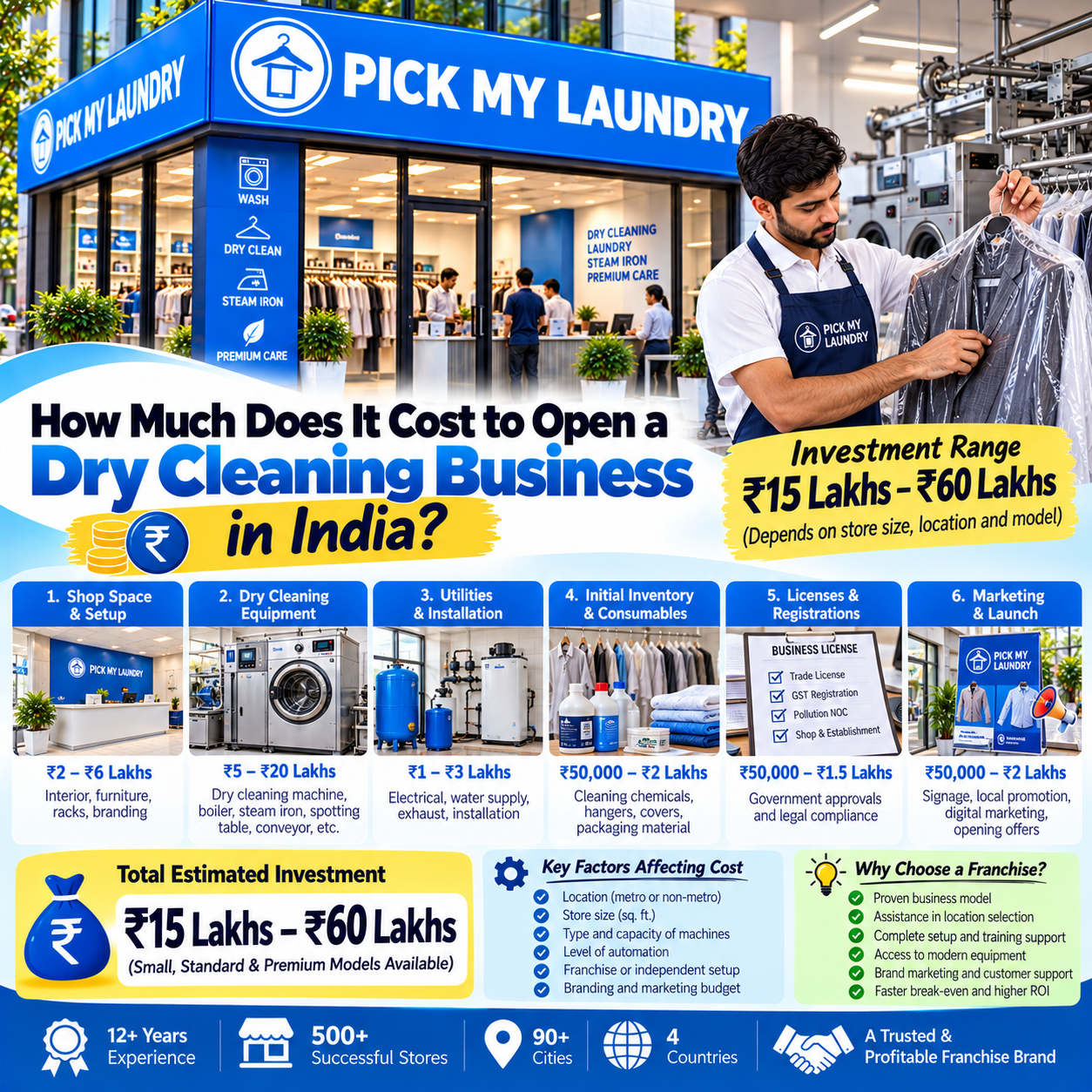
How Much Does It Cost to Open a Dry Cleaning Business in India?
How Much Does It Cost to Open a Dry Cleaning Business in India?
A dry cleaning business can be structured in different ways depending on the location, store format, equipment requirements, processing model and service portfolio.
One of the first questions entrepreneurs ask is:
“How much investment is required to start a dry cleaning business in India?”
There is no single cost that applies to every business. A small local setup, a premium retail outlet and a franchise-based operation can have very different investment requirements.
Before investing, it is therefore important to understand the major cost components rather than looking at one headline figure.
This guide explains the expenses you should consider when planning a dry cleaning business in India.
Note: Actual costs vary by city, property, business model, equipment, staff requirements, service mix and operating scale. The figures in this article should be treated as planning considerations, not guaranteed costs or returns.
1. What Determines Dry Cleaning Business Cost?
The total investment can depend on several factors:
- Business model
- Store size
- Location
- Rent and security deposit
- Equipment
- Store interiors
- Branding
- Staff
- Technology
- Licences and registrations
- Initial inventory
- Packaging
- Marketing
- Pickup and delivery
- Working capital
A proper business plan should estimate each category separately.
2. Choose Your Dry Cleaning Business Model
Before calculating the investment, decide which type of business you want to operate.
Independent Dry Cleaning Shop
You create your own brand, processes and customer base.
Potential expenses include:
- Equipment
- Interiors
- Branding
- Staff
- Marketing
- Technology
- Working capital
Franchise-Based Dry Cleaning Business
A franchise may provide access to an established brand, operating systems, training and other support, depending on the agreement.
Costs can include:
- Franchise-related charges
- Store setup
- Equipment
- Branding
- Technology
- Training
- Working capital
- Marketing
Collection & Delivery Model
Another structure focuses more heavily on customer pickup and delivery, with processing handled through a suitable processing facility or network.
This can change the equipment and property requirements compared with a full processing store.
3. Property & Rent
Property is one of the major costs to consider.
Your budget may include:
- Monthly rent
- Security deposit
- Advance rent
- Interior work
- Electrical work
- Plumbing
- Signage
- Renovation
The required property depends on the business format.
Before finalizing a property, evaluate:
Location + customer demand + accessibility + rent + operational suitability
A cheaper property isn't necessarily better if it significantly limits customer access or delivery operations.
4. Store Interior & Branding
A professional dry-cleaning outlet needs a functional customer-facing area as well as suitable operational space.
Potential setup costs include:
- Reception counter
- Shelving
- Garment storage
- Lighting
- Flooring
- Electrical work
- Plumbing
- Signage
- Branding
- Customer waiting area
- Packaging area
The objective should be to create a layout that supports an efficient garment flow from receiving to processing and final delivery.
5. Dry Cleaning Equipment
Equipment requirements depend on the chosen operating model.
Depending on the setup, equipment may include:
- Dry cleaning machines
- Washing machines
- Dryers
- Steam equipment
- Pressing equipment
- Spotting equipment
- Garment finishing equipment
- Packaging equipment
Equipment pricing can vary substantially depending on:
- Capacity
- Brand
- Technology
- Automation
- New vs used equipment
- Installation
- Maintenance requirements
Therefore, equipment should be selected according to actual processing requirements rather than simply choosing the cheapest available option.
6. Laundry Equipment
Many modern dry-cleaning businesses offer more than dry cleaning.
A broader service portfolio may include:
- Laundry washing
- Wash & fold
- Wash & iron
- Steam ironing
- Blanket cleaning
- Bed-sheet cleaning
- Curtain cleaning
- Shoe cleaning
- Bag cleaning
If these services are offered, additional equipment and operational infrastructure may be required.
This is why your equipment budget should be based on the complete service menu, not only dry cleaning.
7. Staff Costs
Manpower requirements depend on the size and operating model of the business.
Possible roles include:
- Store manager
- Customer service executive
- Laundry operator
- Dry-cleaning operator
- Steam ironing staff
- Quality-control staff
- Packaging staff
- Pickup and delivery personnel
Your staffing budget should consider:
- Salaries
- Recruitment
- Training
- Uniforms
- Employee replacement
- Productivity
A detailed manpower plan helps prevent underestimating monthly operating costs.
8. Working Capital
Working capital is one of the most important areas for a new business.
You may need funds for:
- Rent
- Salaries
- Utilities
- Packaging
- Consumables
- Transportation
- Marketing
- Maintenance
- Technology
- Other operating expenses
Do not allocate your entire investment budget to equipment and interiors.
A new outlet needs sufficient operating funds while it builds its customer base.
9. Technology Costs
Technology can help manage modern laundry and dry-cleaning operations.
Depending on the system, you may need:
- POS/order-management software
- Customer database
- Digital invoicing
- Payment systems
- Order tracking
- Pickup and delivery management
- Customer notifications
- Reporting tools
Technology costs depend on the software and services selected.
For a franchise business, check which technology systems are included as part of the franchise arrangement and which require separate payment.
10. Packaging & Consumables
Garment care doesn't end when the cleaning process is complete.
You may need:
- Garment covers
- Packaging bags
- Tags
- Labels
- Hangers
- Delivery bags
- Receipts/invoices
- Other consumables
Packaging is both an operational expense and an important part of customer presentation.
11. Marketing & Customer Acquisition
A new dry-cleaning business needs local visibility.
Possible marketing channels include:
- Google Business Profile
- Google Search
- Local SEO
- Social media
- Meta advertising
- WhatsApp marketing
- Residential society promotions
- Referral programs
- Local partnerships
- Corporate outreach
- Opening campaigns
Your launch budget should include both initial promotion and ongoing customer acquisition.
12. Pickup & Delivery Costs
If you offer doorstep service, additional expenses may include:
- Delivery personnel
- Vehicles
- Fuel
- Vehicle maintenance
- Route management
- Packaging
- Order tracking
The delivery radius should be designed around customer demand and operational efficiency.
A very large delivery area can increase transportation costs and processing complexity.
13. Licences & Registrations
Depending on the business structure and location, you may need to consider applicable:
- Business registrations
- GST-related requirements
- Shops & Establishments requirements
- Local trade permissions
- Fire-safety requirements
- Pollution/environment-related permissions where applicable
- Labour-related registrations
- Signage permissions
Requirements can vary by state, city and business activity, so entrepreneurs should verify the applicable requirements for their location before starting operations.
14. Example Dry Cleaning Business Budget Structure
Instead of assuming one fixed investment number, build a budget like this:
| Cost Category | Budget Allocation |
|---|---|
| Property deposit & initial rent | ₹___ |
| Store interiors | ₹___ |
| Equipment | ₹___ |
| Technology | ₹___ |
| Branding & signage | ₹___ |
| Licences & professional fees | ₹___ |
| Initial consumables | ₹___ |
| Staff recruitment & training | ₹___ |
| Launch marketing | ₹___ |
| Working capital | ₹___ |
| Total Investment | ₹___ |
This format allows you to create a location-specific business plan.
15. Franchise vs Independent Setup
One of the important decisions is whether to build an independent brand or join an established franchise.
Independent Business
Potential advantages:
- Full brand control
- Freedom to develop pricing
- Independent supplier selection
- Flexible business strategy
Potential challenges:
- Building brand awareness
- Developing SOPs
- Creating technology systems
- Developing marketing processes
- Establishing customer trust
- Developing operational expertise
Franchise Business
Potential advantages may include:
- Established brand identity
- Standardized processes
- Training
- Technology systems
- Marketing support
- Operational guidance
The exact benefits and obligations depend on the individual franchise agreement.
16. Don't Confuse Investment With Profit
A common mistake is to assume that a higher investment automatically produces higher returns.
Investment and profitability are different concepts.
Your financial model should separately evaluate:
Investment
How much capital is required to start?
Revenue
How much can the business generate based on realistic order assumptions?
Operating expenses
How much does it cost to run the outlet?
Contribution
How much remains after variable costs?
Operating profit
What remains after operating expenses?
Payback
How long might it take to recover the initial investment under the assumed scenario?
17. Estimate Break-Even Before Starting
Break-even analysis can help you understand the required sales level.
A simplified formula is:
Break-Even Revenue = Fixed Costs ÷ Contribution Margin %
For example, if:
Fixed monthly costs = ₹2,00,000
and:
Contribution margin = 50%
then:
Break-Even Revenue = ₹2,00,000 ÷ 0.50
Break-Even Revenue = ₹4,00,000/month
This is only an illustrative example.
Your actual break-even point should be calculated using your specific rent, staff, pricing, service mix, variable costs and other expenses.
18. Questions to Ask Before Starting a Dry Cleaning Business
Before committing your investment, ask:
- What is the total setup cost?
- What equipment is actually required?
- What is the expected store size?
- How much working capital should be maintained?
- What are the monthly operating expenses?
- What services will be offered?
- What manpower is required?
- What technology will be used?
- How will customers be acquired?
- What pickup and delivery infrastructure is required?
- What licences apply to the location?
- What are the equipment maintenance requirements?
- What quality-control procedures will be followed?
- What happens if equipment breaks down?
- If choosing a franchise, what exactly is included in the agreement?
Why Consider Pick My Laundry?
Pick My Laundry operates in the laundry and dry-cleaning industry with a network-based business model.
Current brand proof points for this content strategy:
12+ Years of Industry Experience
500+ Stores
90+ Cities
Operations Across 4 Countries
The investment required for an individual franchise outlet can vary depending on the location, format, property, equipment and other operating requirements.
Prospective franchise owners should therefore request the latest outlet-specific investment details and evaluate the complete business model before making an investment decision.
Frequently Asked Questions
How much does it cost to start a dry cleaning business in India?
There is no single fixed amount. Investment depends on the business model, equipment, property, location, store format, staff and working capital requirements.
Is a dry cleaning business different from a laundry business?
Yes. Although they can operate together, dry cleaning and laundry involve different processes, equipment, garment-care requirements and service categories.
What is the biggest cost in a dry cleaning business?
Equipment, property/setup and working capital can represent significant portions of the investment, but the exact cost structure depends on the business model.
Can I start a dry cleaning business through a franchise?
Yes, franchise-based models are one option entrepreneurs can evaluate. The exact investment, support and contractual obligations depend on the specific franchise agreement.
Do I need pickup and delivery?
Not necessarily. It depends on your target market and business model. However, doorstep pickup and delivery can be incorporated where local demand and operational economics support it.
How should I calculate dry cleaning business profitability?
Start with expected orders and average order value to estimate revenue. Then subtract variable costs and fixed expenses to calculate operating profit. Finally, compare the expected operating profit with the initial investment.
Final Takeaway
The cost of starting a dry cleaning business in India should be evaluated as a complete business system, not simply as the price of a machine or shop.
Before investing, calculate:
Property + Equipment + Setup + Staff + Technology + Marketing + Working Capital + Operating Expenses
Then build conservative, base and higher-volume scenarios to understand how the business could perform under different assumptions.
For entrepreneurs considering a franchise model, the same approach should be combined with a detailed review of the franchise agreement, support structure and location-specific economics.