
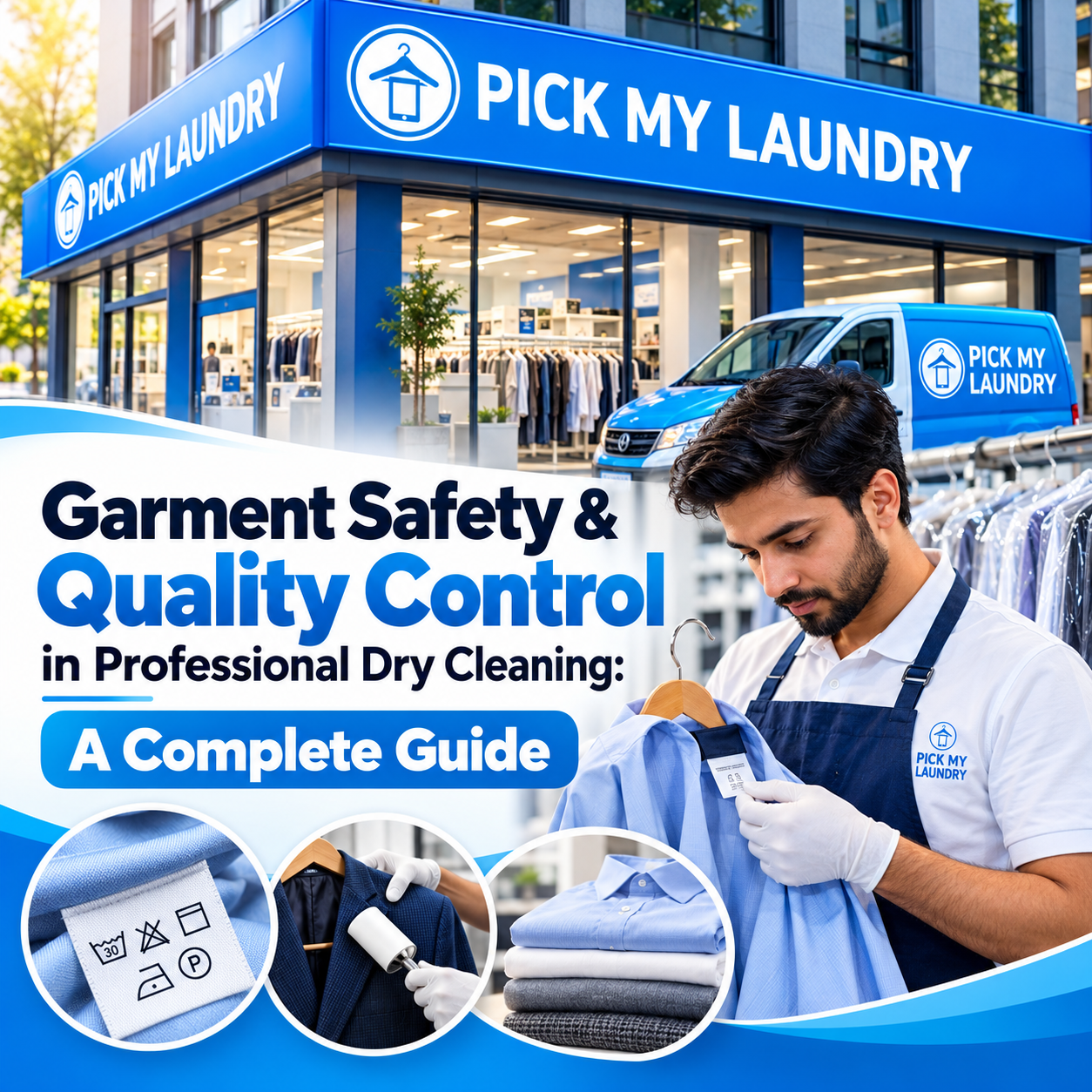
Garment Safety & Quality Control in Professional Dry Cleaning: A Complete Guide
Introduction
Professional dry cleaning is much more than simply cleaning clothes.
Different garments can have different fabrics, colours, trims, embellishments, finishes and care requirements. A process that works for one garment may not be suitable for another. This is why professional garment care requires proper inspection, classification, processing and quality control.
For a modern laundry and dry-cleaning business, garment safety and quality control are essential parts of daily operations.
A professional workflow typically involves receiving the garment, identifying its care requirements, processing it using the appropriate method, conducting a quality inspection and finally packaging it for delivery.
Pick My Laundry's published operational material also describes quality checks before garments are marked ready for delivery, including reprocessing when required. Pick My Laundry
1. Why Garment Safety Matters
Customers hand over garments expecting them to be returned clean, properly finished and in good condition.
Professional garment handling therefore needs attention to:
- Fabric type
- Colour
- Care label
- Existing stains
- Existing damage
- Buttons and accessories
- Embroidery and embellishments
- Garment construction
- Appropriate cleaning method
- Drying and finishing requirements
A systematic inspection before processing can help identify potential risks before the garment enters the cleaning cycle.
2. Garment Inspection Before Cleaning
One of the most important quality-control stages happens before cleaning begins.
The operator should examine the garment for visible issues such as:
Existing Stains
Identify visible stains and, where appropriate, determine what type of treatment may be required.
Tears or Loose Threads
Existing damage should be identified before processing.
Missing or Loose Buttons
Buttons, hooks, zippers and other accessories should be checked.
Colour Issues
Garments with colour-bleeding risks may require additional attention.
Embroidery & Decorative Work
Heavy embroidery, sequins, beads and other decorative elements may require special handling.
Care Labels
The garment's care instructions should be reviewed before selecting the processing method.
3. Understanding Different Fabric Requirements
Not every fabric should be treated identically.
A professional garment-care operation may handle:
- Cotton
- Linen
- Wool
- Silk
- Polyester
- Denim
- Blended fabrics
- Formal wear
- Premium garments
- Embroidered garments
- Furnishings and household textiles
The cleaning method should be selected according to the garment's construction and applicable care instructions.
This is particularly important for premium clothing where appearance, texture and finishing are important to the customer.
4. Stain Assessment & Treatment
Stain removal is another area where professional judgment matters.
Different stains can have different characteristics.
Examples include:
- Oil-based stains
- Food stains
- Beverage stains
- Ink
- Makeup
- Dust and dirt
- Sweat-related marks
- Cosmetic products
A professional operation should assess the stain before applying any treatment.
Why Random Treatment Can Be Risky
Applying an unsuitable treatment can potentially affect:
- Fabric colour
- Fabric texture
- Surface finish
- Prints
- Embroidery
- Decorative elements
Therefore, stain treatment should follow an established SOP rather than relying on guesswork.
5. Choosing the Appropriate Cleaning Process
Depending on the garment and applicable care requirements, processing may involve different methods.
Laundry Washing
Suitable garments can be processed through controlled washing procedures.
Dry Cleaning
Certain garments require professional dry-cleaning treatment rather than conventional washing.
Steam Ironing
Steam finishing can help provide a professional appearance where appropriate.
Specialized Cleaning
Shoes, bags, carpets, curtains and other items may require category-specific processes.
Pick My Laundry's published service portfolio includes laundry, dry cleaning, steam ironing and several specialized cleaning categories. Pick My Laundry
6. Garment Identification & Tracking
When a business processes a large number of garments, accurate identification becomes extremely important.
A structured order-management system can help connect:
Customer → Order → Garment → Processing → QC → Delivery
Modern laundry businesses can use technology such as:
- Barcode systems
- Order IDs
- CRM software
- POS systems
- Digital order records
- Customer notifications
- Delivery management
Pick My Laundry's published franchise material mentions CRM, mobile app access, online booking, order tracking, digital billing and delivery management. Pick My Laundry
7. Quality Control After Processing
Cleaning is not the final step.
Before an order is packed, the garment should go through a final inspection.
QC Checklist
| Quality Check | What to Inspect |
|---|---|
| Cleanliness | Has the required cleaning result been achieved? |
| Stains | Are identified stains adequately treated? |
| Fabric | Is the garment in acceptable condition? |
| Colour | Is the colour appearance acceptable? |
| Ironing | Is the finishing satisfactory? |
| Buttons | Are buttons and accessories intact? |
| Packaging | Is the garment packed appropriately? |
| Order Matching | Does the garment belong to the correct order? |
If a quality issue is identified, the garment can be sent back for appropriate reprocessing before delivery.
This type of post-processing QC is described in Pick My Laundry's published modern laundry workflow. Pick My Laundry
8. Packaging Is Also Part of Quality
A clean garment can still lose its professional presentation if it is poorly packaged.
Packaging should protect the garment from:
- Dust
- Moisture
- Handling damage
- Wrinkles
- Mixing with other orders
Different garments may require different packaging approaches.
For example:
Formal garments:
Hangers and protective covers may be appropriate.
Folded garments:
Neat folding and suitable protective packaging can help maintain presentation.
Premium garments:
Additional care may be appropriate depending on garment construction.
9. Staff Training for Garment Safety
Equipment alone cannot guarantee consistent garment care.
Employees should understand:
- Fabric identification
- Care labels
- Stain identification
- Garment inspection
- Cleaning processes
- Equipment operation
- Finishing
- Packaging
- Customer communication
- Quality-control procedures
Pick My Laundry's franchise information specifically lists training areas including garment handling, laundry processing, dry-cleaning processes, quality control, packaging and equipment operation. Pick My Laundry
10. Creating a Garment Safety SOP
A written SOP helps employees follow the same process consistently.
Recommended Workflow
Step 1: Receive garment
↓
Step 2: Create order/tag
↓
Step 3: Inspect garment
↓
Step 4: Check care instructions
↓
Step 5: Identify stains/damage
↓
Step 6: Select processing method
↓
Step 7: Process garment
↓
Step 8: Finish/iron
↓
Step 9: Quality inspection
↓
Step 10: Package
↓
Step 11: Final order verification
↓
Step 12: Delivery
This structured workflow reduces the chances of skipping important quality-control stages.
11. Common Garment-Handling Mistakes to Avoid
A professional laundry operation should train employees to avoid:
1. Skipping Pre-Inspection
Existing damage may go unnoticed.
2. Ignoring Care Labels
The wrong process may be selected.
3. Treating Every Stain the Same Way
Different stains can require different approaches.
4. Mixing Orders
Incorrect tagging can create customer-service problems.
5. Skipping Final QC
A garment should not automatically be considered ready simply because processing is complete.
6. Poor Packaging
Even properly cleaned garments need suitable presentation.
7. Inadequate Staff Training
Employees should understand the SOP before independently processing garments.
12. Technology & Quality Control
Technology can support garment safety by improving traceability.
For example:
Digital Order Creation
→ Garment Identification
→ Processing Status
→ QC Status
→ Ready for Delivery
→ Delivery
This provides greater visibility into where an order is within the workflow.
Pick My Laundry's published technology information includes mobile app functionality, CRM, order tracking and delivery management. Pick My Laundry
13. Building a Quality-Control Culture
Quality should not be treated as a single inspection at the end.
It should be part of every stage:
Before Processing
Inspect the garment.
During Processing
Follow the correct SOP.
After Processing
Perform QC.
Before Delivery
Verify the order and packaging.
After Delivery
Collect customer feedback when appropriate.
This creates a continuous quality-improvement cycle.
14. Why Quality Control Matters for a Laundry Franchise
For franchise businesses, maintaining consistency across locations becomes especially important.
A franchise network may have:
- Different staff
- Different locations
- Different customer segments
- Different order volumes
Standardized SOPs and training can help create a consistent operating framework.
Pick My Laundry's published franchise material highlights staff training, operational guidance, technology and quality-control systems as parts of its business-support framework. Pick My Laundry
15. Pick My Laundry: Technology-Driven Garment Care
Pick My Laundry operates across laundry and dry-cleaning categories, with services including laundry, dry cleaning, steam ironing, shoe cleaning and other specialized garment-care services. Its published material also describes technology-enabled order management and quality-control processes. Pick My Laundry
For entrepreneurs exploring the franchise model, the brand's current positioning can be presented as:
12+ Years of Industry Experience | 500+ Stores | 90+ Cities | Operations Across 4 Countries 🌍
Frequently Asked Questions
How does professional dry cleaning protect garments?
Protection starts with pre-inspection, care-label checking, appropriate processing, careful finishing and final quality inspection.
Why is garment inspection important?
It helps identify existing stains, damage, accessories and special-care requirements before processing.
Can every garment be dry cleaned?
No. The appropriate cleaning method depends on the garment, its construction and care instructions.
What is quality control in a laundry business?
Quality control is the process of checking garments before, during and after processing to ensure the required service and presentation standards are met.
How can technology improve garment tracking?
Barcode/order systems, CRM platforms and digital order management can help connect individual garments with customer orders and processing stages.
Is staff training important for garment safety?
Yes. Employees need appropriate training in garment handling, processing, quality checks, packaging and equipment operation.
Conclusion
Professional dry cleaning is not simply about removing dirt from clothes. Garment safety, accurate identification, appropriate processing, finishing and quality control are all essential parts of professional garment care.
For a modern laundry business, creating clear SOPs, training employees and implementing technology-supported order management can help build a more structured operating system.
For franchise entrepreneurs, these processes become even more important because consistent operations need to be maintained across multiple locations.
Explore the Pick My Laundry franchise opportunity and learn how a technology-driven laundry and dry-cleaning business can be structured for modern customers.
12+ Years of Industry Experience | 500+ Stores | 90+ Cities | Operations Across 4 Countries 🌍